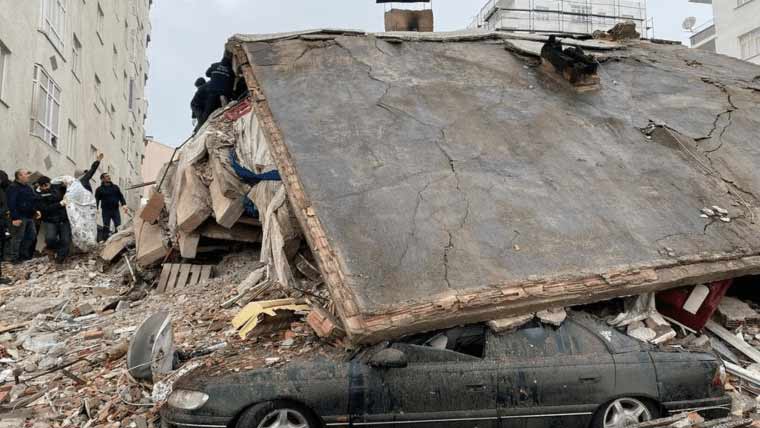
Istanbul (Tassawar News): Western Türkiye was profoundly impacted early Tuesday by a 6.1 magnitude earthquake, causing considerable structural damage to multiple properties and inducing widespread panic across a number of major cities. Initial reports from local authorities, however, provided the crucial reassurance that, as of the time of reporting, no immediate casualties had been officially confirmed. This event re-emphasises the inherent geological vulnerability of Türkiye, situated within one of the world’s most active seismic zones.
The Disaster and Emergency Management Authority (AFAD), the nation’s principal disaster response body, confirmed the seismic details. The tremor was recorded at a relatively shallow depth of approximately 6 kilometres, with its epicenter pinpointed to the Sındırgı district within the Balıkesir province. Due to the intensity and shallow focus of the quake, its effects were distributed across a vast geographical area, including the densely populated metropolitan centres of Istanbul, Bursa, Manisa, and Izmir.
Public Reaction and Initial Damage Assessment
Across the affected provinces, residents recounted the experience of strong and prolonged tremors, which immediately triggered a mass exodus from buildings as fear of subsequent aftershocks gripped the populace. Social media platforms were quickly flooded with videos and images depicting citizens congregating anxiously in open spaces while initial emergency teams were deployed to commence the vital task of assessing potential damage to both residential and commercial infrastructure.
Preliminary reports detailing the damage suggest that several buildings in the epicentral Sındırgı district sustained structural cracks and, in some instances, partial collapses. Authorities have swiftly mobilised a comprehensive team of rescue and safety specialists to conduct rigorous inspections of public infrastructure, including critical facilities such as schools, hospitals, and bridges, ensuring public safety is immediately prioritised.
The spokesperson for AFAD provided an update on the immediate situation:
“We are closely monitoring the situation. So far, there have been reports of property damage but no confirmed injuries or fatalities. Safety inspections are ongoing in all affected provinces.”
Furthermore, the Istanbul Governor’s Office issued a reassuring public statement, confirming that while the tremors were indeed perceptible across the sprawling city, they thankfully resulted in no significant or life-threatening damage. Despite this, emergency services across the region have been maintained on high alert as a precautionary measure against the possibility of significant aftershocks.
Geophysical Context and Enhanced Preparedness
The Turkish Meteorological Institute has compounded the advisory by issuing a warning regarding the possibility of minor aftershocks occurring over the forthcoming hours. Residents have been urgently advised to maintain a state of alertness and to absolutely avoid entering structures deemed unsafe until a complete safety assessment, carried out by qualified engineers, has been concluded.
Eyewitness accounts from cities such as Izmir and Bursa reported that household items and furniture shook violently during the main tremor. Furthermore, temporary power outages were experienced in several rural communities situated near Balıkesir. Local energy providers have, however, since succeeded in restoring the majority of the disrupted electrical supply, mitigating prolonged disruption.
This latest seismic event serves as a sharp reminder of the region’s inherent geological risk. Türkiye’s location astride several major tectonic plates means that earthquakes are a recurring and major concern for both its population and governmental authorities. In August of the current year, the same general area was struck by a quake of an equivalent 6.1 magnitude, which sadly resulted in one confirmed fatality and dozens of injuries.
The most catastrophic seismic episode in Türkiye’s recent history remains the series of massive quakes in February 2023 in the southern provinces, which tragically claimed over 55,000 lives and led to the displacement of millions. This devastating disaster instigated immediate and comprehensive updates to the country’s building safety codes and necessitated a complete overhaul of its emergency response infrastructure.
Operational Response and International Monitoring
In the wake of today’s tremor, Türkiye’s Interior Ministry moved swiftly to reassure the populace, confirming that national disaster response teams are fully equipped and strategically positioned for immediate deployment should any further intervention be required. Citizens have been strongly urged to remain calm, adhere strictly to official updates released through established channels, and actively avoid contributing to the spread of misinformation on social media platforms, which often complicates emergency response efforts.
International monitoring agencies, including the renowned US Geological Survey (USGS), have independently recorded the event and confirmed its magnitude at a precise 6.1 on the Richter scale. Regional seismologists are currently undertaking in-depth studies of the event, particularly focusing on determining whether the tremor is causally linked to any active fault line shifts that may have been detected in recent months.
As immediate rescue and comprehensive structural assessment operations continue, officials have consistently emphasised that Türkiye’s disaster management system has demonstrably improved since the extensive learning experience of the 2023 disaster. Crucially, readiness drills are now implemented on a routine basis to ensure an optimally rapid and coordinated response to any future seismic emergencies, underlining the nation’s commitment to resilience. The efficiency of the current no-casualty report, despite significant damage, is testament to these structural and procedural improvements.
Conclusion: Reinforcing Resilience in a Seismic Landscape
The 6.1 magnitude earthquake in western Türkiye serves as a potent reminder of the country’s persistent geological vulnerability. While the lack of immediate casualties is a significant positive outcome, reflecting tangible improvements in the national disaster management and building safety protocols implemented since the devastating 2023 quakes, the damage to property and the resulting widespread panic underscore the ever-present threat. The coordinated response involving AFAD, emergency services, and international monitoring confirms the rigorous, multi-faceted approach now in place. Ultimately, the focus remains on leveraging regional expertise and adhering to enhanced building codes to continually fortify national seismic resilience, ensuring that future events of this magnitude result in minimal human cost.