Jerusalem (Tassawar News): The ongoing diplomatic efforts to implement U.S. President Donald Trump’s plan for stabilising the Gaza Strip have been met with a staunch assertion of Israeli sovereignty over security decisions, as articulated by Prime Minister Benjamin Netanyahu. The proposed multinational peace mission in Gaza, designed to enforce a lasting ceasefire and initiate post-conflict security, faces considerable hurdles, primarily revolving around the composition of the foreign forces and the issue of Hamas’s disarmament.
Assertion of Israeli Security Prerogative
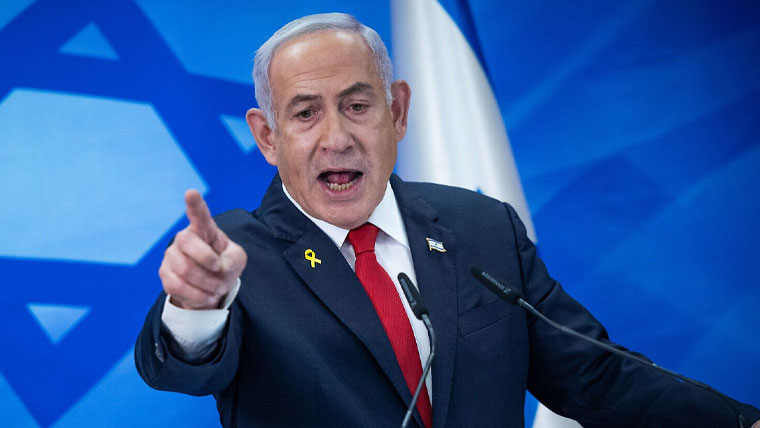
Prime Minister Netanyahu’s statement was unequivocal: Israel will retain the ultimate authority to determine which foreign military contingents may participate in the proposed international mission. This stance underscores Israel’s commitment to maintaining full control over its security decisions, a non-negotiable principle in its foreign policy, especially concerning the highly sensitive territory bordering the Gaza Strip.
Netanyahu robustly rejected any perception of external oversight dictating Israel’s defence calculus, stating:
“We do not need permission from anyone to defend our people or strike at our enemies. Israel alone will decide which international forces are acceptable or not.”
This emphasis on independent decision-making is further reinforced by his claim that the U.S. representatives have not only acknowledged but “respected” this approach. This recognition specifically relates to Israel’s continuous security control over the borders and key access routes surrounding Gaza, ensuring that any multinational force operates within parameters defined by Israeli security interests. This effectively grants Israel a veto power over the deployment of any international troops deemed unacceptable to Tel Aviv.
Diplomatic Complexities of the Multinational Force
The multinational force is intended to be a cornerstone of President Trump’s comprehensive stabilisation plan for the region. However, its actual formation is fraught with political and logistical challenges.
The Trump administration has explicitly ruled out the deployment of American troops in Gaza, instead actively seeking contributions from a variety of nations. Reports indicate the U.S. has engaged in talks with a diverse group of states, including Indonesia, the United Arab Emirates, Egypt, Qatar, Türkiye, and Azerbaijan, concerning their potential involvement in the mission, whether through personnel, financial support, or both.
The composition of this force remains intensely uncertain for several significant reasons:
- Hamas Refusal to Disarm: A fundamental obstacle to the entire framework is the stated refusal of Hamas to disarm under the proposed plan. A non-disarmed militant group poses an unacceptable security risk to any deploying force, making troop contributions highly contentious.
- Arab Country Commitment: As noted in British media reports, it is “unclear whether Arab or other countries will agree to contribute troops.” Deploying forces into a volatile environment without a clear disarming mechanism for Hamas and facing Israeli sovereignty demands is a politically risky proposition for regional states.
- Israeli Reservations: Israel has also expressed reservations over the force’s composition, reserving the right to reject any participant it deems hostile or unsuitable.
The Turkish Involvement Conundrum
The most immediate diplomatic flashpoint revolves around the potential participation of Turkish forces. Reports strongly suggest that Prime Minister Netanyahu is prepared to oppose any Turkish security involvement in Gaza.
This firm stance is directly linked to the strained relations that have deteriorated significantly between Ankara and Tel Aviv. The relationship has been severely tested by Turkish President Recep Tayyip Erdoğan’s vehement criticism of Israel’s military operations in the territory.
Reports indicate that Netanyahu may oppose any Turkish security involvement in Gaza, citing strained relations between Ankara and Tel Aviv following Turkish President Recep Tayyip Erdoğan’s criticism of Israel’s military operations.
From Israel’s perspective, allowing a security contingent from a nation whose leader has repeatedly accused it of war crimes or ‘genocide’ would be untenable, potentially compromising the mission’s neutrality and creating a direct channel for hostile influence within Gaza’s future security structure. This specific rejection highlights the geopolitical complexities and deep mistrust permeating the region, which directly impede the formation of a credible, broadly acceptable international force.
Conclusion: A Sovereign Veto in a Multilateral Plan
Prime Minister Benjamin Netanyahu’s assertion that Israel alone will determine the acceptability of foreign forces marks a critical juncture in the implementation of the U.S.-led Gaza peace plan. This unilateral declaration of a security veto—even over a multinational effort championed by a key ally—demonstrates Israel’s unwavering commitment to its security prerogative. While the Trump administration seeks a broad coalition involving Arab and other nations, the mission’s future remains precarious. The dual challenges of Hamas’s refusal to disarm and Israel’s explicit opposition to involvement from countries like Türkiye underscore the deep-seated geopolitical fragmentation and fundamental distrust that continue to obstruct a path toward a truly stable and lasting peace arrangement in the Gaza Strip.