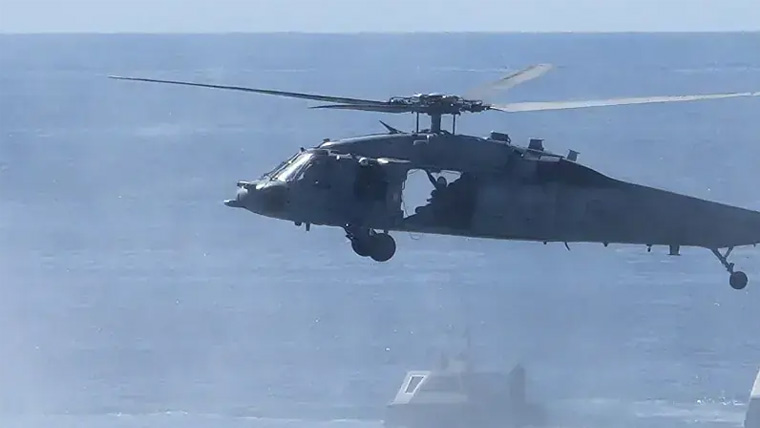
Washington (Tassawar News): The United States Navy has confirmed the loss of two distinct military aircraft—a helicopter and a fighter jet—in two separate but sequential incidents over the strategically vital South China Sea. Operating from the USS Nimitz aircraft carrier, the dual crashes occurred within a tight 30-minute window on Sunday, prompting an immediate investigation by the U.S. Navy Pacific Fleet. Critically, despite the destruction of both high-value assets, all five crew members were rescued safely, a testament to the effectiveness of the carrier group’s immediate search and rescue protocols.
Details of the Dual Aircraft Losses
The twin mishaps involved two integral components of the U.S. Navy’s carrier air wing, highlighting a severe operational challenge in a highly sensitive geopolitical zone.
The first incident involved an MH-60R Seahawk helicopter (assigned to Helicopter Maritime Strike Squadron 73, or “Battle Cats”), which experienced a malfunction shortly after its take-off from the flight deck of the USS Nimitz. The three personnel aboard the aircraft were successfully recovered by search and rescue assets from Carrier Strike Group 11 immediately after the crash.
Roughly half an hour later, a F/A-18F Super Hornet fighter jet (assigned to Strike Fighter Squadron 22, or “Fighting Redcocks”), also operating from the same carrier during standard operations, suffered a separate accident. Both pilots aboard the twin-seat aircraft managed to eject safely before the jet plunged into the sea. They were subsequently rescued and are reported to be in stable condition.
The US Navy emphasised the safety of all personnel in an official statement:
“All personnel involved are safe and in stable condition. The cause of both incidents is currently under investigation.”
The focus now shifts to determining the root causes of the back-to-back incidents, with naval safety teams examining possibilities ranging from independent mechanical failures and operational errors to potential issues such as “bad fuel,” as speculated by some senior U.S. officials.
Geopolitical and Operational Context
The timing and location of these losses amplify their significance, placing them firmly within the context of heightened military activity and complex regional geopolitics. The South China Sea is a major flashpoint, marked by intense territorial disputes and a constant U.S. military presence asserting freedom of navigation rights in the face of expansive Chinese maritime claims.
These crashes occurred during U.S. President Donald Trump’s first Asia tour of his second term, which is intended to focus on diplomacy and trade in the region. Furthermore, U.S. Defense Secretary Pete Hegseth is slated to begin his own multi-nation Asian visit in the coming days. The concurrent nature of the accidents with these high-level diplomatic missions could inevitably introduce an unexpected security element to the discussions. The Chinese Foreign Ministry, in a swift public reaction, remarked that the incidents highlight the maritime security risks caused by the frequent U.S. military presence in the disputed waters.
Moreover, the dual crashes follow a worrying pattern of recent mishaps involving U.S. carrier-based aircraft. Earlier this year, the U.S. Navy had already initiated a review of carrier-based flight safety procedures after two other aircraft from the carrier USS Harry S. Truman were lost during operations in the Middle East.
The back-to-back incidents underscore the inherent operational risks of maintaining a forward military presence in contested waters, and will certainly precipitate a rigorous and comprehensive safety review of flight deck procedures and aircraft maintenance aboard the U.S. Navy’s ageing carrier fleet, particularly the USS Nimitz, which is nearing its scheduled decommissioning.
The financial cost of these losses is substantial, with an F/A-18 Super Hornet fighter jet valued at over $60 million. More importantly, the incidents represent a potential blow to the operational readiness and public confidence in the safety of the U.S. Navy’s carrier assets, especially given the preceding series of non-combat aviation mishaps.
Conclusion: An Urgent Call for Safety Review
The near-simultaneous loss of a MH-60R helicopter and a F/A-18F fighter jet in the South China Sea represents a major operational and safety concern for the U.S. Navy, particularly as the accidents occurred from the same aircraft carrier, the USS Nimitz. While the successful and swift rescue of all five crew members is a substantial achievement in a high-stakes environment, the destruction of two high-value military aircraft in a region of heightened geopolitical tension demands immediate scrutiny. Given the history of recent, similar carrier mishaps, these latest incidents will undoubtedly trigger an urgent and comprehensive review of carrier-based flight safety, maintenance protocols, and operational parameters, with the findings being critical to maintaining the operational effectiveness and safety record of the U.S. naval air wing in the Indo-Pacific theatre.