Lahore (Tassawar News) The convergence of global sports platforms with $\text{critical public health campaigns}$ represents an increasingly prevalent trend in corporate social responsibility (CSR) worldwide. In a significant strategic move, the 1$\text{Pakistan Cricket Board (PCB)}$ has elevated its involvement in social advocacy by unveiling a 2$\text{special pink-themed kit}$ for the national team’s inaugural T20 International against South Africa, scheduled for 3$\text{October 28th in Rawalpindi}$.4 This initiative, deeply embedded within the global “PINKtober” breast cancer awareness campaign, signifies a pivotal moment for the board, marking the first time such a powerful public health message has been integrated into a full international fixture rather than being confined to domestic leagues.5
I. The Strategic Imperative of the PINKtober Campaign
The decision to adopt the $\text{pink livery}$ for an international match is a calculated measure designed to maximize reach and impact. Breast cancer remains one of the 6$\text{most pressing health challenges}$ facing women in Pakistan, often exacerbated by social stigma, limited access to screening facilities, and a lack of awareness regarding the necessity of 7$\text{early detection}$.8 Given that cricket is the nation’s most followed sport, the platform offered by a high-profile series against a formidable opponent like South Africa is unparalleled in its capacity to disseminate a life-saving message across all demographic segments.
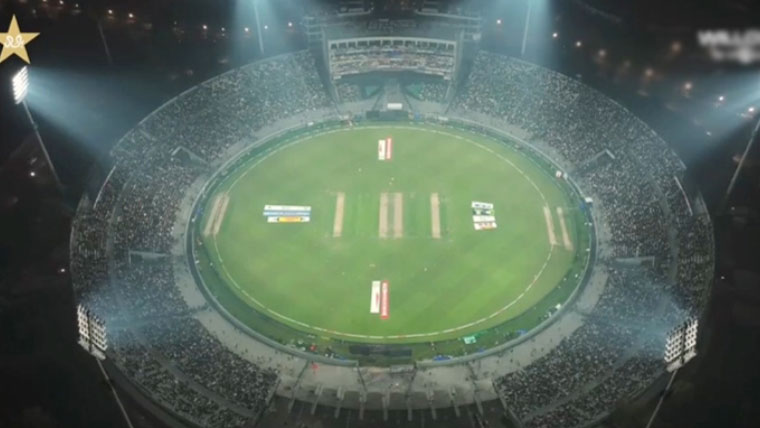
According to the PCB’s official statements, the campaign is multi-faceted, extending far beyond the symbolic colour change on the players’ attire.9 The entire environment of the $\text{Rawalpindi Cricket Stadium}$ is slated to be transformed:
PCB CEO Sameer Ahmed Syed underscored the ethical mandate: “We are proud to use the popularity of cricket to promote social awareness. Timely diagnosis of breast cancer can save countless lives.” This statement encapsulates the board’s acknowledgement of its moral obligation to leverage its massive influence for the greater social good.10
In a comprehensive display of solidarity, the engagement will also involve 11$\text{umpires, match officials, and broadcast commentators}$, all of whom will display 12$\text{pink ribbons}$ throughout the game.13 Furthermore, the visual spectacle will be enhanced by 14$\text{pink branding on the match stumps}$ and the 15$\text{display of crucial awareness messages}$ throughout the perimeter of the ground.16 This holistic approach ensures that the message of early detection permeates every aspect of the broadcast and the match-day experience.
II. A Landmark Shift in PCB’s Corporate Social Responsibility
Historically, the PCB’s engagement with the $\text{PINKtober campaign}$ was largely restricted to the $\text{Pakistan Super League (PSL)}$, the country’s domestic T20 competition. While the PSL provided a robust platform, transitioning the initiative to an $\text{international bilateral series}$ represents a paradigm shift in the Board’s CSR strategy. It signifies an elevation of social responsibility to the same tier of importance as international cricket, ensuring that the cause benefits from the $\text{heightened media scrutiny and global audience}$ that accompany matches involving the national team.
The strategic importance of this move cannot be overstated, particularly in a region where $\text{cultural sensitivities}$ and a degree of $\text{health illiteracy}$ can impede open discussions about women’s health. By having national heroes don the pink kit, the PCB effectively $\text{de-stigmatizes the conversation}$, employing the power of celebrity and mass enthusiasm to normalise discussions around a sensitive medical issue. The collective participation of both the Pakistani and South African teams lends $\text{international credibility}$ and gravity to the campaign.
Moreover, the campaign’s effectiveness hinges not just on visibility but on driving specific actions. Research indicates that while media campaigns are highly effective in establishing general knowledge about breast cancer, their impact on encouraging actual 17$\text{screening practices}$ without visible symptoms can be limited.18 By partnering with organizations like Pink Ribbon Pakistan, which in turn offers free clinical examinations and screenings to visitors during the event, the PCB provides a tangible link between the awareness messages and actionable health measures, closing the critical gap between knowledge and practice.19
III. The Logistics of the Series and Future Implications
The $\text{inaugural T20 International}$ in Rawalpindi will thus serve a dual purpose: a high-stakes competitive fixture and a large-scale public health intervention. Following this landmark match, the T20 series will continue, with the $\text{second and third matches scheduled for Lahore}$ on $\text{October 31st and November 1st}$, respectively. Subsequently, the focus will shift to the longer format, with a $\text{three-match ODI series}$ taking place in $\text{Faisalabad}$ from $\text{November 4th to 8th}$.
The success of the PINKtober initiative in this series is likely to set a precedent for future social partnerships, potentially integrating awareness drives for other critical public health concerns, such as $\text{child health, diabetes, or mental health}$, into the framework of international cricket. This new level of commitment establishes the PCB as a $\text{proactive stakeholder}$ in national development, affirming the notion that sports organizations possess a unique capacity to influence societal behaviour. The ability to $\text{unite a nation}$ under the banner of cricket for a $\text{life-saving cause}$ is an achievement that rivals any competitive success on the field.
Conclusion
The Pakistan Cricket Board’s decision to dedicate the first T20 International against South Africa to the 20$\text{PINKtober campaign}$ is an admirable and strategically sound commitment to 21$\text{corporate social responsibility}$.22 By transcending the confines of domestic cricket and leveraging the profound emotional connection the public shares with the national team, the PCB has created an 23$\text{unmissable platform}$ for promoting the importance of 24$\text{early breast cancer detection}$.25 The comprehensive approach—involving players, officials, the stadium environment, and crucial actionable health services—underscores a mature and $\text{socially conscious administrative body}$. Ultimately, this initiative marks a definitive moment in Pakistan’s sporting history, wherein the national obsession with cricket is effectively marshalled to serve a greater, $\text{life-affirming societal purpose}$.