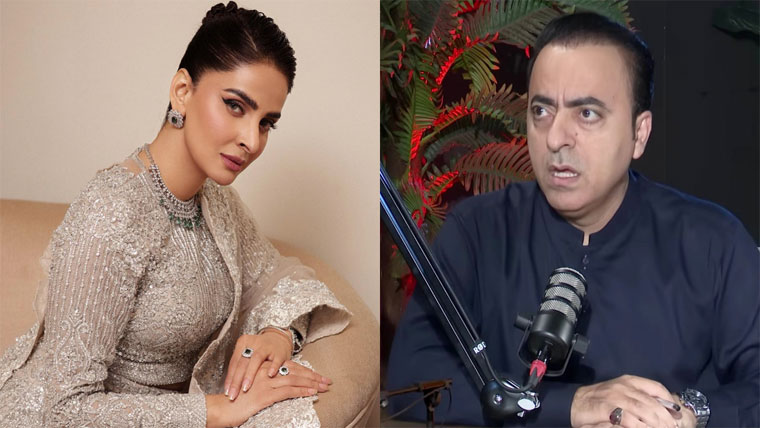
Lahore (Tassawar News) Prominent Pakistani actress Saba Qamar has ignited a firestorm of controversy and faced intense social media backlash following her recent participation in a private television podcast. During the broadcast, the actress expressed a distinct and vocal aversion to the city of Karachi, Pakistan’s largest metropolis and a major hub for the country’s entertainment industry. Her remarks, which suggested a strong preference for other cities and dismissed the possibility of relocating, quickly drew criticism from fans and social media users who viewed her comments as disrespectful and ungrateful.
I. The Context of the Controversial Comments
The genesis of the controversy was a seemingly straightforward question posed to Saba Qamar regarding the potential of moving to Karachi for professional reasons. Her immediate and emphatic response set the tone for the ensuing backlash.
When asked if she would consider a permanent move to Karachi for her career, the actress immediately and unequivocally responded, “Astaghfirullah, never.”
This reaction, using a strong religious expression often used to express shock or to seek God’s forgiveness for something considered inappropriate or undesirable, was perceived by many as deeply offensive and unnecessary. It immediately framed her dislike for the city in a highly charged manner.
Qamar subsequently attempted to soften her stance with conditional clauses, but maintained a clear distance from the city as a permanent residence. She stated that her visits to Karachi are strictly transactional and work-related.
She elaborated, “Well, you never know what the future holds, but I only go to Karachi for work. I finish my projects and return. I prefer Lahore and Islamabad.” She added a seemingly sarcastic qualification: “If someone gifts me a house in Karachi, that’s fine — although I’ve already built one there.”
In a quieter moment during the conversation, she further reinforced her sentiment with a simple, yet pointed, admission: “I don’t like Karachi.” This consistent expression of disdain for the city has been interpreted by critics as a failure to appreciate the professional opportunities the city provides, as Karachi is the operational base for the majority of the television and film industry in which she works.
II. Advocating for Decentralisation of the Entertainment Industry
Saba Qamar did not limit her critique to merely expressing a personal residential preference; she extended her comments to suggest a structural shift within the industry itself. In a proposal that might have been intended to champion decentralisation, the actress publicly suggested that:
She proposed that television projects currently being filmed in Karachi should be relocated to Islamabad.
This suggestion, while potentially supporting the development of a more geographically diverse production base in Pakistan, was ultimately overshadowed by her negative personal feelings toward Karachi. For many industry professionals based in Karachi, this call for relocation, coming from an actress who frequently benefits from Karachi-based productions, appeared hypocritical and ill-considered. The suggestion was viewed as dismissive of the established infrastructure, studios, and workforce that have been painstakingly developed in the coastal city over decades.
The debate thus expanded beyond a simple preference for one city over another, touching upon the complex dynamics of regional identity, the politics of cultural production, and the centralisation of the country’s multi-million-dollar media landscape.
III. The Online Response and Public Critique
The immediate aftermath of the podcast’s release saw a torrent of negative reactions across various social media platforms, indicating a significant disconnect between the actress’s comments and the public’s sentiment toward Karachi. The criticism focused predominantly on the perceived ingratitude and disrespect shown towards the city.
One user sharply articulated the emotional impact of her language:
“Saba Qamar said Astaghfirullah for Karachi — that’s very offensive.” This particular reaction highlights how the choice of language amplified the perceived insult beyond a simple statement of preference.
Another commenter focused on the paradox of her professional life versus her personal views:
“She works in Karachi-based dramas yet speaks negatively about the same city.” This points to the central contradiction in her argument, suggesting a lack of professional integrity or appreciation for the city that largely sustains her career.
A third reaction introduced the element of regional rivalry, suggesting a deeper, perhaps entrenched, issue:
A sarcastic user noted, “People from Punjab and Rawalpindi have an odd obsession with criticizing Karachi.” This comment attempts to contextualise the actress’s remarks within a broader pattern of inter-city criticism, suggesting that the backlash is also fuelled by sensitivities regarding provincial representation and metropolitan pride.
The intensity of the online criticism underscores the deep sense of pride and ownership many Pakistanis feel for Karachi, which, despite its infrastructural and social challenges, remains an economic powerhouse and a multicultural melting pot. The city is widely viewed as a symbol of resilience and diversity, making any slight against it particularly resonant and offensive to its defenders.
Conclusion
Saba Qamar’s candid yet ultimately ill-advised comments on Karachi have resulted in a significant public relations crisis. The use of inflammatory language and the clear expression of disdain for the city, which is foundational to her professional success, sparked a widespread and emotional backlash. This incident serves as a potent reminder of the delicate balance celebrities must maintain between personal preference and professional diplomacy, particularly when discussing sensitive issues of regional identity and national pride. The controversy has not only highlighted the actress’s personal views but also opened a wider discourse on the centralisation of the Pakistani media industry and the deep sociocultural pride associated with its major urban centres. The ongoing investigation and debate demonstrate the power of social media to hold public figures accountable and the importance of mindful communication in the digital age.