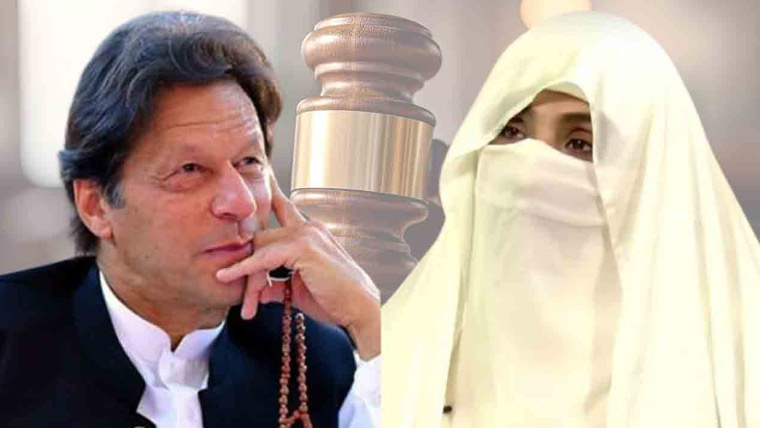
Islamabad (Tassawar News) A significant ruling has been handed down by the District and Sessions Court of Islamabad, which issued a directive mandating that authorities must refrain from arresting Pakistan Tehreek-e-Insaf (PTI) founder Imran Khan in connection with the wide-ranging May 9 riots and several other pending legal matters. Furthermore, the court granted a critical extension to the pre-arrest bail of Bushra Bibi, Mr. Khan’s spouse, effectively securing her legal protection from immediate detention until November 25.
The proceedings were presided over by Additional District and Sessions Judge Muhammad Afzal Majoka. The hearing was a complex consolidation, reviewing the status of a total of six active cases currently filed against the former Prime Minister. These cases include matters directly related to the civil unrest following the May 9 events, alongside charges concerning alleged attempted murder, and financial proceedings involving the submission of fake receipts (an issue often linked to the wider Toshakhana case). The court’s decision, heavily influenced by procedural non-compliance from the custodial authorities, represents a necessary judicial assertion of due process.
Procedural Non-Compliance and Judicial Restraint
A key factor driving the court’s latest directive was the conspicuous failure of officials from Adiala Jail—where the PTI founder is currently detained—to submit a timely and formal response to a show-cause notice previously issued by the court. The show-cause notice is a formal legal instrument requiring an explanation for a failure of duty or non-compliance with a court order. In light of the absence of an official, mandated reply detailing the reasons for this procedural lapse, the court took decisive action.
“In light of the absence of an official reply, the court directed that no arrest should be made in any of the cases concerning the PTI founder until further notice.”
The order, which commands that no arrest should be made in any of the six pending cases concerning the PTI founder until explicitly directed otherwise, is a form of judicial restraint. This directive is designed to maintain the status quo and ensure that the legal rights of the accused are protected when procedural fairness is compromised by the very state institutions responsible for legal compliance. The refusal or failure of jail authorities to respond to a court order creates a vacuum of information regarding the procedural steps taken in the case, thus justifying the court’s decision to temporarily pause any further executive action, such as an arrest.
Judge Afzal Majoka further issued an instruction that Mr. Khan must ensure his presence at the subsequent hearing, to be facilitated either in person or via video link. This measure aims to guarantee the continuation of legal proceedings while simultaneously balancing the fundamental requirements of procedural fairness with overriding security considerations. The use of video link technology, as an accepted legal provision, allows the judicial process to proceed without the logistical and security challenges associated with physically transporting a high-profile, detained individual.
Bail Extension and Financial Irregularities
In parallel with the directive concerning the PTI founder, the court took action regarding Bushra Bibi, granting an extension of her pre-arrest bail in the ongoing case pertaining to the submission of allegedly fabricated receipts. This grant ensures her immediate legal protection from detention for a further period.
This specific case is part of a broader legal conflict often referred to as the Toshakhana fake receipts case, where allegations against Bushra Bibi and others involve the submission of counterfeit receipts associated with the sale and retention of state gifts (Toshakhana). The charges include fraud and the alleged fraudulent use of forged signatures. Legal experts consider the continuous extension of pre-arrest bail in such cases to be a standard procedural mechanism, especially when the final determination of the charges and the sufficiency of evidence requires further time and detailed evaluation by the court. Her successful bail extension provides temporary judicial relief until the next scheduled appearance, allowing her and her legal team to meticulously prepare their defence without the immediate threat of incarceration.
The Broader Legal Landscape and Judicial Intent
The consolidated hearing addressed a substantial volume of active legal proceedings against the former PTI chief, encompassing severe charges ranging from incitement and vandalism related to the May 9 incidents to more technical charges of financial irregularities. The court’s latest directive effectively functions as a procedural pause, explicitly halting potential arrest actions in these matters until all legal formalities are fully complied with. This critical step enables both Mr. Khan and his spouse to exhaust their available legal remedies through the established judicial process.
Legal analysts observing the case widely interpret the court’s decision as a strictly procedural step, primarily designed to enforce due process and compel compliance from administrative state actors.
“Legal experts view the court’s decision as a procedural step aimed at ensuring that all pending cases are handled in accordance with due process.”
Crucially, the decision does not in any way equate to an acquittal of the charges or the outright dismissal of the cases. Instead, it serves to maintain a status quo, ensuring that executive and administrative overreach is mitigated until the subsequent round of hearings is convened and a proper evaluation of evidence and procedural compliance is conducted. The underlying criminal and financial charges, therefore, remain active and subject to the eventual determination of the court. The May 9 cases, which form a significant part of these charges, are themselves rooted in the nationwide political protests that followed the PTI leader’s arrest earlier this year, leading to widespread allegations of property damage and clashes between political supporters and law enforcement agencies.
The deliberate non-compliance by the Adiala Jail authorities, by failing to provide the requisite clarifications regarding the execution of court notices, was the catalyst for the judicial intervention. The court’s insistence on a response underscores the principle that all institutions, including custodial ones, are strictly accountable to the judiciary in the implementation of legal and procedural requirements. The next scheduled session, set for November 25, will be pivotal, as the court is expected to rigorously address the outstanding procedural requirements and review the updated legal status of all related cases involving both the PTI founder and his wife.
Conclusion: Upholding Procedural Integrity
The Islamabad District and Sessions Court has, through its latest order, underscored the paramount importance of procedural integrity within the Pakistani legal framework. By restraining the potential arrest of the PTI founder and extending the bail of Bushra Bibi, the judiciary has asserted its role as the guardian of due process, particularly in the face of administrative non-compliance. This ruling is a clear message that the momentum of executive action cannot override the fundamental constitutional requirement for all state institutions to fully adhere to judicial directives. While the substantive legal battles involving the serious charges related to the May 9 riots and financial irregularities are yet to be definitively resolved, the court’s action provides a necessary, albeit temporary, bulwark against any further legal volatility and ensures that the rights of the accused are respected as the complex legal process continues to unfold.