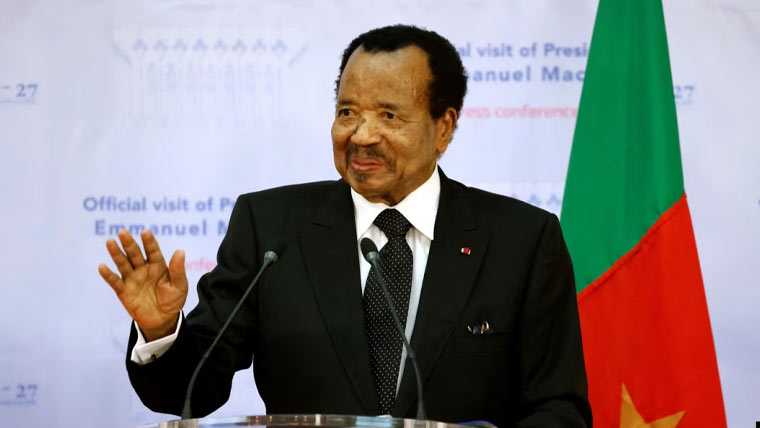
Yaoundé (Web Desk): In a political development both remarkable and intensely controversial, Cameroon’s 92-year-old President Paul Biya has secured an unprecedented eighth consecutive term in office. This victory effectively extends his profound, four-decade-long tenure as the ruler of the Central African nation, cementing his status as one of the world’s most enduring heads of state. The outcome of the election, which was held on October 12, has, however, been significantly marred by pervasive allegations of electoral irregularities, widespread voter intimidation, and devastating violent clashes between fervent opposition supporters and national security forces.
According to the official results released by the electoral commission, President Biya clinched 53.66% of the national vote, successfully defeating his principal challenger and former political ally, Issa Tchiroma Bakary, who garnered 35.19%. This confirmation of victory not only reinforces Biya’s position domestically but also solidifies his global distinction as the world’s oldest serving head of state, a position that now surpasses the tenures of even certain reigning monarchs. Despite escalating domestic discontent and mounting international scrutiny, Biya’s powerful ruling party, the Cameroon People’s Democratic Movement (CPDM), retains an uncompromising and firm grip over the country’s entire political, judicial, and security apparatus.
Widespread Post-Election Unrest and Security Fragility
The immediate aftermath of the announcement of the election results was characterized by a rapid surge in violent demonstrations across several major Cameroonian urban centres. The commercial hub of Douala became a focal point of civil unrest, where devastating clashes between agitated protesters and police tragically resulted in at least four reported fatalities. Eyewitnesses provided alarming accounts of security forces utilizing both tear gas and live ammunition in a determined effort to forcibly disperse the large crowds. In response to the escalating violence, opposition leaders issued urgent calls for restraint, concurrently demanding full transparency and an independent audit of the protracted counting process.
Political analysts have issued stern warnings that the nation is now confronting a period of significantly heightened political tension. This is particularly acute in the Anglophone regions of the country, which have been destabilised by separatist movements fighting for full independence since 2017. The current wave of post-election unrest regrettably exacerbates Cameroon’s already fragile security situation, which is further complicated by persistent cross-border incursions and threats from the militant group Boko Haram operating in the northern provinces. This convergence of internal and external security challenges places an immense burden on the newly re-elected administration.
The Longevity of Power and Institutional Erosion
Paul Biya’s political journey began when he first assumed the highest office in 1982, following the unexpected resignation of Cameroon’s first president, Ahmadou Ahidjo. In the decades since, he has managed to perpetually retain power through a highly effective combination of shrewd political maneuvering, the implementation of crucial constitutional reforms, and the meticulous establishment of complete control over all major state institutions.
A pivotal moment in his prolonged rule occurred in 2008, when Biya controversially engineered an amendment to the constitution that explicitly abolished presidential term limits, thereby legally enabling him to seek office indefinitely. Following this change, he successfully secured re-election in 2011 and 2018, the latter victory officially attributed a majority of over 71% of the vote, although both were heavily clouded by emphatic accusations of electoral fraud from domestic and international observers.
Critics argue that the consequences of Biya’s prolonged, concentrated rule are severe: they contend that it has fundamentally stifled democratic development, systematically weakened state institutions, and profoundly fuelled endemic corruption within the governmental structure. Despite the gravity of these concerns, his steadfast base of political supporters credit the President with the crucial achievement of maintaining relative stability and nurturing essential economic partnerships within a sub-Saharan region notoriously plagued by frequent, destabilising conflicts.
“Critics argue that Biya’s prolonged rule has stifled democracy, weakened institutions, and fueled corruption within the government.”
Divided International Response and Human Rights Concerns
The international community’s response to the election results has been notably cautious. Both the African Union (AU) and the European Union (EU) have issued standard diplomatic statements, collectively urging all political parties to exercise maximal restraint and to commit to resolving any outstanding electoral disputes solely through legitimate legal channels. However, major opposition groups have vehemently rejected this approach, maintaining their demand for a full, independent international investigation into the detailed allegations of widespread irregularities, universally describing the recent election as “neither free nor fair.”
Furthermore, Western governments have collectively expressed significant concern over documented reports of post-election violence and the strategic implementation of internet blackouts across several politically sensitive regions during the critical voting and counting process. Leading human rights organizations, including Amnesty International, have publicly condemned the reported excessive use of force deployed by security agencies against citizens participating in otherwise peaceful demonstrations. These external reactions add significant pressure on the Biya administration to address concerns about democratic erosion and the protection of civil liberties.
Conclusion: The Challenge of Succession
As President Paul Biya officially embarks upon his extraordinary eighth term, profound and urgent questions loom large over the complex issue of leadership succession in Cameroon. With the President now firmly into his nineties, many political observers and regional experts speculate that a sudden, unmanaged power transition could trigger deep-seated internal divisions and factional conflicts within the powerful ruling party itself, potentially destabilising the nation. Despite the palpable atmosphere of growing political discontent and calls for democratic reform, Biya remains determinedly focused on solidifying his legacy as one of the African continent’s longest-serving leaders — a political position whose immense weight will continue to profoundly shape Cameroon’s domestic political trajectory and its increasingly vital, yet contentious, standing on the global stage. The lack of a clear, institutionalized succession plan remains the single most critical structural challenge facing the country.