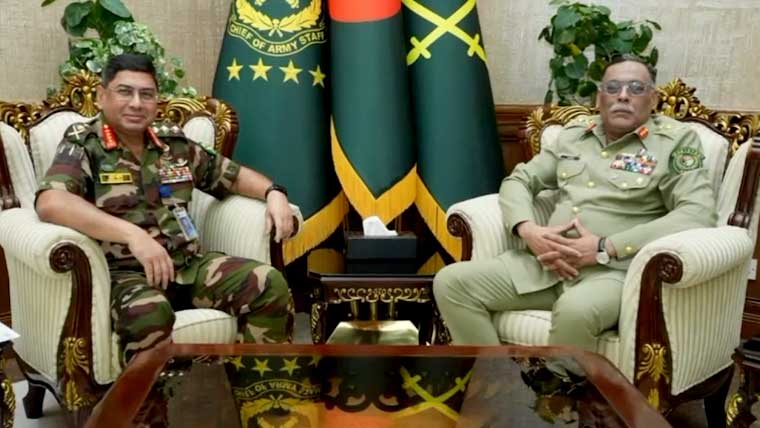
Rawalpindi (Tassawar News): The Chairman Joint Chiefs of Staff Committee (CJCSC) of Pakistan, General Sahir Shamshad Mirza, recently undertook a significant official visit to Dhaka, underscoring the enduring commitment to bolstering bilateral military and diplomatic ties with Bangladesh.1 The focal point of this high-level engagement was a constructive meeting with the Bangladeshi Chief of Army Staff, General Wakar-uz-Zaman, held at the Army Headquarters.2
According to an official communiqué released by the Inter-Services Public Relations (ISPR), the discussions concluded with a mutual expression of profound satisfaction regarding the discernible and positive trajectory of defence cooperation between the two South Asian nations.3 Crucially, both military hierarchies reached a consensus on the imperative to maintain and enhance the frequency of high-level exchanges and reciprocal visits between the military leaderships, thereby ensuring the continuity of strategic dialogue and partnership.4
$\star$ Strategic Alignment on Security Imperatives
The meeting served as a forum for a comprehensive and substantive discussion on the evolving geopolitical landscape, covering both regional and global security developments.5 Both General Mirza and General Wakar-uz-Zaman accentuated the critical necessity of further strengthening collaboration between their respective armed forces.6 This emphasis signals a shared understanding of common security challenges and the value of a coordinated, unified response mechanism.
The dialogue progressed beyond general strategic alignment to pinpoint specific areas where enhanced cooperation would yield maximum mutual benefit.7 A tripartite agreement was reached to intensify collaboration across several functional domains, including military training, the conduct of joint exercises, and the crucial exchange of counter-terrorism expertise. These specific commitments highlight a move towards operational integration and the transfer of specialized knowledge, essential for modern defence capabilities.
“The collaborative framework established between the military commands of Pakistan and Bangladesh is not merely ceremonial; it represents a functional and necessary partnership in an increasingly complex security theatre,” stated a defense analyst following the ISPR release. “The commitment to joint exercises and the formal exchange of counter-terrorism expertise signifies a mature and pragmatic approach to regional security challenges.”
$\star$ Countering Information Warfare and Disinformation
A particularly salient point addressed during the bilateral talks was the growing challenge posed by misinformation and divisive campaigns proliferated across various digital and traditional platforms.8 This acknowledgement reflects a broader regional concern over the threat of information warfare to national cohesion and political stability.
Both the CJCSC and the Bangladeshi Chief of Army Staff conveyed shared concern over this phenomenon and jointly resolved to intensify collaborative efforts specifically aimed at effectively countering such pervasive threats. This agreement indicates an understanding that digital security and the integrity of the information space are now inseparable components of national defence strategy. The mutual intent is to develop joint protocols or shared intelligence to safeguard against destabilizing narratives.
The comprehensive nature of the discussions—ranging from traditional defence cooperation and military capability enhancement to the contemporary challenge of information security—underscores the multifaceted depth of the bilateral relationship.9
$\star$ Conclusion: The Imperative for Enduring Security Partnerships
General Sahir Shamshad Mirza’s official visit to Bangladesh and the resulting dialogue with General Wakar-uz-Zaman mark a decisive step toward entrenching strategic defence cooperation between Pakistan and Bangladesh.10 The mutual satisfaction over existing progress and the formalized commitment to continued high-level engagement demonstrate a shared vision for regional stability, underpinned by robust military ties.11 The agreements to enhance cooperation in critical areas—notably training, joint exercises, counter-terrorism, and the crucial frontier of countering misinformation—are highly indicative of a pragmatic security partnership attuned to both traditional and non-traditional threats. This collaborative momentum is paramount for ensuring that the armed forces of both nations remain resilient, coordinated, and capable of addressing the complex security dynamics of the region.