Washington: (Tassawar News) The fragile ceasefire negotiated in Gaza remains technically in force, yet reports of renewed tensions and sporadic Israeli airstrikes underscore the highly volatile nature of the security situation. This instability has prompted close monitoring from international stakeholders, including the United States.
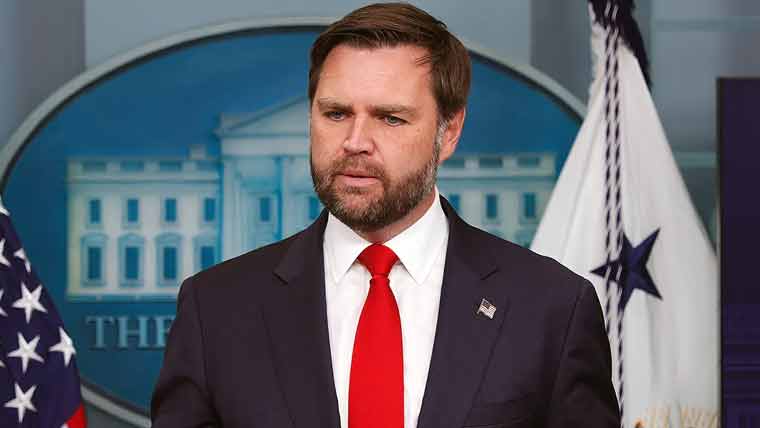
United States Vice President J.D. Vance confirmed the technical continuation of the ceasefire but offered a pragmatic assessment regarding the escalating developments. Responding to the increased military activity, Vice President Vance posited that an aggressive action—specifically, “a Hamas attack or another incident targeting Israeli soldiers”—was the probable trigger for Israel’s retaliatory strikes. He affirmed Washington’s continued, vigilant observation of events unfolding on the ground.
Accusations and Counter-Claims of Truce Violation
The recent escalation was precipitated by an order from Israeli Prime Minister Benjamin Netanyahu, which initiated airstrikes on Gaza City, including operations alarmingly close to a hospital facility in northern Gaza. Prime Minister Netanyahu publicly accused Hamas of having violated the truce through direct attacks on Israeli troops—a charge the Palestinian group has vehemently and categorically rejected.
In a direct counter-response, Suhail al-Hindi, a senior member of Hamas’s political bureau, utilized the platform of Al Jazeera to strongly assert his movement’s adherence to the established agreement. Al-Hindi urged Israel to “stop falsely accusing the movement of violations,” framing the Israeli claims as a cynical attempt to justify their military actions.
“Despite persistent Israeli aggression and the issuance of unsubstantiated claims, Hamas is fundamentally and fully committed to maintaining the ceasefire and actively pursuing a permanent diplomatic resolution,” stated Suhail al-Hindi. “We implore the Israeli authorities to cease their pattern of falsely accusing the movement of violations, which only serves to destabilize the already precarious truce.”
Operational Disputes and Diplomatic Commitment
Al-Hindi offered a specific operational incident as evidence of Israeli intransigence. He detailed a request made by Hamas for permission for search teams to access restricted zones with the humanitarian objective of retrieving the bodies of casualties. This request, he claimed, was definitively refused by Israeli forces, indicating a lack of good faith and cooperation essential for maintaining trust within the ceasefire framework.
Crucially, the senior Hamas official reiterated that despite these instances of what he termed “Israeli aggression,” Hamas remains “fully committed to maintaining the ceasefire and pursuing a diplomatic resolution.” This declaration suggests a strategic desire by the Palestinian movement to uphold the truce, placing the burden of responsibility for any collapse squarely on the Israeli side. The continued, albeit strained, commitment to diplomacy by both sides remains the only barrier preventing a return to full-scale conflict.
Conclusion: The Precarity of Sustained Peace
The statements from Vice President Vance, Prime Minister Netanyahu, and senior Hamas official Suhail al-Hindi collectively illustrate the extreme precarity of the Gaza ceasefire. While the United States acknowledges the continuation of the truce, the conflicting narratives—Israeli claims of Hamas violations countered by Hamas’s assertions of adherence and Israeli obstruction—highlight a profound trust deficit. The operational dispute over humanitarian access further exacerbates tensions. Ultimately, the stability of the ceasefire hinges on immediate, verifiable de-escalation by both parties, as the current atmosphere of reciprocal accusation risks tipping the region back into a destructive military confrontation.
Would you like me to clarify the role of the Vice President in US foreign policy or discuss the concept of a “trust deficit” in diplomatic negotiations?