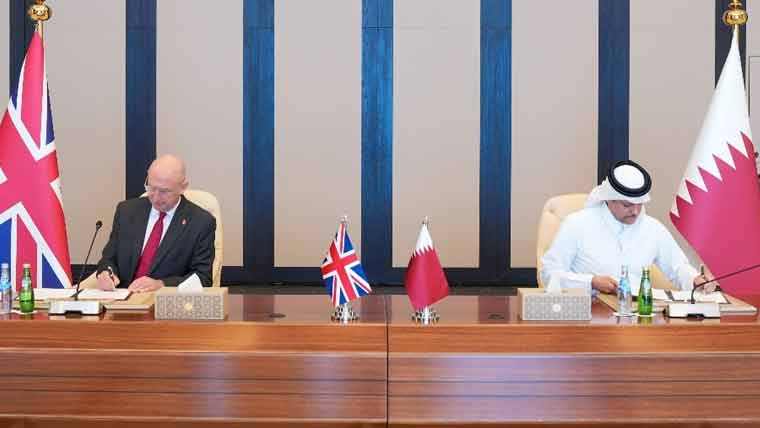
Doha (Tassawar News): The recent signing of a seminal defence agreement between the United Kingdom and Qatar in Doha marks a substantial escalation in the bilateral security and strategic partnership between the two nations. This accord, formally termed a Defence Assurance Arrangement, signifies Britain’s reinforced commitment to regional stability and Qatar’s integral role within the Gulf security architecture. This development transcends a mere transactional defence deal, evolving into a comprehensive framework designed to deepen interoperability and fortify a shared approach to emerging geopolitical threats.
The Core Tenets of the Defence Assurance Arrangement
The formalization of this agreement was the central focus of UK Defence Secretary John Healey’s visit to Doha, where he held critical discussions with the Emir, Sheikh Tamim bin Hamad Al Thani. The core objective of the newly minted arrangement is to elevate the defence partnership from periodic collaboration to integrated, sustained coordination across all military domains—land, air, and naval forces.
The language used by officials post-signing underscored the deal’s profound significance, emphasizing that it is designed to enhance mutual defence capacity through sophisticated joint training, intelligence sharing, and coordinated operational planning. This commitment signals a departure from purely reactive defence policies towards a more proactive and preventative strategic posture.
“This Defence Assurance Arrangement is not merely a document; it is a profound declaration of our unwavering commitment to Qatar’s security and a strategic decision to consolidate our enduring ties. The deepening of coordination across land, air, and naval forces will ensure both our nations are optimally positioned to address the complex and evolving security challenges of the 21st century,” noted a senior official privy to the negotiations.
The focus on joint planning and defence strategy is a particularly crucial element. In an era defined by hybrid warfare, asymmetric threats, and cyber vulnerabilities, the agreement establishes a mechanism for the two nations to jointly conceptualize and implement high-level strategic responses. This collaboration will likely encompass shared threat assessments, technological integration, and the development of common operational procedures to maximize the efficacy of combined forces during any contingency.
Strategic Imperatives and Geopolitical Context
The renewed defence partnership is situated within a dynamic and often volatile regional landscape. The Gulf region is a critical nexus for global energy supplies, trade routes, and international security. For the United Kingdom, maintaining a robust and reliable presence in the Middle East is vital for projecting influence, safeguarding its economic interests, and contributing to the maintenance of global maritime security. Qatar, positioned strategically, acts as a lynchpin of regional diplomacy and a key ally for Western powers.
The historical relationship between London and Doha provides a sturdy foundation for this latest strategic leap. Following Britain’s withdrawal East of Suez in the 1970s, subsequent arrangements have consistently sought to preserve defence ties. This new agreement builds upon a legacy of military cooperation, including long-standing agreements allowing the Royal Air Force to operate from Al Udeid Air Base and the participation of the Qatar Emiri Air Force in joint training exercises in the UK.
Furthermore, the arrangement serves as a tangible reflection of Britain’s ‘Global Britain’ initiative, post-Brexit, underscoring its commitment to international partnerships beyond the European sphere and prioritizing alliances with economically and strategically significant nations. For Qatar, the deal provides an important external security guarantee, complementing its significant investment in modernizing its own armed forces.
The Intrinsic Link Between Defence and Economic Prosperity
The strategic ties between the UK and Qatar are underpinned by an equally robust and burgeoning economic relationship. The seamless confluence of security interests and financial integration highlights a comprehensive partnership model. Economic data illustrates the substantial financial stakes involved: British exports to Qatar have reached a staggering £4.4 billion in 2025, demonstrating the strength of trade flows across various sectors, including advanced manufacturing, professional services, and education.
Perhaps even more telling is the scale of Qatari investment into the UK, which has exceeded £40 billion. This capital infusion is strategically directed towards high-growth, future-focused sectors, representing a vote of confidence in the long-term stability and innovative capacity of the British economy.
- Fintech and Cybersecurity: Investments in these areas secure mutual digital economies and reflect the defence agreement’s focus on modern threats.
- Life Sciences: Significant capital is directed towards research and development, aligning with the UK’s ambition to be a global science superpower.
- Renewable Energy: Qatari sovereign wealth is supporting the UK’s transition to a net-zero economy, creating shared prosperity and employment opportunities.
This reciprocal economic relationship ensures that the security partnership is not isolated; rather, it is mutually reinforced by significant financial interdependence. The creation of new employment opportunities in the UK, stemming from these investments, further deepens the political and social commitment to the Qatari alliance.
“The scale of Qatari capital deployed in key British sectors—from cutting-edge cybersecurity to foundational renewable energy projects—demonstrates a symbiotic relationship. This financial integration ensures that the defence pact is supported by a powerful economic rationale, creating a truly comprehensive and resilient bilateral partnership that benefits both our peoples,” an economic analyst might observe.
Conclusion: A Future of Integrated Strategy
The newly signed Defence Assurance Arrangement between the United Kingdom and Qatar is a pivotal landmark in their enduring relationship. It represents a mature and necessary evolution of their security collaboration, moving towards an integrated strategic partnership equipped to handle the complex challenges of the contemporary global arena.
By focusing on deep coordination across all military domains and bolstering joint strategic planning, the agreement effectively consolidates Britain’s strategic commitment to the Gulf region. Moreover, the security framework is inextricably linked to a £40 billion economic pillar, ensuring that the alliance is robust, multifaceted, and strategically imperative for both London and Doha. This comprehensive approach serves to enhance regional stability, secure mutual economic interests, and project a unified front against potential threats, setting a new standard for strategic bilateral cooperation in the Middle East.
Would you like me to elaborate on the specific types of joint training exercises that might be conducted under this new agreement, or perhaps detail the historical context of the UK-Qatar relationship?