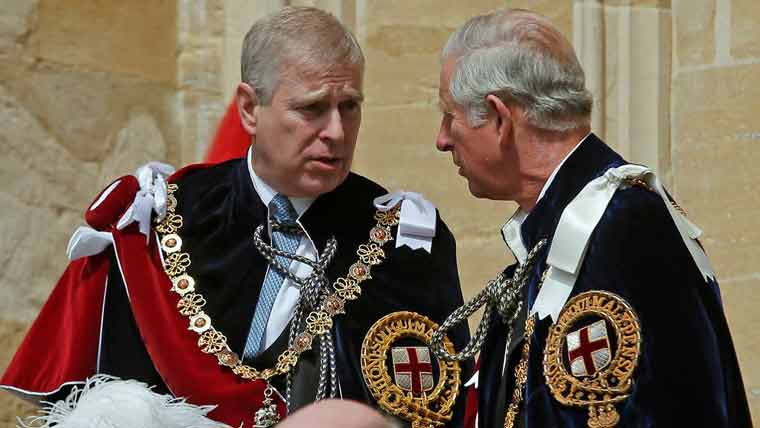
London: (Tassawar News) The monarchical decision by King Charles III to formally divest his younger brother, Prince Andrew, of his remaining royal title of “Prince” represents an unprecedented act of decisive institutional separation designed to safeguard the integrity of the British monarchy. This action, following a protracted period of public controversy and serious allegations of misconduct against the Duke of York, underscores the monarchy’s commitment to prioritizing its public image and ethical standing over familial ties. This development effectively concludes Prince Andrew’s association with official duties, leading to the irrevocable cancellation of all royal privileges, honours, and official residences previously accorded to him.
The withdrawal of the “Prince” title is the culmination of a phased process of disengagement. Earlier in the month, Prince Andrew had already yielded several key designations, including the ceremonial Duke of York title, a move that was framed as voluntary but was widely interpreted as an inevitability under immense internal and external pressure. The latest royal decree, therefore, formalises his complete severance from the privileges of his birthright. Upon the immediate enforcement of the King’s order, the former Duke will transition to the civilian designation of Andrew Mountbatten, aligning his public identity with his legal, non-royal name.
Constitutional and Historical Precedent for Revocation
The removal of royal titles, while rare, is not without historical precedent, though the circumstances surrounding this particular instance—namely, the need to manage profound reputational risk associated with a sexual abuse allegation—are distinctly modern. The power to bestow and withdraw titles ultimately rests with the Sovereign, functioning under the constitutional convention of acting on the advice of government, though often exercised with relative autonomy within the Royal Family’s internal structure.
Title revocation typically occurs under extraordinary circumstances, such as high treason or gross misconduct deemed to bring the Crown into disrepute. King Charles’s actions reflect an acute understanding of the evolving dynamics of public expectation and the need for the monarchy to maintain an unimpeachable moral position in the twenty-first century. The decision effectively constitutes a pragmatic institutional necessity aimed at erecting a protective barrier between the reigning house and the enduring fallout of the allegations.
“The King’s swift and final decision to strip Prince Andrew of his remaining titles, particularly the core designation of ‘Prince,’ signals a non-negotiable requirement for ethical accountability within the monarchy. It is a powerful demonstration that hereditary status cannot insulate an individual from the consequences of severe reputational damage in the eyes of the public and the institution itself,” opined a royal historian.
The Underlying Allegations and Ethical Dimensions
The entire crisis was catalyzed by serious allegations detailed by Virginia Roberts Giuffre, an American citizen, who asserted that Prince Andrew had engaged in inappropriate sexual conduct with her in 2001. Crucially, Giuffre was 17 years old at the time of the alleged incident. Although Prince Andrew has consistently and vehemently denied all accusations, the public scrutiny and legal fallout led to a civil settlement in the United States, effectively rendering the public perception of his innocence untenable for an individual occupying a senior royal position.
The move to strip the title directly addresses the need for the Monarchy to demonstrate empathy and moral clarity. Buckingham Palace’s official statement explicitly emphasized that the King’s sympathies remain resolutely with the victims and survivors involved in the broader case. This carefully constructed rhetoric is designed to align the Crown with humanitarian and ethical responsibilities, distancing the institution from any implication of condoning or excusing the alleged behaviour. This public relations strategy is vital for maintaining the Crown’s support base, particularly among younger generations who demand greater accountability from public figures.
Financial and Residential Implications
The consequences of this action extend beyond the mere removal of titles, fundamentally altering Prince Andrew’s lifestyle and relationship with the Crown’s vast property portfolio. With the loss of all royal privileges, the Duke is set to vacate his official residence, presumably at Windsor, and relocate to the private Sandringham Estate.
Significantly, his residency at Sandringham will be personally funded by King Charles. This arrangement ensures that the former Prince’s future financial maintenance will be drawn from the King’s private funds, such as the Duchy of Lancaster income, rather than being subsidised by the Sovereign Grant, which is funded by the British taxpayer. This measure is a calculated financial safeguard against any future accusation that the public purse is supporting an individual who no longer represents the state. The King is thus effectively assuming private financial responsibility for his brother’s continued living expenses, while simultaneously protecting the Monarchy’s financial transparency.
Conclusion: Institutional Modernisation and The Future of the Monarchy
The formal withdrawal of the “Prince” title and all associated privileges from Andrew marks an unmistakable turning point in the ongoing effort by King Charles III to consolidate and modernize the British monarchy. This definitive action serves as a clear institutional message that personal conduct must meet the highest possible standards for an individual to retain public office or royal status. The move effectively transforms Prince Andrew from a public figure with hereditary rights into a private individual, albeit one with residual familial ties to the Sovereign. This outcome, though painful for the family, underscores a larger strategic imperative: the preservation of the Monarchy’s reputation and its perceived moral authority, which is deemed far more crucial than the maintenance of an unsustainable fraternal relationship within the official royal fold.
Would you be interested in an analysis of the specific legal differences between a title being “voluntarily given up” versus being “officially revoked” by the King?