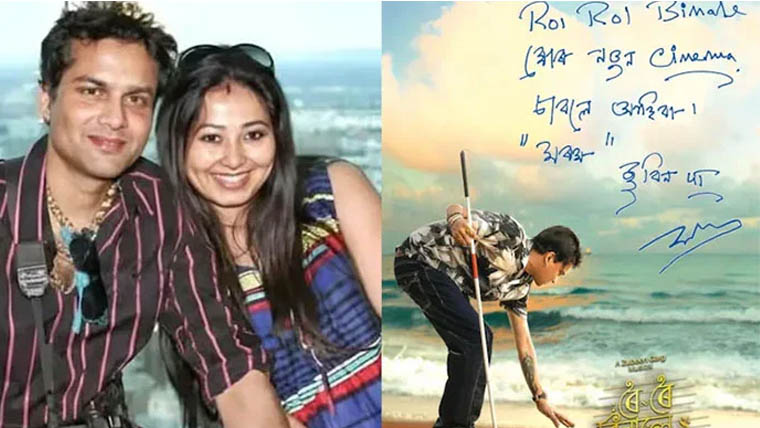
(Web Desk) The untimely demise of Zubeen Garg, the beloved and versatile singer and actor from Assam, in Singapore on September 19th, has profoundly affected millions of his devotees. The sorrow that pervades his vast fanbase has been compounded by a layer of unresolved mystery surrounding the circumstances of his death. This narrative of professional legacy intersecting with profound personal tragedy has been brought into sharp public focus following the sharing of his final handwritten missive by his widow, Garima Garg, on social media platforms.
The letter, originally conceived as a promotional tool for his final cinematic project, Roi Roi Benale, has now been recontextualized as a poignant farewell, imbuing the forthcoming film release with immense emotional weight. The posthumous sharing of this artefact illuminates the intense emotional dichotomy faced by his family and collaborators: the duty to honour his artistic vision juxtaposed with the agonizing search for closure regarding his sudden passing.
The Poignancy of a Posthumous Message
Garima Garg’s decision to publish the note on Instagram provided the public with an intimate glimpse into their personal grief while simultaneously elevating the letter to a symbolic final testament. In her deeply affecting accompanying message, she acknowledged the letter, penned just four days prior to his death on September 15th, describing it as “messages full of love for everyone you cared about.” She concluded her heartfelt expression by stating, “Every word touches my heart, Goldie.”
The letter itself, strikingly brief and characteristic of an artist speaking directly to his audience, simply stated:
“Wait a little… my new film is coming soon. Don’t miss it. With love, Zubeen Da.”
What was intended as a casual, encouraging note—a facet of a routine publicity campaign—has now become an indelible artifact of his final artistic communication. This transition from mere marketing copy to a symbol of enduring memory highlights the tragic irony inherent in his untimely end. The message, meant to generate anticipation, now serves as a haunting echo of an unfulfilled future, forcing his audience to confront the painful reality that the wait for further creativity is permanent.
Fulfilling the Vision: The Cinematic Imperative
The professional commitment to complete and release Roi Roi Benale on the scheduled date of October 31st has now taken on a sacrosanct significance for his production team. The film’s director, Rajesh Bhuyan, articulated the immense responsibility felt by the remaining crew, declaring that the project’s successful completion and distribution have become their “biggest responsibility.”
Bhuyan underscored the imperative nature of the task:
“It was Zubeen’s dream. He left us too soon, but we will do everything possible to fulfill his vision. The completion and release of Roi Roi Benale is now an act of devotion to his unparalleled creative spirit.”
The film itself features Zubeen in a demanding and emotionally resonant role as a visually impaired musician, a character that is expected to showcase his formidable acting range beyond his already established musical genius. The release strategy is suitably ambitious, reflecting his widespread appeal: the film is scheduled for simultaneous release across 50 locations in India, encompassing 31 major metropolitan centres, ensuring his final work reaches the broad audience it deserves.
The Unresolved Nexus of Tragedy and Investigation
The emotional complexity surrounding the artist’s legacy is inextricably linked to the persistence of unanswered questions regarding his death. Zubeen Garg was discovered deceased near an island in Singapore, where he was scheduled to be a headline performer at the prestigious North East India Festival. The incongruity of a seemingly healthy, high-profile artist dying suddenly and unexpectedly while abroad has fueled public speculation and intensified calls for clarity.
Garima Garg has publicly and forcefully advocated for a transparent and comprehensive inquiry, stating:
“There is still a fire burning inside me. What happened on September 19? How? Why? Until I find that answer, even breathing feels heavy.”
She further stressed the need for institutional action: “We need to know what really happened. The authorities must investigate, and everyone should cooperate so that the truth comes out.”
This insistent demand for truth is not merely a private plea for closure but functions as a public petition for accountability and due diligence by the relevant authorities in Singapore and India. The unresolved nature of the event casts a long shadow over his artistic celebration, creating a dual focus: honoring his 30-year career, during which he performed in over 40 languages, while simultaneously pursuing the facts of his premature end.
The ongoing public interest in the investigation underscores the cultural magnitude of Zubeen Garg’s influence, where his personal tragedy has become a matter of collective concern for a region whose culture he so singularly championed.
Conclusion: An Enduring Artistic Eclispe
The narrative surrounding the posthumous release of Zubeen Garg’s final film, Roi Roi Benale, is a poignant admixture of celebration and unresolved grief. The ceremonial release is destined to serve as a powerful cultural event, cementing the multifaceted legacy of an artist who transcended linguistic and regional boundaries through his work. However, this celebration remains significantly tempered by the persistent need for definitive answers regarding the circumstances of his death. The heartfelt, insistent calls from his widow for a thorough investigation highlight a critical dependency: that true emotional and societal closure can only be attained through transparency and truth. Ultimately, Zubeen Garg’s final cinematic offering stands not only as a testament to his creative genius but also as a powerful, and perhaps tragically incomplete, final message to the millions who cherished him.
Would you like me to focus on the cultural impact of Zubeen Garg’s music across the 40+ languages he performed in, or provide a detailed analysis of the investigative protocols typically followed in cases of unexpected death abroad?