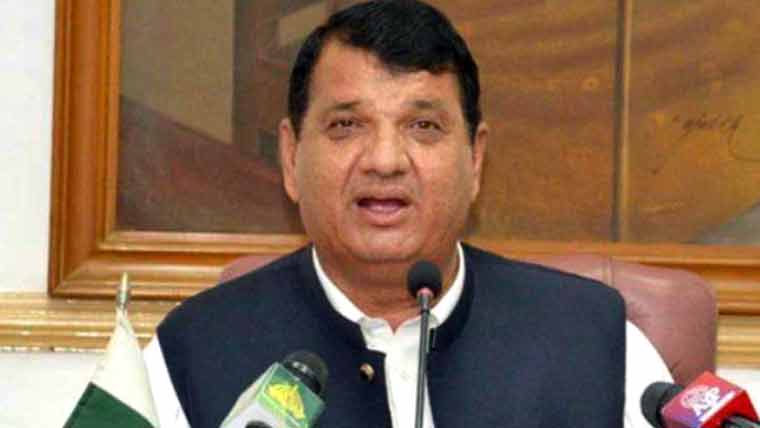
Islamabad (Tassawar News) In a powerful and rhetorically significant address at the Pashtun & Stable Pakistan Grand Convention, Engineer Ameer Muqam, the Federal Minister for Kashmir and Gilgit-Baltistan Affairs, articulated a comprehensive vision emphasizing the primacy of national security and public welfare. His discourse centered on the foundational principle that peace and public order are not merely desirable conditions but are, in fact, paramount imperatives for the nation’s sustained progress, necessitating the active engagement and contribution of every citizen. The Minister’s remarks provided an analytical framework for understanding the critical role of the Khyber Pakhtunkhwa province and the Pashtun community in the national edifice.
The Imperative of Public Order and Governance in Khyber Pakhtunkhwa
Minister Muqam dedicated a significant portion of his address to recognizing the invaluable and catalytic role played by the people of Khyber Pakhtunkhwa (KP) in the broader trajectory of national development. He acknowledged their sustained efforts in promoting stability and progress, yet simultaneously issued a trenchant observation regarding internal dissent. He suggested that certain “elements” within the political landscape find the measurable progress and burgeoning development of the province to be an unacceptable reality, potentially indicating vested interests resistant to transparent governance and stability.
In a direct appeal to the regional administration, the Federal Minister urged the provincial government to recalibrate its priorities, placing public welfare at the absolute forefront of its administrative agenda. This, he argued, requires an unrelenting, focused commitment to resolving the multifaceted and pressing issues that directly impact the daily lives of the citizens. The call was essentially for a shift from political rhetoric to pragmatic, results-oriented governance.
“The engine of national progress is lubricated by stability, and that stability is fundamentally dependent upon the well-being of the common populace. It is an administrative and moral obligation for the provincial leadership to divest their focus from peripheral political manoeuvre and to concentrate, instead, on the urgent and genuine problems facing the people of Khyber Pakhtunkhwa.”
He maintained that the current political climate “cannot afford politics that promote disorder and unrest,” a clear condemnation of political strategies perceived to be exacerbating division or contributing to institutional instability. Such behaviour, he inferred, constitutes a direct impediment to the realisation of long-term national objectives.
The Resilient Spirit: Pashtuns and the Fight Against Terrorism
A cornerstone of Minister Muqam’s speech was the profound recognition of the Pashtun community’s sacrifices, particularly in the protracted fight against terrorism. He underscored the historical truth that the people of Khyber Pakhtunkhwa have consistently “stood shoulder to shoulder with the security forces,” forming an integral front line in the national campaign to eradicate extremist threats. This partnership, he emphasized, has been instrumental in securing “major victories” for Pakistan in its counter-terrorism efforts.
The acknowledgment of this resilience led to a direct and serious admonition for the provincial leadership: the need to enact “special measures to consolidate peace.” He argued that hard-won peace is inherently fragile and requires continuous, proactive political and administrative guardianship. The collective sacrifices made must not be undermined by political expediency or administrative negligence.
Minister Muqam proceeded to embed the Pashtun contribution within the broader historical narrative of the nation. He proudly asserted that Pashtuns have consistently “guarded the dignity of the national flag,” highlighting that their sacrifices, chronicled since the very inception of Pakistan, are an indelible feature of the nation’s history.
“When we evaluate the totality of Pakistan’s history, the narrative of the Pashtun commitment emerges as non-negotiable and sacrosanct. Their valour was not just demonstrated on the battlegrounds of the modern anti-terror campaign, but was decisively evident even at the moment of our nationhood.”
He pointed to the historical record, recalling the region’s “strong endorsement” for joining Pakistan during the crucial referendum era, solidifying the political mandate for unity. Furthermore, he paid tribute to the “historic role Pashtun tribes played alongside the army during early Kashmir battles,” often undertaking arduous journeys, “marching on foot under harsh conditions,” to secure and liberate the areas that now constitute Azad Jammu & Kashmir.
A Warning on Political Exploitation and the Necessity of Stability
In a moment of poignant warning, the Federal Minister lamented a contemporary trend: the regrettable reality that “a few groups have begun exploiting Pashtuns for personal gain.” This practice, he suggested, dangerously co-opts the community’s honour and historical narrative for narrow, self-serving political ends. This exploitation, he posited, threatens to dilute the community’s genuine and historical commitment to national stability.
The Minister then issued a stark, geopolitical caution regarding the fundamental importance of maintaining institutional strength and operational readiness. He directly referenced a recent period of intense internal upheaval—likely alluding to the unrest following the events of May 2023—and stressed the gravity of the potential consequences.
“It is a sobering truth that must be universally acknowledged: had Pakistan’s armed forces not secured strong, defensible positions during the short but absolutely critical period of fighting last May, the very existence and geopolitical integrity of the country could have been gravely jeopardized.”
This statement underscores his central thesis: that the stability of national institutions, particularly the security apparatus, is not merely a political talking point but an essential prerequisite for the nation’s survival and continued sovereignty.
Conclusion: Prioritizing the National Interest
Engineer Ameer Muqam’s address was ultimately a powerful synthesis of historical commendation and contemporary political responsibility. It served as a forceful reminder that the collective spirit and immense sacrifices of communities like the Pashtuns are foundational to Pakistan’s identity, but that this legacy must be protected from political manipulation and internal disorder. The core message is unequivocal: the national interest, encapsulated by peace and public welfare, must supersede all forms of politics that promote discord. The onus now rests upon all levels of leadership, particularly the provincial government of Khyber Pakhtunkhwa, to translate this call for stability into tangible administrative actions, thus ensuring the consolidation of both peace and progress for future generations.
Would you like an analysis of the specific challenges and opportunities facing Khyber Pakhtunkhwa’s government in consolidating peace and achieving public welfare, as suggested by the Minister?