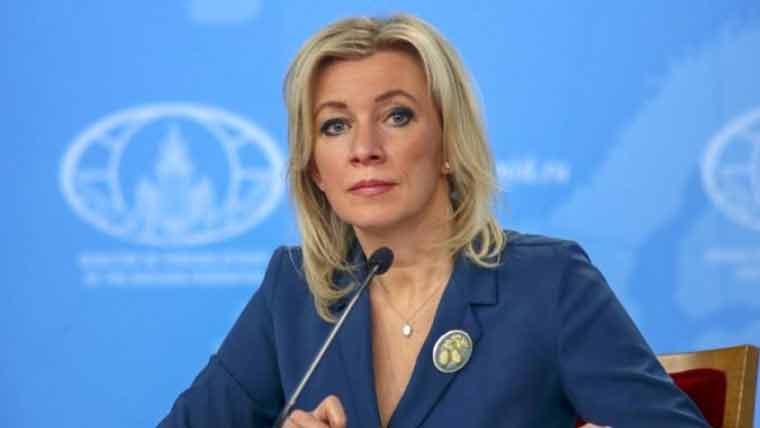
Moscow (Web Desk): The Russian Federation has issued a staunch diplomatic admonition regarding proposed legislative maneuvers within the Israeli Knesset, expressing profound concern that the final approval of a bill extending Israeli sovereignty over the Jordan Valley and sections of the occupied West Bank could serve as a catalyst for a “new spiral of dangerous escalation” across the volatile Middle East. This official warning, conveyed during a press briefing by Russian Foreign Ministry Spokesperson Maria Zakharova, underscores Moscow’s apprehension about unilateral actions that threaten to fundamentally derail the already precarious Palestinian-Israeli peace process.
The Legislative Threat and Moscow’s Reaction
The focus of the international community has been drawn to the Israeli Parliament following the initial legislative steps taken concerning the occupied territories. Spokesperson Zakharova recalled that on October 22nd, the Knesset had already granted initial approval to two distinct bills, both explicitly aimed at expanding Israel’s sovereignty over areas within the West Bank, often focusing on existing Jewish settlements and strategically important geographical zones, such as the Jordan Valley. The Jordan Valley, which constitutes approximately one-third of the West Bank, is viewed by Israel as a vital security buffer, while Palestinians see it as the agricultural heartland and eastern border of their future state.
Moscow’s official response is characterized by a blend of hope and stark forewarning. Ms. Zakharova conveyed the expectation that these controversial bills “will not proceed to final approval.” However, this expression of hope was immediately counterbalanced by an unequivocal caution regarding the potential geopolitical fallout should the Israeli legislative process be completed.
“Should these bills receive final legislative assent, it will become, in Moscow’s considered assessment, ‘impossible to avoid a new spiral of dangerous escalation’—a conflict dynamic that will be acutely felt not only in the Occupied Palestinian Territory but also reverberate across the Middle East region as a whole. This is a moment where legislative action must be weighed against the colossal risks to regional stability.”
This formal declaration highlights Russia’s anxiety that the annexation, by creating irreversible “facts on the ground,” would directly violate international law, contradict numerous United Nations resolutions, and ignite a fresh wave of Palestinian resistance and regional antagonism.
The Undermining of International Peace Efforts
The Russian Foreign Ministry further elaborated on the destructive impact of the proposed annexation on the already moribund international peace efforts. Ms. Zakharova warned that any resultant “new conflict” would fundamentally “undermine international peace efforts, which are already moving forward with difficulty.” The fragile nature of diplomatic engagement, compounded by recent regional volatility, renders any unilateral move profoundly destabilizing.
Moscow’s position firmly rejects the use of unilateral territorial expansion as a means of conflict resolution. Russia maintains a consistent stance that the Palestinian issue can only be resolved through political and diplomatic means, adhering to the internationally endorsed framework for negotiations. Unilateral actions like annexation are viewed as antithetical to the spirit of dialogue and mutual concession required to achieve a lasting political settlement.
The proposed annexation effectively threatens to dismantle the two-state solution—the internationally recognized framework for peace which envisions an independent Palestinian state coexisting alongside Israel. By annexing large, contiguous blocks of land, particularly the Jordan Valley, Israel would deprive a future Palestinian state of its territorial integrity, control over vital water and agricultural resources, and its external border with Jordan, thereby rendering it non-viable.
The Call for Direct Negotiations and a Viable Palestinian State
In detailing the pathway to a sustainable peace, Spokesperson Zakharova emphasized that the main goal of the international community must now be to focus exclusively on “ensuring lasting peace in the region.” This requires a deliberate and structured process centered on creating the necessary conditions for direct negotiations between Palestinian and Israeli representatives.
The negotiations must be comprehensive, addressing “all final-status issues.” This established diplomatic terminology encompasses a range of complex and highly sensitive topics, including:
- Borders: Delimitation based on the 1967 lines, with mutually agreed land swaps.
- Jerusalem: Determining the status and future administration of the city, claimed as a capital by both sides.
- Refugees: Resolving the plight of Palestinian refugees displaced since 1948 and 1967.
- Security: Establishing credible and sustainable security arrangements for both states.
- Settlements: Determining the fate of Israeli settlements in the West Bank.
The ultimate, non-negotiable objective of these negotiations, as reaffirmed by the Russian Federation, is the establishment of an “independent and geographically contiguous Palestinian state,” capable of “living side by side with Israel in peace and harmony.” This articulation aligns Russia with the majority international consensus which holds that only a viable, sovereign Palestinian state can guarantee long-term stability and justice in the region.
“The international community cannot afford to permit the creation of irreversible facts on the ground that preempt the outcome of final-status negotiations. The only pathway to peace is one built upon mutual recognition and the establishment of a territorially contiguous Palestinian state—a state that is economically viable and politically sovereign, capable of serving as a responsible partner for peace with Israel.”
Conclusion: The Peril of Unilateralism
The robust warning issued by the Russian Foreign Ministry regarding the potential final approval of the Knesset’s annexation bill is a significant diplomatic utterance, reflecting deep international apprehension. It underscores the global conviction that such unilateral territorial aggrandizement would constitute a fundamental breach of international legal norms and carry the inherent risk of igniting a devastating and protracted conflict. The path forward, as articulated by Moscow, must necessarily eschew such divisive actions and instead pivot decisively toward a renewed commitment to direct, comprehensive political and diplomatic negotiations, aimed at achieving the foundational goal of a just and enduring two-state solution.
Would you be interested in a detailed analysis of the implications of annexing the Jordan Valley specifically on the water security and agricultural viability of a future Palestinian state?