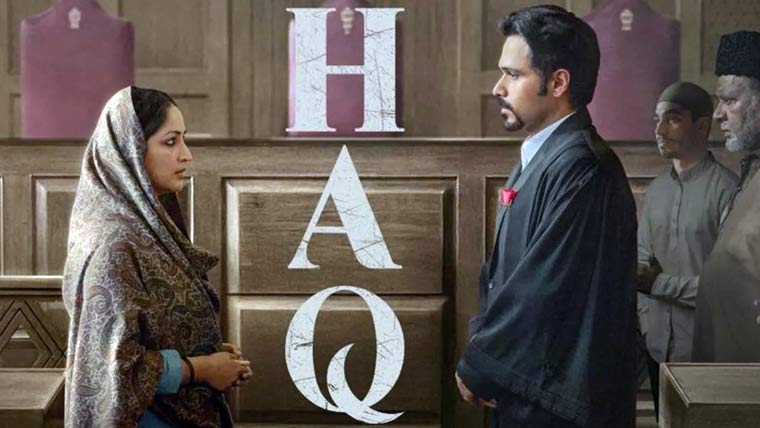
Mumbai (Web Desk): Bollywood stalwart Emraan Hashmi has proactively responded to the emergent controversy surrounding his forthcoming legal drama, Haq, providing a meticulously reasoned defence against accusations that the film harbours anti-Islamic sentiments or targets any specific religious group. In a recent detailed interview with an Indian news channel, the actor meticulously clarified the cinematic project’s secular foundation and its central focus on women’s constitutional rights and dignity within the context of Indian law. This engagement serves as a significant attempt to preemptively frame the film’s narrative within the boundaries of legal and humanistic discourse, rather than religious critique.
Thematic Core: Personal Belief versus Constitutional Law
Hashmi underscored that the narrative trajectory of Haq is not one of religious condemnation, but rather an exploration of the nuanced tension that exists between an individual’s personal faith framework and the overarching legal provisions of the Indian Constitution. The film aims to present a balanced viewpoint, fostering a discussion on the subject without resorting to didacticism or polemics.
He acknowledged that the production draws deep inspiration from the 1985 Shah Bano case, which remains a watershed moment in India’s legal history. This landmark Supreme Court judgement ignited a protracted nationwide debate concerning the applicability of secular law, specifically Section 125 of the Code of Criminal Procedure, to Muslim women seeking maintenance from their divorced husbands, thereby directly challenging the prevailing Muslim personal laws of the time.
“The new generation may not know much about it,” he noted, suggesting a generational gap in awareness regarding this crucial legal precedent. He added: “The film takes inspiration from Shah Bano’s struggle — her fight for justice through the lower courts, the High Court, and finally the Supreme Court after her husband refused to provide financial support.”
By anchoring the film to the historical struggle of Shah Bano, Hashmi establishes the project as an examination of legal and social justice, rather than a critique of theology. The central theme, therefore, pivots on the dignity and rights of women as enshrined in constitutional principles.
Artistic Sensitivity and Personal Conviction
In addressing the sensitivities surrounding the subject matter, Emraan Hashmi stressed the profound care and conscious mindfulness with which he approached the role. He admitted that dealing with a subject touching upon the laws and sentiments of his own community presented a unique professional challenge.
“This is the first time in my career that I had to be consciously mindful of my own community’s sentiments. The story doesn’t point fingers or deliver judgment — it simply reflects on women’s rights through a humanistic lens.”
This commitment to a humanistic perspective is further reinforced by Hashmi’s personal testimony regarding his family life, which he presented as a microcosm of India’s secular ethos. By openly sharing details of his interfaith marriage, he aims to validate his credentials as a liberal and unbiased voice on a subject sensitive to religious communities.
“I married a Hindu woman. My children both pray and perform puja. India is home not only to Muslims but people of all faiths — and Haq is a story that every woman should watch.”
Hashmi’s personal life narrative—a blend of Muslim, Hindu, and Christian influences—serves as a powerful, real-world example of secular upbringing and religious tolerance. By presenting his family as an exemplar of peaceful co-existence and the respectful observance of multiple traditions, the actor effectively supports his assertion that the film’s intent is to promote equality and dignity for women, transcending religious boundaries. His final call to action, urging all women, irrespective of their faith, to watch the film, consolidates the message of universal human rights that Haq ostensibly champions.
Conclusion
Emraan Hashmi’s comprehensive defense of Haq demonstrates a sophisticated public relations strategy aimed at mitigating controversy by elevating the film’s thematic content. His deliberate focus on the Shah Bano case frames the movie as a vital retelling of an Indian legal and social milestone concerning women’s right to maintenance and dignity. By unequivocally asserting the film’s secular and pro-women agenda and leveraging his own interfaith family as proof of his liberal Muslim viewpoint, Hashmi attempts to steer the public dialogue away from religious conflict and toward a constitutional debate on gender equality. The success of this strategy, however, will ultimately be judged by the extent to which the film’s narrative maintains the “balanced and unbiased” perspective the actor so meticulously champions.