Mumbai (Web Desk): The contemporary landscape of celebrity journalism and digital media recently witnessed a significant episode of public misinterpretation, centring on prominent Bollywood actors Mahima Chaudhry and Sanjay Mishra. An initially simple promotional event for their upcoming film, Durlabh Prasad Ki Doosri Shaadi (Durlabh Prasad’s Second Marriage), was rapidly amplified by social media, leading to widespread but entirely unfounded speculation that the two veteran stars had entered into a secret marriage. This incident provides a fascinating case study in the rapid dissemination of unverified information and the fine line between creative marketing and genuine news in the digital age. The subsequent clarification by reputable Indian media sources became necessary to quell the intense public confusion generated by a single, deliberately ambiguous video clip.
The Spark of Speculation: A Viral Video and Ambiguous Context
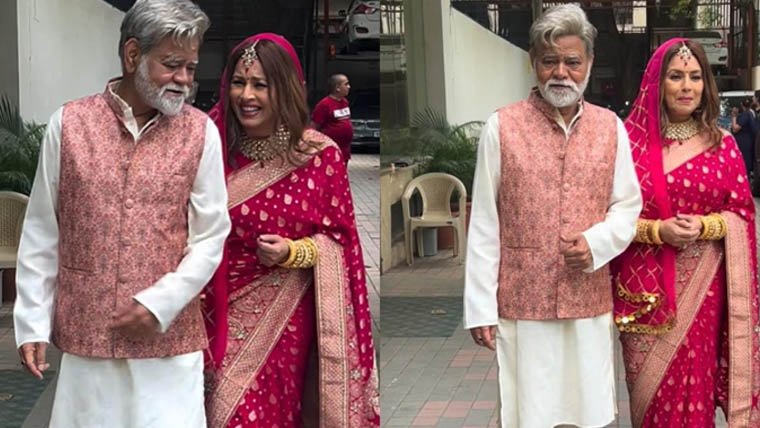
The catalyst for the widespread rumours was a video clip, disseminated across numerous social media platforms, capturing the two actors in elaborate wedding attire. Mahima Chaudhry was visually arresting, draped in a traditional, vibrant red bridal saree, complemented by ornate jewellery and meticulous bridal makeup. Correspondingly, Sanjay Mishra donned a classic groom’s ensemble, consisting of a white kurta-shalwar layered with a structured waistcoat, presenting a perfect picture of a newlywed couple.
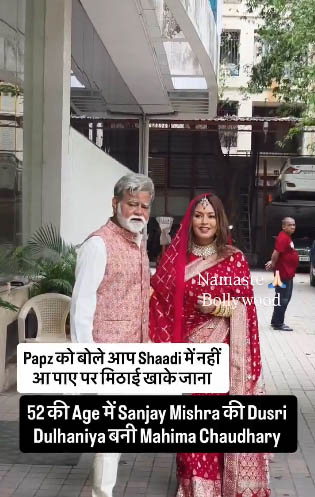
The key moment that served to ignite the viral frenzy was a playful interaction captured between Mahima Chaudhry and the assembled paparazzi. In a light-hearted, yet strategically ambiguous, manner, the actress addressed the photographers, suggesting they had missed a personal milestone:
“You couldn’t attend the wedding, but at least have some sweets!”
This comment, delivered within the context of the highly convincing bridal presentation, was instantly taken at face value by a significant portion of the online audience. The digital echo chamber, characterised by its speed and propensity for sensationalism, interpreted the actress’s remark not as promotional dialogue, but as a direct, albeit belated, confirmation of an actual, private wedding ceremony. The resulting buzz was immediate and intense, leaving fans profoundly “shocked and confused,” as many genuinely began to believe that the beloved actors had indeed “secretly married.” The sheer surprise was compounded by the fact that neither actor had publicly hinted at a relationship, making the supposed event all the more sensational.
Unravelling the Fiction: Promotional Campaign as Catalyst
The subsequent media investigation swiftly established that the viral content was a deliberate act of creative publicity, meticulously orchestrated as part of the marketing strategy for their joint cinematic project. The production, Durlabh Prasad Ki Doosri Shaadi, directed by Sidhant Raj, centres on the relationship dynamics of a married couple, roles essayed by Chaudhry and Mishra. The entire sequence—the elaborate costumes, the celebratory atmosphere, and the captured interaction with the press—was a staged component intended to generate pre-release hype.
The core clarification, which ultimately settled the matter, was straightforward: the “wedding scenes” observed by the media were “shot purely for promotional purposes,” and did not originate from a real-life matrimonial event. This distinction highlights a crucial aspect of modern film marketing: the willingness of publicists to blur the lines between on-screen fiction and off-screen reality to generate immediate, high-volume social media engagement.
“However, Indian media has now set the record straight — the viral video was not real. It was part of the promotional campaign for their upcoming film ‘Durlabh Prasad Ki Doosri Shaadi’ (Durlabh Prasad’s Second Marriage).”
The strategy, while highly effective in generating headlines and digital traction, simultaneously underscores the challenges faced by the media in authenticating content in an environment where visual evidence can be easily manipulated or contextually misrepresented.
The Cultural Context of Stardom and Public Gaze
The readiness of the public to believe the narrative of a “secret wedding” reflects several cultural and sociological factors inherent in the relationship between Indian film stars and their audience. Firstly, there is the intense, often proprietary, public interest in the personal lives of cinematic icons. Bollywood stars are frequently subject to relentless scrutiny, and any perceived secrecy often fuels intense speculation.
Secondly, the notion of the “creative publicity stunt” is not new in the film industry, but the sophistication with which such stunts are executed has grown exponentially with the advent of viral video technology. The immediate, personal feel of the video, coupled with Mahima Chaudhry’s convincing, celebratory tone, lent it an air of authenticity that official press releases often lack. The stunt successfully leveraged the audience’s emotional investment in their stars, generating the desired high-impact confusion that translates directly into publicity for the film.
The incident ultimately serves as a reminder for media consumers to critically evaluate the source and context of content, particularly when it pertains to celebrity personal lives. The relief expressed by fans following the clarification confirmed the powerful emotional hold the actors have on their followers, even as they learned they were subjects of a clever marketing ploy. The initial shock ultimately transitioned into a humorous appreciation for the production team’s successful, albeit misleading, pre-launch campaign.
Conclusion: A Triumph of Promotion, Not Personal Union
The swift circulation of the video featuring Mahima Chaudhry and Sanjay Mishra in matrimonial attire and the subsequent correction by Indian media is a succinct encapsulation of the perils and potency of digital-era marketing. The staged interaction and the ambiguous comment were masterfully employed as a publicity tool to generate maximum curiosity and conversation around the upcoming film, Durlabh Prasad Ki Doosri Shaadi. While the rumours momentarily bewildered the public, the official clarification ensured that fans could “rest easy” knowing the actors’ on-screen marriage was not a reflection of a real-life event. This episode ultimately highlights the increasingly aggressive and often deceptive tactics employed in film promotion, demonstrating how easily a single, carefully framed moment can be misconstrued as undeniable fact in the high-speed engine of social media. The incident, therefore, will be remembered less as a celebrity wedding scandal and more as a textbook example of a highly effective, though temporarily misleading, publicity coup.
Would you like me to analyse the impact of such publicity stunts on the credibility of media reporting in the entertainment sector?