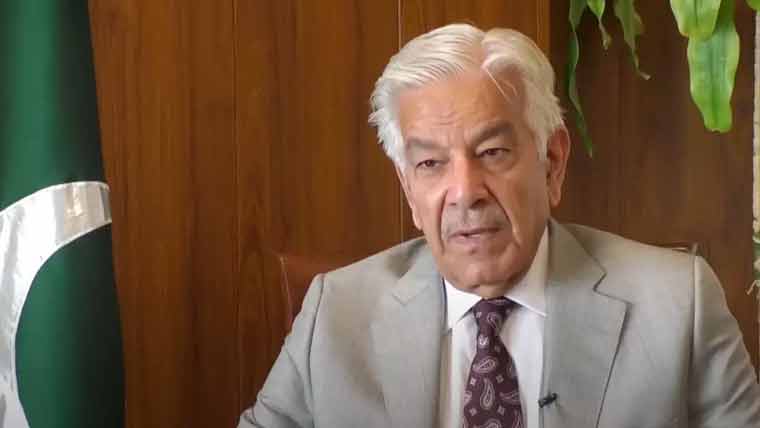
Islamabad: (Tassawar News) The recent affirmation by Pakistan’s Defence Minister Khawaja Asif, conveyed through an official statement on his social media platform (X), provides a crucial and detailed articulation of the nation’s steadfast approach to national security. The Minister’s remarks unequivocally underscore Pakistan’s commitment to executing decisive measures against cross-border terrorism with the paramount objectives of safeguarding both its citizens’ safety and its core national interests. This public pronouncement, laden with geopolitical significance, not only reiterates the current administration’s security doctrine but also offers a critical, unvarnished assessment of the prevailing situation in Afghanistan and its direct implications for regional stability.
The Minister specifically highlighted a fundamental prerequisite for effective security policy: the existence of a national consensus regarding both Pakistan’s overarching security policies and its comprehensive strategy vis-à-vis Afghanistan. This emphasis on domestic unity is a key rhetorical device, designed to signal internal strength and resolve in the face of external threats. Furthermore, the statement explicitly asserts that the populations of Khyber Pakhtunkhwa and Pakistan are fully cognizant of the reality of terrorist proxies operating under the alleged patronage of the Afghan Taliban and India. The use of such unambiguous language, emphasizing that this knowledge leaves “no room for ambiguity,” suggests a move away from diplomatic euphemism towards a more direct and declarative policy articulation. This stance is reflective of heightened border tensions and the perceived inadequacy of cooperation from the interim Afghan administration in dismantling terrorist networks operating from its territory.
A Critical Analysis of the Afghan Governance Deficit
The statement’s second major thematic focus involves a sharp critique of the non-representative Afghan Taliban government, detailing what Pakistan perceives as profound internal vulnerabilities and governance failures. The Defence Minister’s assessment characterizes the regime as “deeply divided internally,” a state of fragmentation that contributes to systemic instability within Afghanistan. This internal disunity, he suggests, is directly correlated with the continued oppression of vulnerable segments of Afghan society.
Specifically, the discourse highlights the continuous subjugation faced by women, children, and minorities, coupled with severe and ongoing restrictions on fundamental human rights, including freedom of expression, education, and representation. This line of argument strategically aligns Pakistan’s security concerns with broader international humanitarian principles, lending a moral dimension to its policy stance. The explicit mention that, despite “four years in power,” the Taliban have demonstrably “failed to fulfill their promises to the international community,” serves to isolate the regime diplomatically and justify Pakistan’s firmer approach. This diplomatic failure, in Pakistan’s view, has direct security consequences for the region.
“The failure of the Afghan interim administration to secure internal cohesion and adhere to basic international covenants on human rights and governance constitutes a significant systemic risk for regional security. This internal disarray, far from being a purely domestic affair, provides fertile ground for the propagation of extremist ideologies and the operation of terrorist syndicates that directly impinge upon the sovereignty of neighbouring states.”
This academic perspective illustrates the deep connection between failed governance in Afghanistan and the ensuing cross-border security dilemmas facing Pakistan.
The Calculus of Proxy Warfare and National Interest
In a powerful act of geopolitical analysis, the Defence Minister posits that the Taliban’s alleged allowance of terrorist proxies is a calculated measure—an attempt to “divert attention from their internal disunity, instability, and governance failures.” This suggests a strategic assessment that the Afghan regime may be externalising its internal political and administrative weaknesses onto Pakistan through the medium of cross-border militancy. The concept of the Taliban “acting as proxies for external elements” is a serious accusation, one that places the burden of regional destabilisation squarely on the shoulders of the interim Afghan government.
In stark contrast to this portrayed opportunism, the Minister stressed that Pakistan’s Afghan policy is constructed purely on the bedrock principles of national interest, regional peace, and stability. This declarative statement reinforces the defensive, reactive nature of Pakistan’s current strategy, positioning its actions as necessary responses to externally generated threats rather than aggressive interventions. It fundamentally asserts a coherent, principles-based framework for foreign policy engagement, one that prioritizes the cessation of violence and the establishment of a peaceful regional environment.
The final and most crucial emphasis is placed upon the imperative of decisive actions to eliminate cross-border terrorism and protect its citizens. The Defence Minister’s concluding rhetorical flourish, “False statements cannot change the facts,” underscores a resolute determination to base future interactions and security measures on verifiable outcomes. He stressed that genuine trust can only be built through concrete actions, a definitive demand for verifiable steps from the Afghan side to dismantle the terrorist infrastructure. This signifies a departure from reliance on verbal assurances to a non-negotiable insistence on measurable compliance.
Conclusion
The statement by Defence Minister Khawaja Asif serves as a formal, comprehensive declaration of Pakistan’s reinforced security doctrine and its increasingly critical posture toward the Afghan Taliban regime. The analysis expertly links the internal governance failures, human rights deficits, and political divisions within the non-representative Afghan administration to the persistent menace of cross-border terrorism affecting Pakistani territories, notably Khyber Pakhtunkhwa. By asserting a national consensus and demanding concrete, verifiable actions to dismantle terrorist proxies, Pakistan is signalling a strategic escalation in its counter-terrorism commitment, moving from diplomatic appeals to the execution of decisive measures. The foundation for any future normalization of relations, as articulated by the Minister, rests exclusively upon the Afghan administration’s capacity to demonstrate genuine commitment to regional peace through tangible actions that eliminate the threat emanating from its soil.