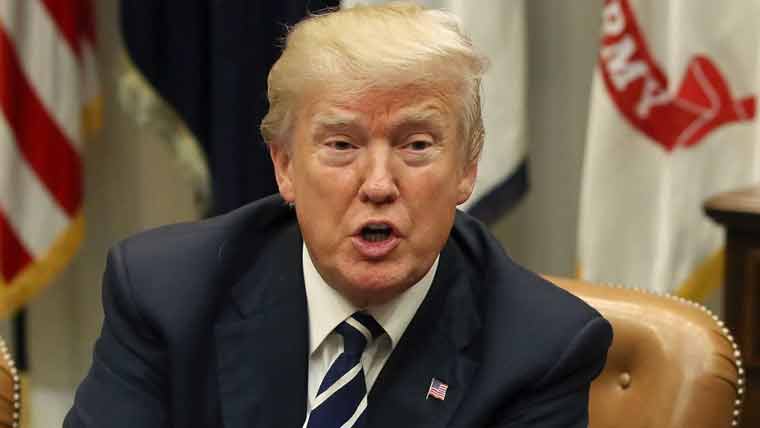
Washington: (Tassawar News) The recent declaration emanating from Washington, D.C., wherein the then-U.S. President, Donald Trump, issued a stark warning regarding potential military intervention in Nigeria, represents a profound and highly contentious pivot in American foreign policy towards the African continent. This unprecedented threat, explicitly linked to the pervasive and escalating violence and religious killings within the West African nation, immediately injected a degree of high-stakes tension into bilateral relations and raised serious questions regarding the parameters of sovereignty and humanitarian intervention. The presidential statement, initially concise but loaded with significant geopolitical weight, necessitated an immediate re-evaluation of the American strategic posture toward counter-terrorism and religious freedom advocacy abroad.
The Justification: Pervasive Violence and Mass Killings
The core justification for the severe U.S. warning was the chronic instability and the devastating civilian casualty rates attributed to various forms of sectarian and terror-related violence in Nigeria. The presidential statement pointed directly to the Nigerian government’s perceived failure to curb the mass killings, a term often used to describe violence perpetuated by groups such as Boko Haram, ISWAP, as well as longstanding, deadly conflicts between herders and farmers. This emphasis framed the potential U.S. action not merely as a security measure but as a humanitarian imperative rooted in the responsibility to protect civilian populations.
President Trump’s directive to the military preparation for action highlights the gravity with which the situation was viewed at the highest level:
“In a forceful declaration that eschewed traditional diplomatic ambiguity, President Trump explicitly stated he has directed the Department of Defense to prepare for action to stop mass killings in Nigeria. This preparatory military directive underscores the Administration’s willingness to operationalize its warnings, signalling a move beyond diplomatic rhetoric toward tangible security measures designed to stabilise a region gripped by sectarian turmoil.”
This direct mandate to the Pentagon established a clear, albeit controversial, framework for intervention based on the premise that the internal security crisis in Nigeria had reached a threshold demanding external, forceful remediation. The claim that “America has the power to eliminate terrorists in the region if necessary” serves as a potent assertion of U.S. military capability and its willingness to unilaterally project power in pursuit of counter-terrorism objectives, should diplomatic avenues prove insufficient.
The Policy Toolkit: Suspension of Financial Aid and Conditionality
Beyond the threat of direct military engagement, the U.S. President employed a secondary, powerful policy tool: the conditionality of international assistance. This financial leverage was articulated as a direct ultimatum to the Nigerian government, tying the continued flow of critical developmental and security aid to demonstrable progress in protecting civilian populations and ensuring religious freedom.
The warning was unequivocally clear, focusing on economic and developmental lifelines:
“The U.S. President further warned that if the Nigerian government fails to prevent religious violence, Washington will proceed to suspend all financial aid to the country. This constitutes a severe economic sanction, aiming to compel immediate governmental reform and action on security matters through fiscal pressure.”
This stance is underpinned by a foreign policy philosophy that prioritises religious liberty and civilian security as non-negotiable prerequisites for partnership. President Trump explicitly emphasised that “international assistance cannot continue without ensuring religious freedom and civilian protection.” This established a precedent of hyper-conditionality, suggesting that geopolitical strategy would be subordinated to human rights and religious freedom metrics. The loss of U.S. financial aid—which often supports crucial anti-poverty programs, health initiatives, and security sector reform—would have potentially destabilising effects on the Nigerian economy and its ongoing efforts to manage the complex internal conflicts, thus raising questions about the proportionality and wisdom of the threatened action.
Geopolitical Ramifications and Legal Scrutiny
The contemplation of military action and the unilateral threat to suspend aid carry substantial geopolitical ramifications. Such a policy shift challenges the fundamental principle of non-intervention in the internal affairs of a sovereign state, potentially alienating regional partners and inviting scrutiny from international bodies such as the African Union and the United Nations Security Council. An American military operation, even if framed as a counter-terrorism effort, would necessitate complex logistical arrangements and risk further destabilising the volatile West African region, potentially leading to unintended consequences and a broader regional conflict.
Moreover, the decision to use aid suspension as a coercive measure could be viewed as punitive rather than supportive, hindering the very institutions in Nigeria that are struggling to implement necessary reforms. The rhetoric, while forceful, risks being counterproductive by undermining the Nigerian government’s authority at a time when domestic cohesion is paramount to tackling internal security threats.
Conclusion
The statement by President Donald Trump, threatening military intervention and the suspension of financial aid to Nigeria over unresolved violence and religious killings, was a moment of profound diplomatic tension. It articulated a forceful foreign policy doctrine that prioritises the immediate cessation of mass atrocities and the protection of religious freedom, backed by the severe instruments of both military force and economic sanction. While the warning reflected legitimate international concerns over the devastating humanitarian toll in Nigeria, the unilateral and aggressive nature of the threatened response raised serious international law and sovereignty questions. Moving forward, the global community, and future U.S. administrations, must critically balance the humanitarian imperative to intervene against the necessity of preserving state sovereignty and ensuring that policy choices, particularly those involving financial aid, are ultimately constructive rather than punitive in addressing the root causes of the endemic violence.