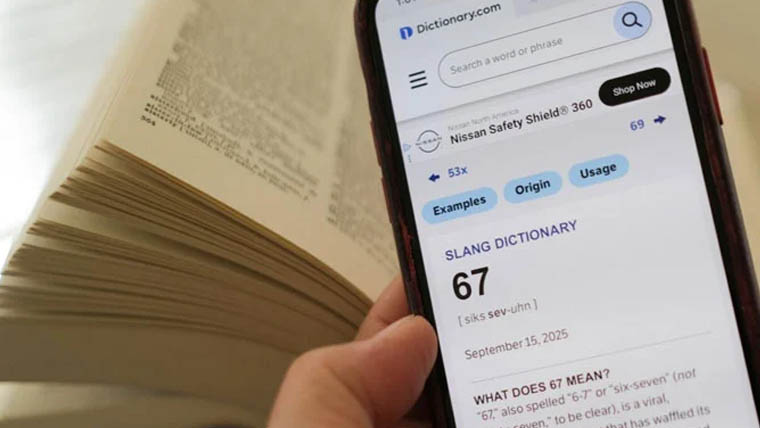
(Web Desk) The annual selection of the “Word of the Year” by leading language authorities is typically a serious linguistic exercise, designed to capture the zeitgeist—the prevailing spirit and defining socio-cultural trend—of the preceding twelve months. However, Dictionary.com’s 2025 designation of the term “67” has not only achieved this objective but has done so in a dramatically unconventional manner, prompting widespread confusion and debate among linguists, educators, and the general public. This choice, which is demonstrably a numerical rather than a lexical item, signals a radical and perhaps irreversible shift in modern communication, particularly amongst the Generation Alpha demographic.
Deconstructing the Numerical Phenomenon
The immediate confusion surrounding the choice stems from its non-word status. The term is not a newly coined verb, noun, or adjective, but a two-digit numeric combination. Furthermore, the pronunciation defies conventional mathematics:
“Interestingly, it’s not pronounced ‘sixty-seven’, but rather ‘seven-six’, as adopted by Generation Alpha (those born between 2010 and 2024).”
This inversion, reportedly stemming from the viral TikTok track “Doowut Doowut (7 6)” by American rapper Skrilla, immediately establishes the term as an in-group signifier deeply rooted in digital youth culture. Its connection to social media and viral memes underscores the power of algorithmic content to unilaterally shape language evolution at an unprecedented velocity.
The Power of Ambiguity: Function Over Fixed Meaning
Perhaps the most compelling argument made by Dictionary.com for its controversial selection is the term’s very ambiguity. The official explanation assigns a vague, almost contradictory range of meanings to the term:
“Dictionary.com explains that ’67’ loosely means ‘neither good nor bad’ or ‘maybe this, maybe that.’ Yet, its real power lies in its ambiguity—it’s a meaningless yet unifying term connecting a generation through humour and internet culture.”
In this sense, “67” functions less as a word with a fixed semantic definition and more as an interjection or a social signal. It conveys a feeling of ironic detachment, shared absurdity, or simply an acknowledgement of participation in a widespread meme. This reflects a growing trend, often dubbed “brainrot slang” by some commentators, where young people prioritise performative absurdity and communal belonging over clarity and precision in their casual language. The term’s very lack of stable meaning becomes its defining characteristic, functioning as a cultural password.
The Digital Age’s Linguistic Legacy
The decision by a major lexicographical institution to crown a number as its word of the year highlights a profound transformation in how the English language is being reshaped by the digital world. The Generation Alpha cohort, who are digital natives in the truest sense—having never experienced a world without smartphones and viral content—are driving this change.
Experts view this choice not as a decline of language but as a powerful indicator of its adaptability in the 21st century:
“Experts believe that choosing a two-digit combination as the Word of the Year highlights how digital-era children are reshaping language and communication in the 21st century. The speed at which ’67’ travelled from a rap lyric to a classroom chant demonstrates the erosion of traditional linguistic gatekeepers and the rise of decentralised, bottom-up linguistic innovation driven by platforms like TikTok.”
The term’s surge in digital media, reportedly six times greater in recent months compared to the preceding year, provides the empirical data that, in the eyes of the dictionary editors, validates its cultural significance. The choice of “67” is, therefore, a reluctant but necessary acknowledgement of the fluid, often nonsensical, nature of language in the age of viral media.
Conclusion
Dictionary.com’s Word of the Year for 2025, “67,” is a potent symbol of contemporary linguistic evolution. By selecting a term that is simultaneously a non-lexical item and highly ambiguous, the institution has underscored the ascendancy of digital culture and Generation Alpha’s influence in redefining communication. The term’s viral success, originating from a rap track and flourishing across social media, demonstrates that for younger generations, language functions primarily as a tool for social connection and shared humour rather than merely for conveying explicit information. While the choice has undoubtedly caused confusion, it accurately serves as a ‘linguistic time capsule’ for a year defined by the cultural power of the absurd and the unifying force of the internet.