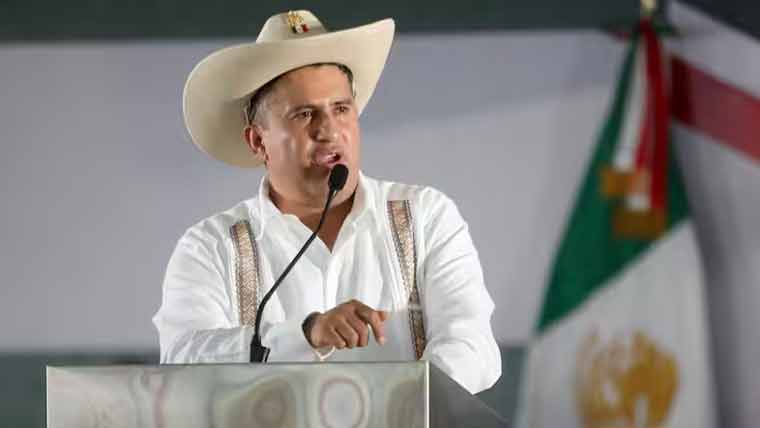
MEXICO CITY: (Tassawar News) A deeply disturbing act of violence has rocked central Mexico, with the confirmation by authorities that Carlos Manzo, the recently elected mayor of a town in the state of Michoacán, was fatally shot on Monday. The shocking incident took place during a local festival, brutally exposing the ongoing vulnerability of local governance to the forces of organized crime and endemic political violence that have long plagued the region. This assassination compounds the profound security crisis facing Mexico’s democratic institutions.
Immediate Aftermath and Early Investigations
Foreign media reports have confirmed that Mayor Carlos Manzo, aged 40, had only assumed the responsibilities of his high-stakes office just one week prior to his murder. The attack occurred while he was in attendance at a traditional Day of the Dead festival, a major public and cultural event. Armed assailants reportedly opened fire directly on the mayor in front of dozens of terrified attendees, resulting in his instantaneous death.
The swift response by law enforcement resulted in the immediate apprehension of two suspects at the scene. In a dramatic turn, a third suspect reportedly took his own life to evade capture by the authorities. The complexity of the motive is now the central focus of the investigation. Officials from Mexico’s Public Security Agency are actively working to determine whether the murder was politically motivated, a direct consequence of the mayor’s recent election, or specifically linked to the powerful organized criminal groups that operate extensively and often unopposed in the Michoacán region.
“The incident took place in the state of Michoacán, an area that has long struggled with organized crime and political violence. Investigators are currently determining whether the murder was politically motivated or linked to organized criminal groups active in the region.”
A Critic Silenced: Manzo’s Political Profile
Carlos Manzo was widely known within political circles for being an outspoken and vocal critic of Mexico’s federal government. His criticism was particularly sharp regarding its perceived failure in the handling of national security issues and systemic corruption. His assassination adds a chilling new entry to the rapidly growing list of politically targeted killings in Mexico, thereby escalating serious national and international concerns regarding the fundamental safety of local government officials, who often stand on the frontline of conflict with criminal networks.
The State Prosecutor’s Office of Michoacán has confirmed that specialized forensic teams have been deployed to the scene, and a full, official investigation is now underway. In an effort to contain potential spillover violence, authorities have also significantly increased security measures across neighbouring municipalities.
Eyewitness accounts paint a vivid picture of the sheer terror and chaos that erupted during the festival. One attendee, speaking to local media, described the panic:
“It all happened so fast — we heard loud shots, and people started running everywhere. It was absolute panic. The tragic nature of the attack, carried out in front of dozens of attendees at a traditional festival, underscores the brazenness of the criminal forces at work.”
The Broader Crisis: Violence Against Public Officials
Political analysts globally recognize that Mexico has experienced a worrying and sustained sharp rise in violence against public officials in recent years. This phenomenon is particularly acute for those taking office at the municipal level, the stratum of government closest to the community and often most susceptible to local pressure. Experts widely suggest that such targeted attacks are frequently orchestrated by powerful criminal cartels whose primary objective is to gain complete control over local administrations, including municipal police forces and law enforcement agencies, thereby securing their illicit operations.
This latest killing follows a disturbing series of deadly incidents targeting political figures in both 2024 and 2025. A notable example occurred in May, where gunmen on motorcycles shot and killed the personal secretary and advisor to Mexico City Mayor Clara Brugada in the capital’s central district, demonstrating that the threat is not confined to remote or rural areas.
Human rights organizations have repeatedly and urgently called upon the Mexican government to implement significantly stronger protection protocols for vulnerable individuals, including local politicians, journalists, and civil society activists, all of whom frequently face severe threats from sophisticated and powerful criminal networks.
The Interior Ministry issued a formal condemnation of Mayor Manzo’s assassination, classifying it as “an attack on democracy and public service.” The Ministry made a public pledge for a full, comprehensive investigation and promised to ensure that those responsible for this heinous crime are swiftly brought to justice.
In light of the mounting domestic outrage and international pressure to urgently restore public security across the country, President Andrés Manuel López Obrador is expected to officially address the killing in his next press briefing, detailing the federal government’s plan to combat this persistent wave of political violence.
Conclusion
The brutal assassination of Mayor Carlos Manzo, merely a week into his tenure, serves as a devastating illustration of the profound security crisis and the chilling vulnerability of democratic governance in areas of Mexico controlled or influenced by organized crime. While authorities have acted swiftly to detain suspects, the true test of the government’s commitment lies in the transparency and thoroughness of the forensic investigation to determine the precise motive, whether political retaliation or criminal control. This tragic event necessitates an immediate, concerted effort from the federal government to bolster protection for local officials and confront the deeply entrenched impunity that allows criminal elements to brazenly undermine the nation’s democratic structures and the safety of its public servants.