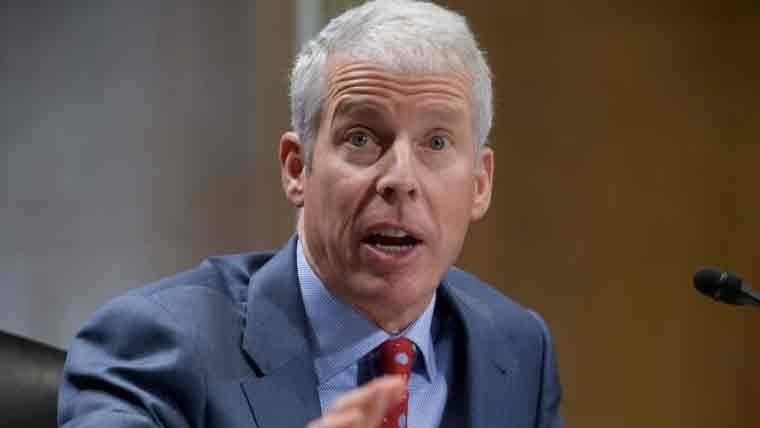
WASHINGTON: (Tassawar News) In a significant and clarifying interview with international media, U.S. Energy Secretary Chris Wright, who also holds the executive oversight for the nation’s nuclear weapons programs, definitively confirmed that the United States is not currently planning or conducting any nuclear explosion tests. This statement serves as a direct rebuttal to recent speculation, particularly those following ambiguous comments made by President Donald Trump, regarding a potential renewal of full-scale nuclear testing. Secretary Wright’s remarks emphasize the current administration’s continued reliance on advanced scientific stewardship and commitment to international non-proliferation commitments.
Non-Critical Tests and Scientific Reliability
Secretary Wright made it unequivocally clear that all current activities related to the nation’s nuclear arsenal fall under the category of “non-critical tests,” meaning they do not, under any circumstances, involve actual nuclear detonations. These tests are conducted with an explicit purpose: to ensure the long-term reliability and safety of the nuclear deterrent without breaching international agreements.
“We are not conducting or planning nuclear explosion tests,” Wright stated. “These are system-level assessments designed to ensure that our nuclear weapons function as intended without resorting to explosive testing, upholding our commitment to global non-proliferation.”
The Energy Secretary provided a technical explanation of these procedures, clarifying that the non-critical experiments are primarily focused on examining the components and overall performance of nuclear weapons systems. This rigorous examination allows engineers to confirm that the complex systems can activate correctly and safely, should they ever be required, all while remaining in full compliance with global nuclear test bans.
He explained that these advanced experiments operate under stringent monitoring frameworks and leverage the capabilities of cutting-edge simulation and computational technology, specifically supercomputing. This scientific approach ensures that the data gathered accurately predicts how nuclear devices would perform under various conditions, including design modifications or stress scenarios, thereby validating reliability.
“With the power of modern science and supercomputing, we can determine with extreme precision what would happen in a nuclear explosion,” he emphasized. “We can validate those results without any physical detonation, maintaining a credible deterrent through scientific rigour.”
Commitment to Global Stability and Non-Proliferation
Secretary Wright’s clarification is critically important given the recent public discourse. The speculation surrounding renewed testing stemmed from comments by President Donald Trump, who had suggested he authorized U.S. forces to resume nuclear testing for the first time in over three decades. When subsequently questioned, Trump remained deliberately vague on whether his statement specifically included the cessation of the current moratorium on underground nuclear detonations, a common practice during the Cold War era.
Wright’s authoritative statement is designed to reassure international partners worldwide that the United States remains firmly committed to the principles outlined in the Comprehensive Nuclear-Test-Ban Treaty (CTBT). The nation has no intention of reigniting the era of full-scale underground nuclear testing.
The Secretary noted that these non-explosive tests are a key part of a broader, long-term U.S. initiative to strategically modernize its nuclear arsenal while strictly adhering to its international non-proliferation commitments.
“The United States remains committed to global nuclear stability and has no intention of reigniting the era of full-scale underground nuclear testing. Our commitment to international non-proliferation frameworks is unwavering.”
The current administration, led by President Joe Biden, continues its deep reliance on the science-based stockpile stewardship programs. Experts underscore the efficacy of these methods, which involve using sophisticated computer modelling, high-energy lasers, and subcritical experiments to reliably validate the performance of the nuclear stockpile without resort to physical explosions. These technical approaches allow the U.S. to successfully maintain a credible and safe deterrent while simultaneously fulfilling its obligations to global nuclear non-proliferation and arms control frameworks.
Conclusion
U.S. Energy Secretary Chris Wright’s definitive confirmation that the United States is not planning any nuclear explosion tests is a pivotal statement intended to stabilize international nuclear policy discourse. By emphasizing the effectiveness of “non-critical tests” and advanced computational science, the U.S. reassures its global partners that it can maintain a safe, reliable, and credible nuclear deterrent while continuing to honor the Comprehensive Nuclear-Test-Ban Treaty (CTBT). This reliance on scientific stewardship over explosive trials reinforces the Biden administration’s commitment to global stability and non-proliferation, positioning the nation’s nuclear policy as both modern and responsible.