Faisalabad (Sports Desk): The recently concluded Second One Day International (ODI) between Pakistan and South Africa at the Iqbal Stadium in Faisalabad witnessed a clinical and dominant performance by the visiting Proteas, resulting in a convincing 8-wicket victory. This decisive win successfully levelled the three-match ODI series at 1-1, dramatically setting the stage for a highly anticipated series decider scheduled for November 8th. The outcome of the match was largely determined by a formidable run-chase, where South Africa’s top-order batting unit exhibited exceptional proficiency and intent, easily surpassing the 270-run target with an overwhelming display of power and precision.
Quinton de Kock’s Century Propels Proteas’ Dominance
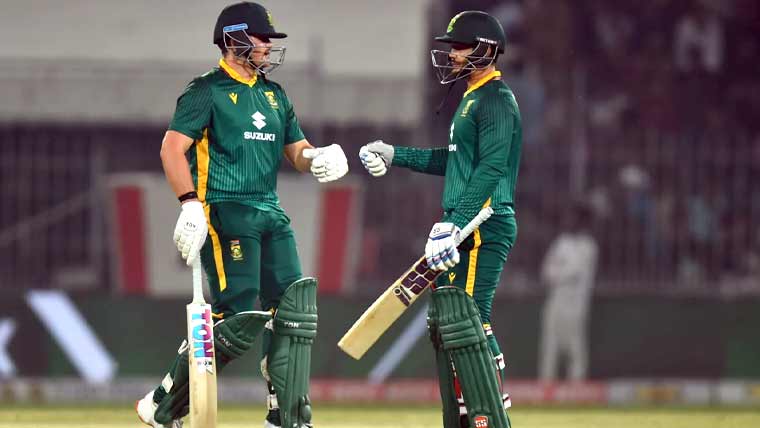
The cornerstone of South Africa’s triumphant pursuit was the scintillating, career-defining knock played by their star opener, Quinton de Kock. Demonstrating a masterful blend of technique and sheer aggression, de Kock compiled a magnificent, unbeaten 123 runs off a mere 98 deliveries. His innings was an exhibition of modern limited-overs batting, punctuated by seven colossal sixes and eight elegant fours, reflecting his current rich vein of form and a clear determination to seize the initiative for his team. De Kock’s ability to dismantle the Pakistani bowling attack established an early and insurmountable advantage.
The opener did not carry the burden alone; he was ably supported by his opening partner, Tony de Zorzi, who contributed a valuable and solid 76 runs. Their partnership laid a robust foundation that effectively deflated the morale of the home side’s bowlers. Subsequently, Louwan Pretorius further capitalised on the momentum with a brisk 46 runs before his dismissal. The innings was comfortably anchored to completion by Matthew Breetzke, who remained not out on 17, ensuring the target was reached with an impressive 9.5 overs to spare.
“The remarkable efficiency of the Proteas’ chase, particularly Quinton de Kock’s belligerent century, showcased a batting unit operating at peak performance, leaving the Pakistani bowling attack with few answers.”
Pakistan’s limited success with the ball saw a wicket each claimed by Faheem Ashraf and Mohammad Wasim Jr. However, the overall performance of the Pakistani bowlers was largely ineffectual, failing to apply sufficient pressure or contain the fearless onslaught orchestrated by the South African batsmen. The chase was completed in just 40.1 overs, emphasising the one-sided nature of the South African batting dominance.
Pakistan’s Batting Struggles Set a Subpar Target
Earlier in the day, the home team’s decision to bat first after winning the toss proved to be a miscalculation, as their innings was characterised by a persistent struggle to forge meaningful and enduring partnerships. Pakistan managed to post a total of 269 runs for the loss of nine wickets within their allocated 50 overs, a score that was ultimately deemed insufficient on a good batting surface at the Iqbal Stadium.
The innings suffered an immediate setback, with key batsmen falling cheaply. Opener Fakhar Zaman was dismissed for a duck, and the prolific Babar Azam could only muster 11 runs. The middle order crisis deepened when Mohammad Rizwan added a negligible 4 runs before becoming a victim of the South African pace bowler Nandre Burger.
The innings was temporarily rescued by a crucial stabilisation effort mounted by Saem Ayub (53 runs) and Salman Ali Agha (69 runs). Their significant partnership offered a glimmer of hope, but their dismissals triggered another collapse, exposing the fragility of the middle order. Contributions from the lower order became vital for reaching a competitive total:
- Hussain Talat: Contributed a modest 10 runs.
- Mohammad Nawaz: Played a valuable, fighting knock of 59 runs.
- Faheem Ashraf: Added a late flourish with 28 runs.
Captain Shaheen Afridi (1 run) failed to contribute significantly, while the tail-enders, Mohammad Wasim Jr. (12) and Naseem Shah (6)**, managed to shepherd the innings to the final ball, achieving a respectable, though ultimately inadequate, final score.
“A consistent pattern of partnership breakdowns and the failure of key players to convert starts into substantial scores ultimately curtailed Pakistan’s potential, leaving their bowlers with a challenging, uphill defence.”
Disciplined Bowling from South Africa
The platform for the Proteas’ victory was expertly laid by a highly disciplined and effective bowling performance. The star with the ball was the left-arm pacer Nandre Burger, who delivered a match-winning spell, claiming a remarkable 4 wickets for minimal runs. Burger’s early breakthroughs included the crucial wickets of Rizwan and Zaman, effectively rocking the top order and preventing a strong start for the Green Shirts.
Further control was asserted by Kabaya Omzi Pieterse, who skillfully secured 3 wickets, consistently chipping away at the middle and lower order. Corbin Bosch also contributed effectively, picking up one crucial wicket to ensure Pakistan could never build the required momentum. Their collective effort was instrumental in restricting Pakistan to a total below the 270-run mark, demonstrating a cohesive and strategic bowling attack that capitalised on the conditions and the vulnerability of the opposition’s batting line-up.
Series Decider Anticipation
With the ODI series now perfectly poised at one win apiece, the stakes for the third and final ODI on November 8th are astronomically high. This sudden-death scenario guarantees a high-voltage clash as both cricketing heavyweights vie to secure the coveted ODI series trophy.
The question looming large is whether Pakistan can swiftly address their batting woes, regroup, and mount an effective challenge, or whether the dominant South African team, buoyed by their comprehensive victory, will seal the series with another powerful and unyielding display. Cricket fans across the globe are eagerly awaiting what promises to be a thrilling conclusion to this tightly contested limited-overs series. The decider will be a true test of nerve, strategy, and execution under pressure for both teams.
“The third ODI transforms from a mere fixture into a gladiatorial contest, a decisive test of psychological resilience and tactical acumen, where the momentum gained by South Africa meets the urgency for redemption in the Pakistani camp.”
The series has now reached its climax, demanding peak performance from both sides.