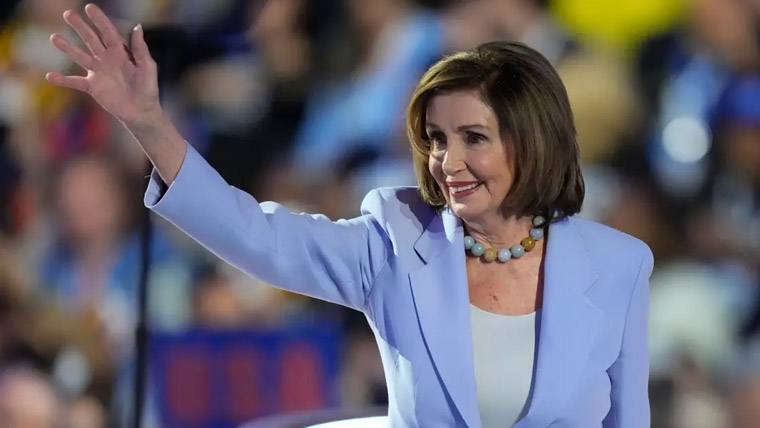
News York: (Tassawar News) The political landscape of the United States is poised for a seismic shift following the announcement by former Speaker of the U.S. House of Representatives, Nancy Pelosi, that she will not seek re-election in the upcoming congressional cycle, thereby concluding a distinguished political career spanning nearly four decades. At the age of 85, her decision—which will see her serve out the remainder of her current term until January $3$, $2027$—marks the decisive end of an epoch defined by her groundbreaking leadership, formidable legislative acumen, and status as a profoundly polarising figure in modern American governance.
The news was delivered directly to her constituents in San Francisco via a heartfelt video message, a gesture underlining the deep-seated relationship between the representative and her home district. As a figure synonymous with the city’s liberal politics, her address was both personal and consequential.
“I want you to hear it first: I will not be a candidate in the upcoming congressional election. With a grateful heart I look forward to serving out my final year as your representative.”
This voluntary departure from competitive politics, following her stepping down from party leadership in $2022$, formalises a generational handover within the Democratic caucus, paving the way for newer leadership, such as Representative Hakeem Jeffries, to consolidate influence.
A Legacy of Legislative Architecture
Pelosi’s enduring impact is inextricably linked to her trailblazing role as the first female Speaker of the House in $2007$, an achievement that irrevocably shifted the boundaries of political possibility for women in America. Beyond the symbolic significance, her tenure is characterised by a nearly unmatched capacity for legislative strategy, enabling the passage of landmark bills under two successive Democratic administrations.
Under President Barack Obama, she was lauded as the chief architect who marshalled the Affordable Care Act (ACA) through the House of Representatives against fervent, unified Republican opposition. The ACA, a pivotal piece of social legislation, fundamentally reshaped the American healthcare system by prohibiting insurers from denying coverage based on pre-existing conditions and extending coverage to millions. Similarly, she successfully shepherded the Dodd-Frank Wall Street Reform and Consumer Protection Act following the $2008$ financial crisis, imposing stricter regulations on the financial sector.
Her second tenure as Speaker, which spanned the turbulent years of the Trump and early Biden presidencies, proved equally consequential. She was instrumental in facilitating President Joe Biden’s core economic agenda, including the Infrastructure Investment and Jobs Act and the Inflation Reduction Act (IRA). The latter represents the most extensive climate change legislation in U.S. history and notably included provisions granting Medicare the authority to negotiate prescription drug prices—a long-sought Democratic objective. Furthermore, her leadership was critical in steering the House through two impeachments of President Donald Trump and establishing the rigorous investigation into the January $6$th Capitol attack.
The Dual Nature of a Political Powerhouse
Despite the extensive catalogue of legislative victories, Pelosi simultaneously cemented her status as one of the most contentious figures on the national political stage. For her supporters, she was viewed as an indefatigable champion of progressive causes, exhibiting a political resilience and command of congressional procedure that few could rival. Her commitment to LGBTQ+ rights, exemplified by her spearheading the repeal of the discriminatory ‘Don’t Ask, Don’t Tell’ policy, and her advocacy for women in politics are frequently cited as hallmark achievements.
Conversely, she became a potent ideological rallying cry for the Republican opposition. Critics frequently portrayed her as an elitist figure, detached from the socioeconomic realities of ordinary Americans, often framing her as the embodiment of an entrenched, coastal political establishment. This pervasive criticism transformed her into the primary target for vast Republican fundraising and campaign advertising across multiple election cycles.
Political analysts consistently describe her as a master strategist, noting that her iron will and ability to enforce party unity—even among ideologically diverse members—was the cornerstone of her success in navigating one of the most politically fractious periods in modern history.
Reflection and the Path Forward
Pelosi’s announcement transcends the typical retirement of a long-serving politician; it signifies the definitive closure of a pivotal chapter in U.S. politics. Her legacy is one of institutional power wielded to effect sweeping, generation-defining policy changes, particularly in healthcare and economic regulation.
As her final year of service unfolds, the reverberations of her decision will be felt immediately. Firstly, the race for her highly coveted, reliably Democratic San Francisco seat is expected to be intensely competitive. Secondly, and more broadly, her absence will remove a profound source of institutional knowledge, fundraising prowess, and tactical stability from the Democratic caucus, obligating a new cohort of leaders to assume the mantle of effective majority-building and negotiation. Her influence reached far beyond her district; she became one of the most recognisable faces of American governance and a symbol of both historic progress and deep political contention.
Conclusion
Ultimately, Nancy Pelosi’s political career will be judged not just by the length of her service, but by its sheer scope and impact. She retires having redefined the Speakership, not merely as the highest-ranking woman in U.S. history, but as one of the most consequential congressional leaders of the modern era. Her exit compels a necessary reflection on the evolving nature of legislative leadership in Washington, leaving behind a profound legacy that future generations of lawmakers—both Democratic and Republican—will continue to debate, learn from, and attempt to surpass. The battle for the American political soul, as she often framed it, will now proceed without her commanding presence on the House floor.