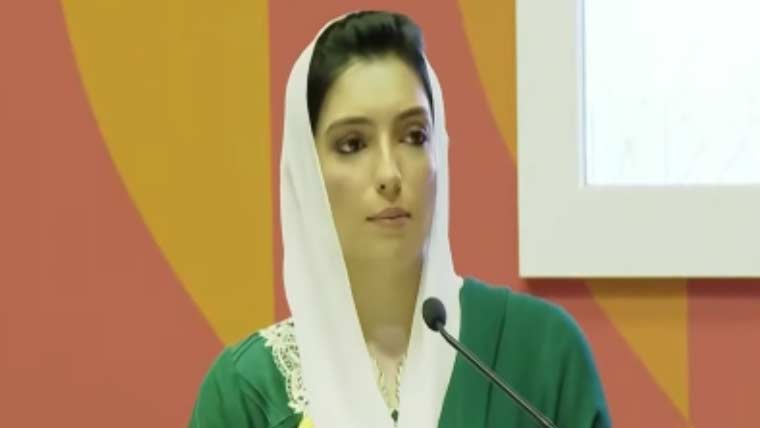
Doha: (Tassawar News) In a compelling address at an international conference on women’s empowerment in Doha, Pakistan’s First Lady, Asifa Bhutto, underscored a profound truth: the empowerment of women is the quintessential key to unlocking the doors of sustainable development. Her speech resonated with a powerful articulation of the critical, multi-faceted role women play in forging prosperous and inclusive societies globally. This declaration sets the stage for a deeper examination of both the philosophical and practical implications of achieving genuine gender equality, reinforcing it not merely as a social ideal, but as an indispensable economic and moral imperative for all nations.
Pakistan’s Stance on Gender Parity and National Progress
The First Lady emphasized an undeniable correlation between gender parity and the overall progression of a state. She asserted that the trajectory of national development is directly contingent upon the equal and robust participation of both men and women across all sectors of life. This perspective shifts the discourse from seeing women’s inclusion as a supplementary benefit to recognizing it as a fundamental requirement for holistic growth.
“The progress of any nation depends on equal participation of men and women in all sectors of life,” stated Asifa Bhutto, highlighting the essential symmetry required for societal advancement.
To illustrate this commitment, Asifa Bhutto detailed the transformative steps undertaken by Pakistan to uplift women, systematically promote gender equality, and ensure unfettered access to education, pivotal leadership roles, and substantive economic opportunities. These initiatives, she argued, are a direct reflection of a national vision aimed at dismantling systemic barriers. The narrative of progress, she pointed out, is inherently linked to the vision, courage, and resilience of Pakistani women themselves—individuals who are continually breaking barriers in diverse and demanding fields, ranging from politics and business to the sophisticated domains of science, technology, and the arts. This acknowledgment transforms the national effort into a tribute to the sheer will and tenacity of its female population.
Alignment with Global Goals: SDG 5 and Economic Imperative
Beyond national efforts, the First Lady extended her commendation to the global community’s sustained endeavors aimed at fostering gender balance and establishing equal opportunities for women across the world. Her remarks served to reaffirm Pakistan’s commitment to aligning its policies with overarching international goals, particularly those stipulated by the United Nations Sustainable Development Goals (SDGs). She specifically cited Goal 5, which mandates the global objective of achieving gender equality and empowering all women and girls, positioning it as a foundational pillar of Pakistan’s external policy.
A central, perhaps most persuasive, component of her address was the reframing of women’s empowerment as not just a social cause, but a critical economic imperative. The argument presented is lucid and compelling: when women are fully empowered to work, innovate, and lead, the dividends are universally beneficial. Nations that successfully implement such empowerment strategies inevitably experience stronger economies, marked by increased productivity and stability, alongside better governance, and the cultivation of healthier communities. The intrinsic value of female contribution, therefore, transcends the social domain and becomes an engine of macroeconomic prosperity.
“Empowering women is not merely a social cause—it is an economic imperative. When women are empowered to work, innovate, and lead, nations experience stronger economies, better governance, and healthier communities,” she passionately asserted, linking empowerment directly to national success.
She concluded this point by stating that true national development is only realizable when both women and men contribute equally and synergistically to the construction of a sustainable future. This assertion calls for a cultural and structural shift, moving away from traditional, restrictive models toward an inclusive, collaborative paradigm.
Initiatives for Inclusion and the Call for Collective Action
Asifa Bhutto provided concrete examples of Pakistan’s commitment, outlining strategic initiatives for women that are actively being implemented. These include the strategic expansion of access to education, which serves as the bedrock for all future opportunities. Additionally, the government is committed to supporting women entrepreneurs through sophisticated financial inclusion programs, designed to provide the necessary capital and resources for success. Furthermore, the focus on creating safer workplaces is crucial, directly addressing one of the most significant traditional barriers to women’s participation in the public sphere. These targeted policies are collectively aimed at removing the persistent barriers that have historically limited women’s participation in both the economy and public life.
She elevated the discussion further by connecting women’s empowerment with the overarching concepts of social justice, equality, and fundamental human dignity. By framing it as a matter of universal human rights, she imbued the initiative with deeper moral weight. In a final call to action, she strongly encouraged policymakers, civil society organizations, and the private sector to forge a powerful, unified front. The goal of this collaborative effort is to accelerate progress and ensure that, definitively, “no woman or girl is left behind”.
Conclusion: Transforming Societies Through Women’s Flourishing
The First Lady’s impactful address in Doha garnered significant appreciation from attendees, who acknowledged Pakistan’s evolving and growing commitment to empowering women, particularly at the vital grassroots level, and promoting inclusive economic growth.
In her conclusive statement, Asifa Bhutto synthesized her core message, reiterating that the act of empowering women transcends mere improvement of individual circumstances—it is fundamentally about transforming entire societies. The message is one of profound interdependence: when women thrive, communities flourish, leading nations inexorably closer to the aspiration of achieving lasting peace and sustained prosperity. The future of global sustainability, as articulated in her powerful speech, is inextricably linked to the full, equal, and empowered participation of every woman and girl. The door to this future is ready to be unlocked; the key, she persuasively argued, is in our collective hands.