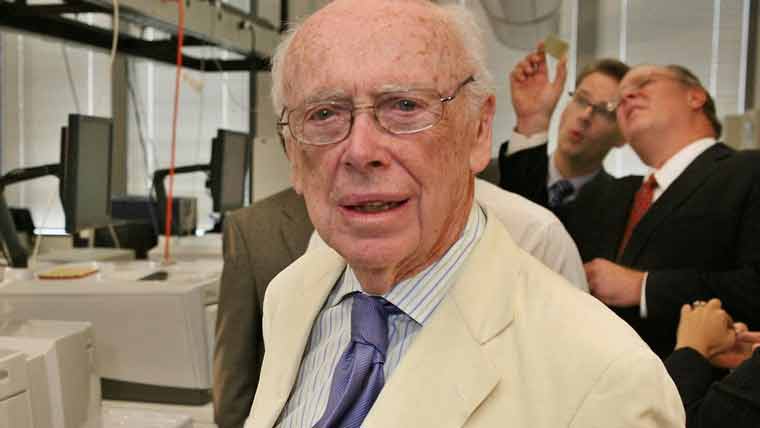
New York: (Tassawar News) The global scientific community is mourning the loss of a true pioneer: James Watson, the renowned American scientist who was jointly awarded the 1962 Nobel Prize in Physiology or Medicine for his epoch-making research on the structure of Deoxyribonucleic Acid (DNA). Watson passed away at the age of 97, a development that was officially confirmed by a spokesperson for the Cold Spring Harbor Laboratory (CSHL), the distinguished institution where he dedicated a substantial portion of his illustrious and impactful career.
Watson’s name is inextricably linked with one of the greatest scientific breakthroughs of the 20th century. Working alongside his esteemed colleagues, Francis Crick and Maurice Wilkins, he was instrumental in the elucidation of the double-helix structure of DNA in 1953. This singular discovery, first unveiled to the world in a seminal paper published in the esteemed scientific journal Nature, instantly became a cornerstone of modern science, fundamentally revolutionising the fields of molecular biology, genetics, and our understanding of heredity and core biological processes. His passing marks the end of an era defined by transformative biological discovery.
A Pursuit of Scientific Enlightenment
Throughout his long life, James Watson exemplified an unwavering commitment to intellectual curiosity and the rigorous pursuit of scientific truth. In reflective interviews conducted prior to his death, Watson often mused upon his profound and lifelong quest for fundamental discovery. He articulated a singular sense of purpose, emphasising that his core goal in life was to “explore the unknown and contribute to scientific understanding.”
“He emphasized that his purpose in life was to explore the unknown and contribute to scientific understanding. This dedication led to several transformative advancements in genetics and molecular biology.”
This deep-seated dedication was the driving force behind several transformative and irreversible advancements in the burgeoning fields of genetics and molecular biology. The fundamental scientific framework established by Watson’s initial research on DNA laid the groundwork for a vast and diverse array of subsequent genetic studies. These include the detailed mechanisms of DNA replication, the processes governing gene expression, and the colossal effort that became known as the Human Genome Project. His profound contributions continue to exert a powerful influence across numerous scientific domains, ranging from modern medicine and the development of targeted therapies to cutting-edge biotechnology, perpetually shaping how researchers approach complex challenges such as genetic disorders, cancer research, and the exploration of evolutionary biology.
The clarity and simplicity of the double-helix model provided the essential framework needed to ask and answer entirely new categories of biological questions, transforming a complex mystery into a systematic field of inquiry. Without Watson’s pivotal insight, the rapid pace of genetic advancement we see today would have been unimaginable.
Nobel Recognition and Enduring Mentorship
The supreme recognition of the discovery’s importance arrived in 1962, when Watson, Crick, and Wilkins were collectively bestowed with the Nobel Prize in Physiology or Medicine. The Nobel committee acknowledged that their research had provided the world with the first detailed and comprehensive explanation of how genetic information is securely stored, accurately transmitted, and faithfully copied—a true watershed moment in the entire history of scientific endeavour.
Watson’s enduring legacy extends far beyond the confines of his singular, monumental research achievement. He cultivated a remarkable career as a dedicated mentor, guiding and shaping the careers of countless students who went on to make their own marks on science. He also authored and published numerous influential scientific papers and texts, including The Double Helix, his highly popular personal account of the discovery process. Furthermore, his administrative and scientific leadership played a crucial role in the development and expansion of the Cold Spring Harbor Laboratory, transforming it into a globally renowned epicentre for advanced genetic and molecular research.
Transformational Global Impact
The 1953 discovery of DNA’s structure by Watson and his colleagues is universally acknowledged as one of the most significant scientific achievements of the 20th century. Its impact was immediate and long-lasting: it not only unlocked the secrets of life at the most fundamental molecular level but, crucially, also directly paved the way for the entirety of modern genetics, the rise of biotechnology, and the rapidly developing field of personalized medicine.
“The discovery of DNA’s structure is widely regarded as one of the greatest achievements of the 20th century. It not only unlocked the secrets of life at a molecular level but also paved the way for modern genetics, biotechnology, and personalized medicine.”
Watson’s collective contributions have positively impacted millions of lives globally. They form the foundational basis for breakthroughs ranging from the latest advancements in medical research and the creation of life-saving therapeutics, to essential technologies that enable dramatic progress in forensic science and criminal justice. The ability to sequence, manipulate, and understand DNA is a direct progeny of his initial insight.
Remembering a Visionary Pioneer
James Watson will be perpetually remembered as a visionary scientist whose relentless curiosity and total dedication to empirical evidence and discovery fundamentally transformed humanity’s understanding of life itself. His groundbreaking work has served, and will continue to serve, as a powerful inspiration for generations of subsequent researchers to delve deeper into the intricate mysteries of genetics and molecular biology.
As the scientific community and the world at large reflect upon his passing and mourn his loss, the profound echoes of Watson’s discoveries and his relentless pursuit of knowledge are assured to continue shaping and influencing the trajectory of science and, by extension, the welfare of humanity for many decades to come. His intellectual legacy is permanently woven into the fabric of modern life sciences.