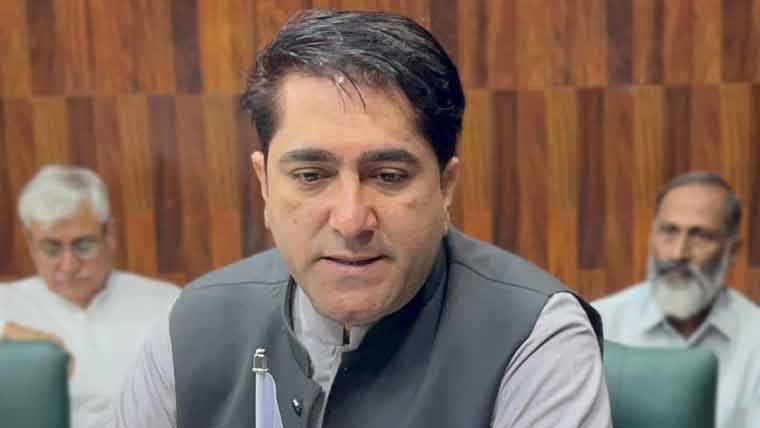
Islamabad: (Tassawar News) The political landscape of Pakistan is currently witnessing a significant point of friction at the confluence of digital media, provincial governance, and state authority, underscored by the recent initiation of legal proceedings against a sitting chief minister. In a development that has immediately amplified tensions between federal and provincial apparatuses, the Federal Investigation Agency’s (FIA) National Cyber Crime Investigation Agency (NCCIA) has formally instituted a case against Khyber Pakhtunkhwa Chief Minister Sohaib Afridi. This action, predicated on alleged breaches of the stringent Prevention of Electronic Crimes Act (PECA), was triggered by a formal complaint lodged by a private citizen at the Cyber Crime Reporting Centre in Islamabad.
The gravity of the situation is reflected in the nature of the allegations contained within the First Information Report (FIR). The provincial chief executive stands accused of deliberately employing social media platforms to disseminate content deemed false, misleading, and inflammatory. Crucially, the prosecution’s central premise is that these digital communications were designed with the explicit intent to detrimentally affect the public standing, reputation, and operational credibility of the nation’s key state and national security institutions. The FIR cites a spectrum of digital materials, encompassing several recorded video clips and various online posts, wherein the Chief Minister purportedly circulated baseless claims and widespread disinformation.
The Contentious Ambiguity of the PECA Framework
To fully appreciate the ramifications of this case, one must consider the contentious legislative environment provided by the PECA Act of 2016 (and its subsequent amendments, which have been subject to intense public and parliamentary debate). PECA was initially enacted to provide a comprehensive legal framework for combating serious cybercrime, including electronic fraud, unauthorised access, and malicious code. However, its provisions relating to digital defamation, hate speech, and the spreading of “false information” have drawn extensive criticism from civil society organizations, digital rights activists, and legal experts alike, who argue that the Act’s vague language grants overly broad powers to state authorities.
Sections of the Act dealing with the dissemination of information intended to malign state institutions are particularly sensitive, often leading to a challenging deliberation concerning the demarcation between legitimate political critique and criminal cyber-offence. The ambiguity inherent in such clauses necessitates a rigorous judicial scrutiny, ensuring that the law is not weaponised for the purpose of political victimisation. The very existence of such a case against a high-profile political figure reignites the perennial debate regarding the constitutional guarantees of freedom of expression versus the state’s duty to maintain public order and institutional integrity.
“The Prevention of Electronic Crimes Act (PECA) operates on a delicate frontier, attempting to curb digital excesses while simultaneously navigating the fundamental constitutional rights enshrined in Article 19, which guarantees freedom of speech, albeit subject to reasonable restrictions. This inherent tension means high-profile cases invariably become a litmus test for the democratic health of the nation’s digital public sphere.”
Detailed Exposition of the Allegations
The core of the matter, as articulated in the FIR, is the assertion that the content strategically published across various online platforms contained remarks possessing the demonstrable capacity to sow seeds of widespread public scepticism and animosity towards the government’s constitutional institutions. Investigators further contend that this digital material was not merely confined to individual or unofficial accounts but was systematically circulated from both personal and official political handles. This deliberate broadening of the dissemination reach is deemed a factor that significantly expanded the potential impact and velocity of the alleged defamatory content.
A particularly compelling point of evidence cited in the report relates to a media interaction conducted by Chief Minister Sohaib Afridi outside the confines of Adiala Jail. Authorities have categorised the pronouncements made during this public address as “factually incorrect and damaging statements” specifically targeting the roles and performance of key governmental and security apparatuses. Furthermore, the video recording of this controversial press talk was subsequently amplified and endorsed through its circulation on the official social media pages belonging to a major political party, thereby dramatically increasing its visibility and perceived endorsement. This aspect suggests a premeditated strategy to leverage established political infrastructure for the dissemination of the alleged disinformation.
Procedural Mechanics and Legal Defences
The Federal Investigation Agency (FIA) has underscored that the case has been initiated strictly under the relevant provisions of the PECA Act, which governs cyber offences such as digital defamation, the propagation of false information, and content strategically designed to destabilise public confidence in state organs. Sources within the FIA have elaborated that the impetus for the filing was a detailed submission from a private citizen, who claimed the viral videos had occasioned “serious reputational harm to national institutions” and possessed the potential to ignite public unrest. The agency’s subsequent procedure, involving a thorough preliminary review of the available digital evidence, preceded the official lodging of the FIR.
The immediate legal response from the Chief Minister’s side involved seeking judicial protection. Following the registration of the case, it became evident that the Chief Minister, fearing potential arrest, approached the Peshawar High Court (PHC) to secure protective transit bail. This proactive legal manoeuvring temporarily shields him from arrest, providing him the necessary window to approach the relevant trial court. This defensive legal action is often symptomatic of the high-stakes political environment that accompanies the application of PECA against powerful opposition figures. Subsequent attempts by the Chief Minister to meet his incarcerated party leader, which authorities reportedly obstructed despite court directives, further highlighted the charged political atmosphere surrounding the case.
Conclusion: Navigating the Digital Scrutiny and Due Process
This significant development inevitably underscores the accelerating scrutiny being applied to online political communication within Pakistan. The utilization of social media by public officials, once viewed merely as a tool for outreach, is now firmly situated within a complex legal framework demanding both responsibility and accountability under existing cybercrime legislation.
Ultimately, the legal process will be tasked with the formidable challenge of distinguishing between protected political discourse—which is vital for a functioning democracy—and content that crosses the threshold into criminally actionable misinformation or digital defamation. The outcome of this investigation, which is set to involve the collection of digital forensic evidence and verification of the circulated materials, will establish a critical precedent for future applications of the PECA Act. Political commentators universally agree that the handling of this matter is likely to exacerbate existing tensions between the federal and provincial spheres of influence. Nevertheless, legal experts maintain a cautious optimism, stressing that the integrity of the process depends entirely on the rigorous adherence to due process, ensuring that factual evidence, rather than political expediency, determines whether the Chief Minister’s statements constituted a clear and actionable violation of the relevant provisions of the PECA Act. The case serves as a profound indicator of the growing stakes in Pakistan’s digital political accountability landscape.