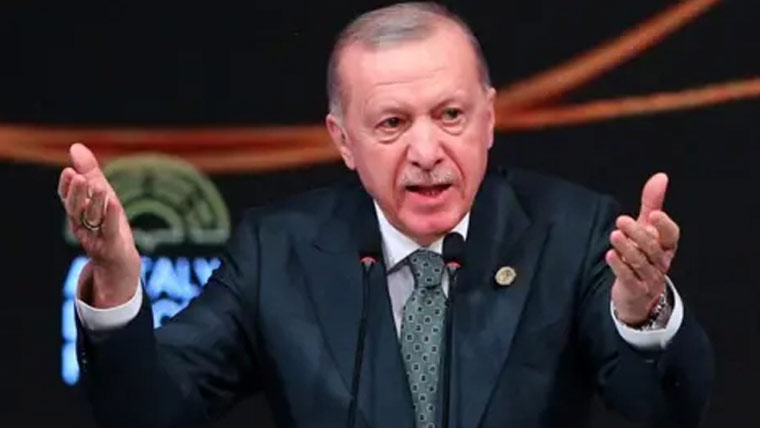
Ankara / Islamabad:: (Tassawar News) In a significant diplomatic intervention aimed at de-escalating the mounting tensions between Pakistan and Afghanistan, Turkish President Recep Tayyip Erdogan has officially confirmed that Turkey will dispatch a high-level delegation to Islamabad next week. This proactive step underscores Turkey’s commitment to regional stability and its willingness to leverage its diplomatic influence to facilitate dialogue between the two neighbours whose relations have been strained by persistent cross-border security concerns.
Ankara’s Delegation and the Rationale for Mediation
Speaking to journalists upon his return from an official visit to Azerbaijan, President Erdogan revealed the composition of the delegation, which is set to include some of Turkey’s most senior officials:
- Foreign Minister Hakan Fidan
- Defense Minister Yasar Guler
- Intelligence Chief Ibrahim Kalin
The collective presence of Ankara’s top diplomatic, security, and intelligence chiefs highlights the gravity with which Turkey views the current bilateral impasse. Their mission in Islamabad is to engage in robust diplomatic discussions specifically aimed at promoting peace and stability in the region by seeking pathways to resume the stalled Pakistan-Afghanistan negotiations.
President Erdogan’s comments also shed light on the recent breakdown in the Istanbul peace talks. He noted that the Afghan Taliban delegation that participated in the dialogue lacked a clear strategy and ultimately declined to sign a written agreement, which resulted in a regrettable stalemate. Sources further confirmed that the central point of failure in Istanbul was a fundamental disagreement over mechanisms to monitor cross-border terrorism, an issue that remains the core irritant in the bilateral relationship.
Talks Suspended and the Role of Mediators
The difficult conclusion of the Istanbul talks was officially confirmed by Pakistan’s Defence Minister, Khawaja Asif, who stated unequivocally that the negotiations had formally ended and were now “suspended indefinitely.” Despite this significant setback in formal diplomacy, a crucial face-saving measure was achieved: both sides agreed to maintain a temporary ceasefire along the shared border, a vital consensus intended to prevent any immediate escalation of hostilities and provide a necessary window for renewed diplomatic efforts.
Diplomatic sources have confirmed that both Turkey and Qatar played active and instrumental roles as mediators throughout the arduous Istanbul dialogue. This dual-nation effort underscores the international concern regarding the security dynamics in the South Asian region. Intriguingly, it was noted that there was no direct meeting between the Pakistani and Afghan delegations on the final, critical day of the talks, signalling the deepness of the impasse.
The Pakistani team in Istanbul was led by ISI Director General Lt. Gen. Asim Malik, while the Afghan delegation was headed by Abdul Haq Wasiq, Director General of Afghanistan’s General Directorate of Intelligence (GDI). The official position of the Pakistani side was later articulated by Foreign Office spokesperson Tahir Hussain Andrabi, who emphasised the thoroughness of their presentation:
The Pakistani side presented its position with “concrete evidence and documented proofs,” emphasizing the need for stronger cooperation to prevent militant groups from operating along the border.
Regional Concerns and Ankara’s Advantage
The suspension of talks has understandably heightened regional concerns, as a continued diplomatic vacuum risks escalating the current cycle of cross-border attacks and militant movements that have severely strained Pakistan-Afghanistan relations in recent months.
Analysts widely agree that Turkey’s decision to intervene is well-timed. Ankara’s longstanding ties with both countries and its carefully maintained neutral diplomatic stance position it uniquely as a highly suitable mediator in this complex and sensitive security situation.
Analysts believe Turkey’s proactive role could help bridge communication gaps between Islamabad and Kabul. Ankara’s longstanding ties with both countries and its neutral diplomatic stance make it a suitable mediator in this complex situation.
For the moment, the truce remains intact, which offers a fragile yet essential period for diplomatic manoeuvres. The forthcoming visit by the Turkish high-level delegation to Pakistan is therefore being viewed by observers as a critical opportunity to restart dialogue. Success in this endeavour is vital for avoiding a potential escalation that could severely destabilize the wider South and Central Asian region, affecting trade, security, and migration patterns across a broad swathe of the continent.
Conclusion: The Imperative for Constructive Engagement
The Turkish decision to deploy a high-level diplomatic and security mission to Pakistan signals a resolute commitment to facilitating a breakthrough in the frozen Pakistan-Afghanistan relationship. The immediate goal is clear: to leverage the current temporary ceasefire to rebuild communication channels and lay the groundwork for a credible, sustainable dialogue. Observers maintain hope that the constructive engagement, strongly supported by both Turkish and Qatari diplomacy, will ultimately help both Pakistan and Afghanistan to effectively address their shared security concerns and, in the long term, build a foundation for genuine regional stability. The success of Ankara’s initiative will be a defining factor in preventing a descent into further border conflict and securing a peaceful future for both nations.
Would you like me to research the details of the security mechanisms that Pakistan proposed during the Istanbul talks to monitor cross-border terrorism?