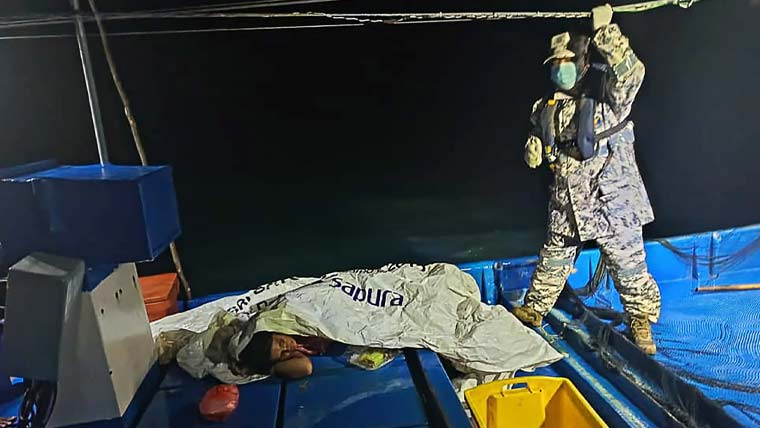
Kuala Lumpur: (Tassawar News) A tragic maritime disaster has unfolded near the Malaysia-Thailand border, resulting in a devastating loss of life after a boat carrying a large contingent of migrants capsized. The vessel, reported to be carrying approximately 300 individuals, faced catastrophic failure, leading to at least seven confirmed deaths and leaving a staggering number of passengers still missing. Early reports indicate that only ten people survived the ordeal, underscoring the severity of the catastrophe.
The Circumstances of the Perilous Journey
The doomed vessel had embarked on its journey three days prior from Buthidaung in Myanmar, carrying migrants desperate to seek safety and refuge in Malaysia. The entire operation was reportedly coordinated by ruthless human smugglers, who routinely exploit the vulnerability of persecuted populations.
Officials have shed light on the mechanics of the disaster, explaining that the journey involved a critical and dangerous maneuver: the transfer of passengers from the larger vessel onto three smaller boats, each intended to carry roughly 100 people. This risky partitioning was allegedly executed in an attempt to evade detection by authorities near the sensitive maritime border, a common tactic employed by trafficking networks.
Among the confirmed deceased is at least one woman. The small group of survivors includes three Myanmar nationals, two Rohingya, and one Bangladeshi. The vast majority of the passengers remain unaccounted for, prompting the launch of urgent, large-scale search and rescue operations by Malaysian maritime authorities.
Root Causes: Persecution and Perilous Crossings
The incident serves as a stark and tragic reminder of the ongoing migrant crisis in Southeast Asia, which disproportionately affects the Rohingya and other persecuted groups fleeing Myanmar. Officials explained that these migrants frequently resort to dangerous sea routes to escape systematic persecution, statelessness, widespread discrimination, and grave human rights abuses within their home country.
The perilous crossings are marked by extreme risk, as the boats used by smugglers are characteristically overcrowded and possess little to no safety equipment. These deliberate safety shortcomings significantly increase the risk of capsizing and mass fatality, turning the journey for refuge into a high-stakes gamble with life.
Officials explained that migrants, including Rohingya, frequently risk dangerous sea routes to escape persecution in Myanmar, where they face statelessness, discrimination, and widespread human rights abuses.
Rescue Efforts and Initial Response
The Malaysian maritime authorities from the states of Kedah and Perlis immediately spearheaded the rescue efforts following the disaster. Admiral Romli Mustafa, the head of the maritime authority for the region, confirmed the ongoing, intensive efforts to locate the numerous missing migrants.
The ten survivors are currently receiving crucial medical care, food, and shelter provided by the authorities. Police in Kedah, reporting via the national news agency Bernama, verified that the entirety of the boat’s manifest was attempting to reach Malaysia in search of refuge. The authorities concurrently issued a severe warning about the continued risks associated with these journeys, noting that smugglers consistently opt for unsafe routes specifically to avoid official detection, showing a callous disregard for the migrants’ safety.
Humanitarian Outcry and Call for Regional Action
This catastrophic incident highlights the persistent failures of regional governance to address the humanitarian needs of the Rohingya population. Human rights organisations have renewed their calls for governments across the region to facilitate safer, legal migration routes and to dramatically increase the provision of essential humanitarian support.
The tragedy fundamentally underscores the extreme dangers posed by human trafficking networks, whose operations are based on profit over human life, leading to fatalities in overcrowded and poorly maintained vessels. International aid agencies have strongly urged enhanced coordination between the governments of Thailand, Malaysia, and Myanmar to establish effective mechanisms that can prevent further such catastrophic loss of life at sea.
The tragedy underscores the dangers of human trafficking networks, with overcrowded and poorly maintained vessels often resulting in fatalities. International aid agencies have urged enhanced coordination between Thailand, Malaysia, and Myanmar to prevent further loss of life.
The ongoing rescue operations necessitate public vigilance and assistance. Authorities are appealing to the public to provide any information or support that could help locate those stranded or in distress along the maritime border, acknowledging that the sheer scale of the missing requires a collective effort.
Conclusion: The Urgency of Safe Passage
The capsizing of the migrant boat off the Malaysia-Thailand border is a profound humanitarian catastrophe that reflects the dire circumstances of persecuted communities in Southeast Asia. It serves as an undeniable indictment of the existing political environment that compels individuals to entrust their lives to dangerous trafficking networks. While the immediate focus remains on the critical search and rescue efforts for the dozens still missing, the incident necessitates a wider, systemic response. Governments in the region must move beyond simply policing borders and instead prioritize the creation of safe and legal pathways for those seeking refuge, while simultaneously dismantling the ruthless human smuggling operations that profit from such desperation and death. The only way to honour the lives lost is through immediate, coordinated action to prevent future maritime tragedies.
Would you like me to find out about the specific details of the human rights abuses currently faced by the Rohingya population in Myanmar?