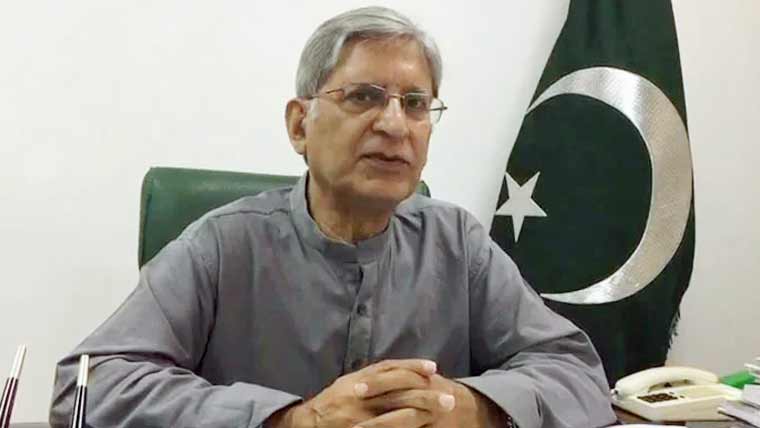
Islamabad: (Tassawar News) The recent commentary provided by Aitzaz Ahsan, a preeminent constitutional lawyer and seasoned political stalwart, offers a piercing analysis of the precarious judicial environment in Pakistan. Delivered during a high-profile interview on Dunya News, his remarks meticulously scrutinise both the internal vulnerabilities of the judiciary and controversial legislative provisions, particularly those concerning executive authority. Ahsan’s central concern is the preservation of institutional integrity amidst profound political turbulence.
The Peril of Premature Judicial Resignations
Ahsan’s primary caution was directed at the potential ramifications stemming from the abrupt resignation of judges at a time of national sensitivity. He expressed considerable alarm that such precipitous departures could effectively cultivate an atmosphere of systemic uncertainty for the government and, crucially, for the institutions entrusted with maintaining the nation’s legal stability. This goes beyond mere political inconvenience; Ahsan positions the judiciary as the bedrock of the democratic framework.
In a system grappling with a persistent democratic deficit, the strength and endurance of any democratic structure are directly proportional to the consistency and credibility of its judicial framework. When senior judicial officers elect to resign suddenly, it inevitably sparks profound concern among the citizenry regarding the continuity and ultimate outcome of critical ongoing legal proceedings. Ahsan firmly asserted that maintaining continuity within the judiciary is not merely advisable but absolutely essential to safeguard public trust and ensure the unhindered, smooth operation of the entire legal mechanism. The departure of judges is not a silent act; it sends an unmistakable signal of institutional distress that can be exploited for political gain, thus undermining the foundational principle of the rule of law.
“The abrupt withdrawal of judicial officers, particularly at a critical juncture, carries the grave potential to inject an unnecessary and destabilising uncertainty into the very heart of the state apparatus. The judiciary’s moral and operational consistency is the lynchpin of public confidence in the democratic structure.”
The Call for Internal Accountability
Moving to the broader structural issues, Ahsan placed significant emphasis on the indispensable necessity of internal accountability within the judicial sphere. He argued persuasively that any public institution, including the apex judiciary, has an ethical and operational obligation to critically assess its own past decisions and overall performance. This introspection, he posited, is vital for long-term institutional health.
Ahsan observed that the judiciary’s historical challenges have stemmed not solely from explicit external pressures, but often from decisions and policies formulated within the system itself. Consequently, he advocated for a focused strategy aimed at strengthening internal mechanisms of transparency and accountability. The goal of this self-scrutiny is not punitive but constructive: to fortify the institution against future crises and build a more resilient foundation for national legal stability. True independence, in Ahsan’s view, can only be secured when the institution is demonstrably accountable to its own principles and to the Constitution it is sworn to uphold.
Constitutional Debate: Executive Immunity and Benazir Bhutto’s Stance
Ahsan then addressed the controversial subject of presidential immunity, particularly the conferral of lifelong immunity upon the head of state. He unequivocally stated that such far-reaching constitutional protections warrant scrupulous reconsideration to maintain the delicate balance and fundamental fairness requisite in a just democracy. His perspective implies that absolute, perpetual immunity tilts the constitutional scales dangerously toward executive overreach.
To underscore his argument, Ahsan drew a powerful parallel with the constitutional vision of the late former Prime Minister, Benazir Bhutto. He suggested that, were she alive today, she would likely not have supported such an extensive form of presidential immunity. Ahsan’s recollection is rooted in her consistent political philosophy. He emphasised that Bhutto invariably valued the pre-eminence and authority of the Chief Justice’s office and was deeply committed to empowering legal institutions.
“Benazir Bhutto’s constitutional ethos, which I witnessed first-hand, was one of unwavering deference to the Chief Justice’s office. It is highly improbable that her commitment to the rule of law would have permitted her to endorse any provision granting perpetual, unchecked immunity to the President.”
His testimony frames Bhutto’s historical stance on judicial independence as clear and unyielding throughout her political career, offering a benchmark for contemporary politicians to measure their own commitment to constitutionalism.
The Timing of Resignations: A Tactical Assessment
Reflecting on the recent specific actions, Ahsan characterised the judges’ decision to resign as potentially premature. He maintained the position that they should have exercised greater restraint and awaited the organic unfolding of ongoing judicial processes before taking such a decisive and irreversible step. A sudden resignation, he cautioned, can cause unnecessary administrative confusion and may detrimentally affect the pending legal matters that require consistent judicial supervision and finality. His counsel here is one of strategic patience—that an institutional protest must be timed for maximum effect and minimum institutional disruption.
Conclusion
Aitzaz Ahsan’s comprehensive remarks underscore a crucial political-legal axiom: the judiciary’s role is central to shaping and sustaining a nation’s democratic values, and thus, every major internal development directly impacts national governance. His analysis serves as a powerful imperative for deeper reflection on how judicial decision-making, institutional structure, and constitutional provisions collectively influence Pakistan’s trajectory toward democratic consolidation. By prioritising stronger internal accountability, adopting balanced constitutional practices, and demonstrating responsible decision-making, the country’s legal and political systems possess the potential to evolve in a direction that safeguards the rule of law and preserves judicial autonomy.