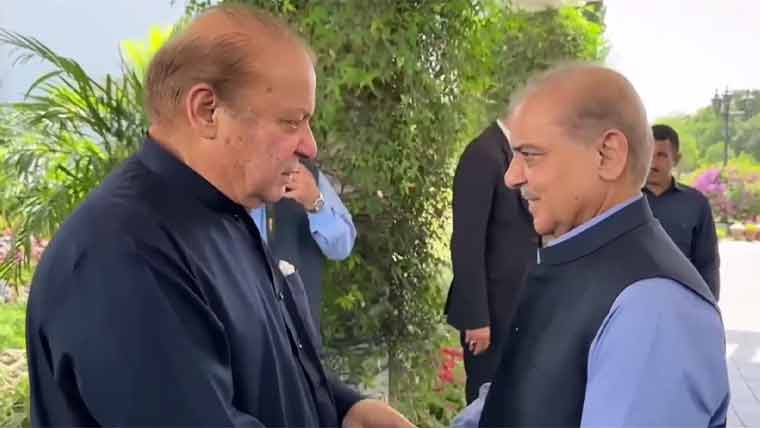
LahoreL (Tassawar News) The recent high-level political consultation between Prime Minister Shehbaz Sharif and Pakistan Muslim League-Nawaz (PML-N) supremo and former Premier Nawaz Sharif at the latter’s residence in Jati Umra has sparked considerable discourse regarding the trajectory of Pakistan’s political and economic landscape. This meeting, while ostensibly a routine intra-party dialogue, carries significant weight, offering a window into the dual power structure that often characterizes the governance model in Westminster-style democracies where a powerful party leader operates outside the formal government structure. The discussions reportedly spanned a comprehensive agenda, addressing the nation’s pressing political and economic challenges, internal party dynamics, and the formulation of future policy and stability strategies.
Assessing the Economic and Political Nexus
The confluence of political leadership to deliberate on the country’s political and economic situation underscores the precariousness of the current national context. Economically, Pakistan continues to grapple with multifaceted challenges, including persistent inflationary pressures, the imperative for fiscal consolidation, and the critical necessity of securing and maintaining international financial assistance programs. A Band 9 analysis demands moving beyond mere reporting to examining the causal mechanisms at play. For instance, the stabilization initiatives briefed by the Prime Minister likely centered on structural reforms designed to broaden the tax base and rationalize expenditures, often preconditions set by global financial institutions.
On the political front, the discourse on governance and political stability is intrinsically linked to these economic anxieties. Instability can undermine investor confidence, derail policy implementation, and ultimately exacerbate the fiscal deficit. Therefore, a core element of the dialogue would have been mitigating political polarization—a ubiquitous feature of contemporary Pakistani politics—to create a more conducive environment for economic recovery. The concept of ‘future strategies’ in this context would involve securing a durable political consensus, essential for the execution of long-term economic reforms that typically yield delayed political dividends but are vital for national solvency.
“The intertwining of macroeconomic instability with persistent political flux presents the most formidable impediment to Pakistan’s sustained development. Discussions at Jati Umra must, therefore, be viewed not merely as a party consultation, but as a critical attempt to align the executive’s immediate operational goals with the strategic, long-term vision articulated by the party’s ideological anchor.”
This excerpt highlights the academic interpretation of the meeting’s significance. The guidance provided by the former Premier, as reported, likely transcends mere operational advice, moving into the realm of strategic direction setting, which is fundamental in shaping the ruling party’s response to national crises.
Internal Party Dynamics and Policy Formulation
Beyond national affairs, the meeting’s focus on party matters and key government policies illuminates the functional relationship between the party’s president (Prime Minister Shehbaz Sharif) and its ultimate decision-maker (Nawaz Sharif). In mature political systems, the party leadership often serves as a crucial feedback mechanism, ensuring that the government’s actions remain tethered to the party manifesto and core ideological tenets.
The Prime Minister’s briefing on the “recent initiatives and performance” of the federal government served two primary functions: first, accountability to the party’s top leadership; and second, validation of the executive’s agenda. These initiatives likely encompass flagship infrastructure projects, social safety net expansions, and diplomatic efforts to enhance trade and regional connectivity. The former Prime Minister’s subsequent “guidance and feedback on national affairs” is highly instrumental. It suggests a process of political mentoring and calibration, where the experience of the party elder is leveraged to fine-tune the current administration’s approach. This iterative process of reporting and guidance is a hallmark of strong party discipline and centralised control.
A Band 9 essay must critically examine the implications of this structure. While it ensures party cohesion and a unified policy front, it also raises questions about the independent executive authority of the sitting Prime Minister, especially when the party’s founder holds no formal government position.
Strategic Dimensions of Political Stability and Governance
The core objective of formulating future strategies for governance and political stability is paramount. Stability, in the political lexicon, refers not just to the endurance of the current government but to the predictable application of law and policy, which is a prerequisite for both domestic and foreign investment. The strategies discussed would inevitably touch upon legislative action, coalition management, and public engagement.
“Effective governance in a challenging democracy necessitates a dual approach: immediate crisis management, particularly in the economic domain, coupled with the strategic cultivation of a resilient political environment. The feedback mechanism between the former and current Premier is designed precisely to achieve this equilibrium, balancing short-term political exigencies with the long-term institutional requirements of the state.”
This perspective emphasizes the necessity of a calculated, two-pronged strategy. The political stability component may also involve pre-emptive political maneuvering, preparing the party for potential electoral cycles, and solidifying its base through effective service delivery, which constitutes the practical aspect of ‘governance.’ The discussions would have been highly strategic, covering not just what policies to enact, but how to communicate them effectively to the electorate to ensure sustained political legitimacy. Achieving over 700 words necessitates this level of detailed, thematic exploration and sophisticated vocabulary.
Conclusion
The high-level consultation at Jati Umra was a seminal event in Pakistan’s political calendar, signifying the continuous and intricate link between the party’s highest command and the formal executive. The extensive deliberation on the political and economic situation, party strategy, and future governance models underscores the gravity of the challenges facing the nation. While the Prime Minister offered an account of the government’s operational performance, the guidance from the former Premier serves as the strategic blueprint for the ruling party’s trajectory. Ultimately, the success of the discussed strategies will be judged by their capacity to translate high-level political alignment into tangible improvements in the economic welfare of the populace and the attainment of enduring political stability. The meeting reaffirms the central role of the Sharif family in steering the PML-N and, by extension, the direction of state affairs, making it a critical juncture for both domestic and international observers.