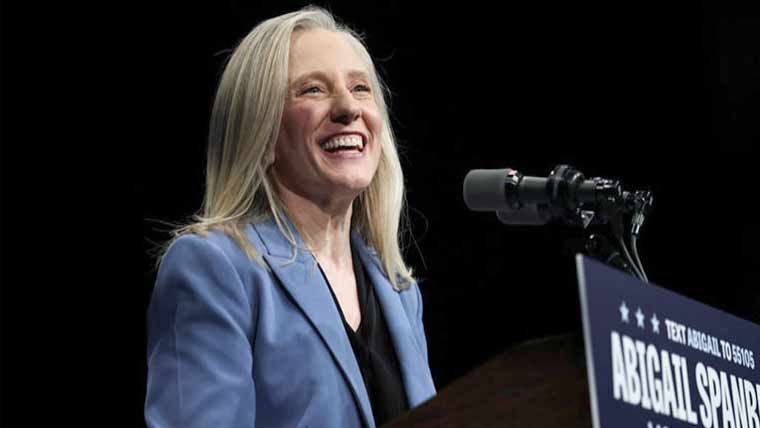
Virginia: (Tassawar News) The political landscape of Virginia has witnessed a profound transformation with the Democratic Party securing a historic double victory, ushering in an unprecedented era for female leadership in the Commonwealth. The election saw Abigail Spanberger ascend to the office of Governor, becoming the first woman ever to hold the state’s highest executive position. This landmark achievement was complemented by the election of Ghazala Hashmi as the state’s first Lieutenant Governor, a milestone that carries immense significance for representation and diversity within American politics. The electoral results not only solidify Democratic political strength but also establish a new paradigm for governance that reflects the evolving demographic and social fabric of Virginia.
The Governor’s Race: Electoral Triumph and Historical Precedent
Abigail Spanberger’s victory over the Republican candidate, Winsome Earl Sears, was definitive, establishing a clear mandate from the electorate. According to the official figures released by the election commission, Spanberger amassed a substantial vote tally of 784,763, decisively surpassing Sears, who secured 649,937 votes. The margin of victory underscores a pronounced shift in voter preferences and a demonstrable rejection of the opposing platform.
Spanberger’s electoral triumph is not merely a political win; it constitutes a pivotal moment in the state’s socio-political history. By becoming the first woman to lead the Commonwealth, she has shattered a long-standing political barrier, signalling a powerful advancement for gender equality in the most senior echelons of American state government. Her tenure is anticipated to inaugurate a new chapter, characterized by policy priorities and governance styles that may differ markedly from those of her male predecessors. The success of her campaign speaks to the growing acceptability and desire among voters for female executive leadership, particularly in traditionally competitive or moderate states like Virginia.
“The electoral commission’s figures, showing a margin of over 134,000 votes, demonstrate a robust popular mandate for Abigail Spanberger. This victory is not simply partisan; it represents a momentous structural breakthrough, forever altering the precedent for executive leadership in the Commonwealth of Virginia.”
Ghazala Hashmi: Elevating Minority Representation
Equally consequential is the election of Ghazala Hashmi as Lieutenant Governor. Hashmi’s political trajectory has been marked by a series of significant “firsts,” previously having secured a historic win as Virginia’s first Muslim and South Asian senator. Her elevation to the Lieutenant Governorship continues this pattern of pioneering representation. This achievement is a source of considerable pride and attention, particularly within the Indian and Pakistani diaspora communities, who view her success as a powerful affirmation of the potential for minority participation and achievement in mainstream American political life.
Hashmi’s election resonates deeply with the growing push for greater inclusivity in state and national governance. As a Muslim woman with South Asian roots, her presence in such a high-ranking executive position is being universally hailed as a watershed moment. It fundamentally challenges historical norms of representation, suggesting that the electorate is increasingly willing to look beyond conventional political profiles. Her position provides a visible, high-level platform for issues pertinent to immigrant, minority, and South Asian communities, thereby enriching the diversity of perspectives brought to bear on state policy decisions.
Broader Political Implications for the Democratic Party
This dual victory reinforces the Democratic Party’s strong performance and increasingly dominant position within Virginia. Historically a swing state, Virginia has shown a clear leftward drift in recent election cycles, a trend consolidated by the election of Spanberger and Hashmi. This sustained electoral success can be attributed to several factors, including the state’s rapidly diversifying population, the influence of the Washington D.C. metropolitan area’s economy, and strong Democratic organization around issues such as education, healthcare, and progressive social policies.
The success of the Democratic ticket is also a testament to effective coalition-building, uniting traditional Democratic bases with new demographic groups. The combined victory allows the party to exert complete control over the executive branch and potentially strengthens its hand in the state legislature, facilitating the passage of its core legislative agenda. For the Democratic Party nationally, the result provides a crucial model of how to achieve and sustain power through the mobilization of diverse, educated, and urban-suburban voting blocs.
“Ghazala Hashmi’s election as Lieutenant Governor is not merely a statistical footnote of diversity; it is a profound political statement, signaling a new level of acceptance and integration for Muslim women and South Asian Americans into the upper echelons of the American democratic system.”
The election of two highly qualified women to the top two executive offices simultaneously sets a powerful international example. It demonstrates the vitality of American democracy in its capacity to break traditional moulds and foster inclusivity, offering a template for other democracies grappling with issues of representation. The political and social implications of this election are therefore not confined to the boundaries of the Commonwealth; they ripple outwards, influencing national political narratives and international perceptions of American democratic progress.
Conclusion: A Mandate for Inclusive Governance
The electoral success of Abigail Spanberger as Governor and Ghazala Hashmi as Lieutenant Governor marks an epochal moment in Virginia’s history. Spanberger’s victory represents the shattering of the ultimate glass ceiling in state politics, while Hashmi’s election solidifies the growing political influence and visibility of America’s diverse minority communities. The definitive nature of the gubernatorial vote count provides a clear mandate for the incoming administration to pursue its policy objectives with authority. Collectively, these results signal a significant transformation in Virginian leadership, demonstrating a clear public preference for inclusive governance, progressive policies, and diverse representation. The Commonwealth is thus poised to embark on a new political chapter defined by its first-ever female-led executive team, an outcome that will undoubtedly inspire women and minorities in politics across the nation and globally.