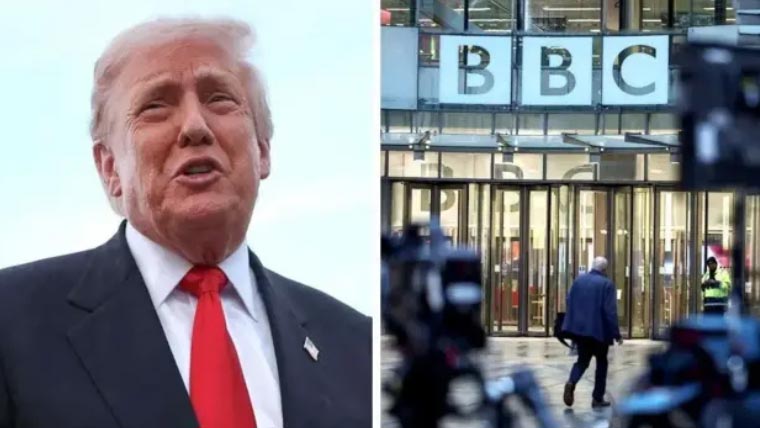
London: (Tassawar News) The British Broadcasting Corporation (BBC), a globally recognized public service broadcaster, recently found itself at the centre of a significant media controversy, prompting a formal apology and intense internal review concerning its editorial practices. The imbroglio arose following the airing of an edited segment featuring a statement by former U.S. President Donald Trump, which, according to the organisation itself, unintentionally created the misleading impression that the President had directly advocated for violence. This incident has reignited extensive discussions among media analysts and the public regarding the critical importance of accuracy, transparency, and responsible reporting, particularly when handling politically sensitive material.
The Genesis of the Editorial Error
The core of the dispute stemmed from a segment broadcast on the BBC’s investigative programme, Panorama. The network acknowledged that the problematic editing had inadvertently altered the context of President Trump’s remarks. In its detailed explanation published in the corrections and clarifications section, the BBC elaborated on the precise nature of the editorial lapse:
“The broadcaster acknowledged that the arrangement of clips made it seem as though President Trump’s speech was presented in a continuous sequence, when in fact it consisted of excerpts from different moments. This presentation unintentionally led some viewers to assume that the President had explicitly encouraged violent conduct, a perception the BBC publicly acknowledged as misleading.”
This detailed admission highlights a crucial ethical pitfall in modern news production: the deceptive impact of selective juxtaposition. By presenting disparate fragments of a speech as a seamless, continuous narrative, the editorial decision fundamentally altered the perceived intent of the speaker, causing a significant misrepresentation of the original discourse. In response to the backlash, the BBC took immediate corrective action, confirming that the program containing the edited content would not be rebroadcast and that the specific clip had been subjected to a rigorous internal editorial review aimed at preventing future recurrences of such an error.
Legal Ramifications and Leadership Changes
The fallout from the edited segment swiftly escalated beyond mere public critique and into the legal arena. Legal representatives for President Trump issued a formal communication, raising the stakes considerably by threatening to pursue a one billion dollar lawsuit against the BBC. The demanding letter stipulated several prerequisites for avoiding legal action, specifically requiring the BBC to issue a formal apology, publish an official correction across its platforms, and provide substantial financial compensation for the damage reputedly caused by the misleading broadcast.
Adding dramatic weight to the controversy, the unfolding debate over editorial standards and institutional responsibility coincided with the simultaneous resignations of two senior figures within the organisation: Tim Davie, the BBC Director General, and Deborah Turness, the Head of News. Although the BBC did not explicitly link these departures to the specific editing controversy, the timing naturally amplified public speculation about the internal pressures and accountability mechanisms at play within the public broadcaster’s upper echelons. Such high-profile resignations during a period of intense scrutiny invariably underscore the gravity of failures in journalistic integrity and governance.
The BBC’s formal legal department subsequently responded in writing to the claims put forth by President Trump’s attorneys. While a spokesperson for the broadcaster confirmed that the organisation “deeply regretted the editing error,” they also firmly maintained that the BBC “strongly disagreed with the suggestion that a defamation claim was justified.” Furthermore, Samir Shah, the Chairman of the BBC, demonstrated a commitment to direct communication by writing a separate, personal letter to the White House to formally express regret concerning the specific editing approach applied to the President’s January 6, 2021, speech.
A Broader Context of Scrutiny
The incident involving the edited Trump clip did not occur in isolation. The formal apology and the subsequent internal reviews emerged at a juncture when the BBC’s overall editorial practices were already under heightened scrutiny. A precedent for such concerns had been set in 2022, when The Daily Telegraph reported a similar issue concerning an edited clip used on the current affairs programme Newsnight. These repeated episodes have prompted wider industry-wide discussions focusing on the non-negotiable standards of accuracy and media accountability in an increasingly polarized and fast-moving news environment.
Following the public release of the apology, BBC News proactively reached out to the White House to secure an official comment, signalling an attempt to maintain a professional, journalistic line of communication despite the strained circumstances. This approach, combined with the commitment to internal review, highlights the organisation’s efforts to manage the crisis while reinforcing its stated commitment to high editorial standards.
Conclusion: The Unwavering Need for Precision and Trust
The controversy surrounding the BBC’s edited segment of the U.S. President’s speech serves as a salient and powerful case study on the paramount importance of precision and transparency in contemporary news reporting. It underscores the profound responsibility that major news organisations bear, particularly when navigating politically sensitive terrain where even minor editorial alterations can drastically reshape public perception and incite major legal or political disputes.
The BBC’s robust response—encompassing the formal public apology, the immediate removal of the offending content, the official legal defence against the defamation claim, and the explicit commitment to enhancing verification processes—demonstrates the organisation’s earnest attempts to reinforce public trust. As global media landscapes continue their rapid evolution, characterised by the instantaneous dissemination of information, maintaining unambiguous clarity and absolute precision in all reporting remains the essential cornerstone for preserving public confidence in the integrity of the news industry and the democratic functions it supports. The incident, therefore, acts as a crucial reminder to all media professionals that journalistic ethics are not abstract ideals but concrete practices with significant real-world consequences.