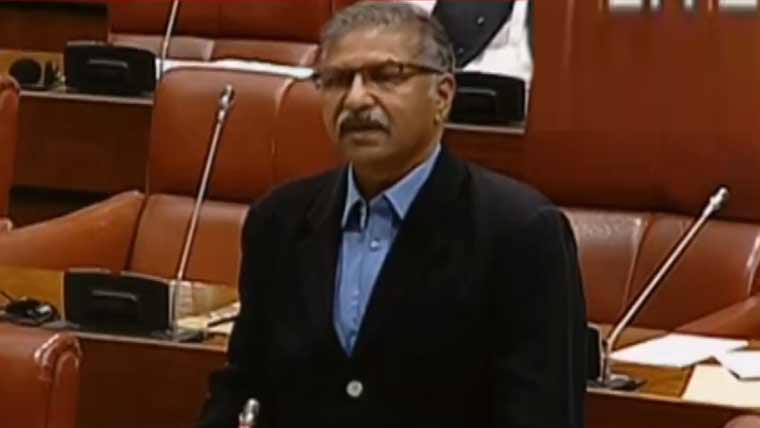
Senator Ali Zafar, the Parliamentary Leader for the Pakistan Tehreek-e-Insaf (PTI), has voiced a powerful and unyielding opposition to the proposed 27th Constitutional Amendment, delivering a stern warning about the potential catastrophic consequences for the nation should its foundational constitutional structure be disturbed. Speaking eloquently in the Senate, Zafar meticulously laid out the reasons for PTI’s absolute refusal to support the amendment, urging a collective, cross-party stand against what he perceives as a dangerous act of constitutional tampering.
The Five Pillars of State and the Threat of Disaster
Senator Zafar framed the Constitution of 1973 not as a malleable document subject to the whims of a temporary majority, but as the bedrock of the Pakistani state, belonging “to the entire nation.” He articulated a fundamental constitutional principle, asserting that the state’s entire legal and political architecture rests upon five core foundational pillars:
- Parliament
- Executive
- Judiciary
- Federation
- Fundamental Rights
The PTI leader warned in the strongest terms that weakening or removing even one of these pillars would inevitably lead to a “great disaster” for Pakistan. This emphasis on the delicate balance of power established in 1973 serves as the central argument against the proposed amendments. Any attempt to compromise this equilibrium, in his view, is an existential threat to the constitutional order.
“The Constitution was not made for one person or one party; it belongs to the entire nation. Disturbing even one of the Constitution’s five foundational pillars would bring ‘great disaster’ to the country.”
⏳ Rushed Legislation and the Erosion of Consensus
A significant point of contention raised by Senator Zafar is the alarming speed with which the current government coalition is attempting to push the amendment through the Parliament. He drew a crucial contrast between the present process and historical precedents for major constitutional overhauls. He reminded the House that past, transformative amendments, including those enacted under periods of martial law, were preceded by months of extensive national debate and consultation.
The Senator specifically cited the 18th Amendment, a landmark piece of legislation that strengthened provincial autonomy, noting that it required “nine months of consultation.” In stark contrast, Zafar lamented that the present proposal is being rushed through without achieving the necessary political consensus. This lack of consensus is, for PTI, a fatal flaw, invalidating the legitimacy of the entire process.
Zafar drew a clear distinction between a majority and consensus, arguing forcefully that simple arithmetic is insufficient for amending the core foundation of the state.
“Without consensus, no constitutional amendment can gain legitimacy. Any amendment passed by a disputed or unrepresentative parliament will not be accepted by the nation.”
He expressed profound skepticism regarding the ruling coalition’s motives, claiming that the outcome was predetermined even before the legislative debate had commenced, leading him to accuse the government of attempting to “dismantle the very foundation of the building.”
Judicial Independence: The Primary Target
The most urgent threat identified by Senator Zafar lies in the proposed changes to the Judiciary. The draft amendment, he claims, poses a direct and immediate danger to the independence of the courts. His criticism centered on two controversial proposals:
- Creation of a Federal Constitutional Court: Zafar alleged that this new body is designed to effectively demote the Supreme Court, reducing it to the status of a “Supreme District and Sessions Court.”
- Presidential Appointment of Judges: The proposed authority for the President to appoint judges—a process that Zafar fears will result in “hand-picked and politically influenced” individuals—is seen as a direct assault on the separation of powers.
Furthermore, he strongly objected to the provision allowing for the transfer of judges without their consent. He warned that this measure is essentially a coercive tool, intended to force judges into early retirement or otherwise bring the entire judiciary under the executive’s direct control.
He also criticized the proposal to grant life-long immunity to the President and Governors, denouncing it as an alarming step toward unaccountability and an undermining of democratic principles.
Upholding Civilian Supremacy and Federalism
Beyond the judiciary, Senator Zafar underscored the importance of two other critical pillars: civilian supremacy and the federal structure. He emphasized that PTI, as a political entity representing millions of citizens, believes its founder’s removal and the subsequent political manoeuvres have already disrupted the constitutional balance. He alleged the misuse of judicial mechanisms to undermine the public’s clear mandate.
On federalism, Zafar reaffirmed that Pakistan is fundamentally a federal state where the provinces enjoy constitutionally guaranteed autonomy. He stressed that Parliament itself derives its entire authority from the people’s vote and must therefore remain strictly bound by the established constitutional framework.
Conclusion: Focus on Substantive Justice
In his concluding remarks, Senator Zafar shifted the focus from institutional power plays to the practical needs of the ordinary citizen. He issued a final plea to his fellow lawmakers: reject the current draft amendment and instead dedicate collective legislative effort toward substantive judicial reforms.
The PTI leader highlighted the overwhelming crisis in the lower courts, noting that while the Supreme Court handles only about 2% of all cases, a staggering 98% remain pending in the lower judicial system. He argued that true commitment to justice requires fixing the system where it impacts the “ordinary citizens” most directly, rather than “weaken[ing] the institutions that uphold the Constitution.”
Senator Zafar’s address therefore serves as a comprehensive warning: the push for the 27th Amendment is not a quest for reform but a perilous attempt to fundamentally restructure the power dynamics of the state, threatening the balance between the executive, parliament, judiciary, and the inherent rights of the Pakistani people. His call is for a principled rejection of rushed legislation in favour of a consensual, meticulous approach to constitutional change.
Would you like me to elaborate on the historical context of the 18th Amendment or detail the specific constitutional articles that Senator Zafar’s objections might be referencing?