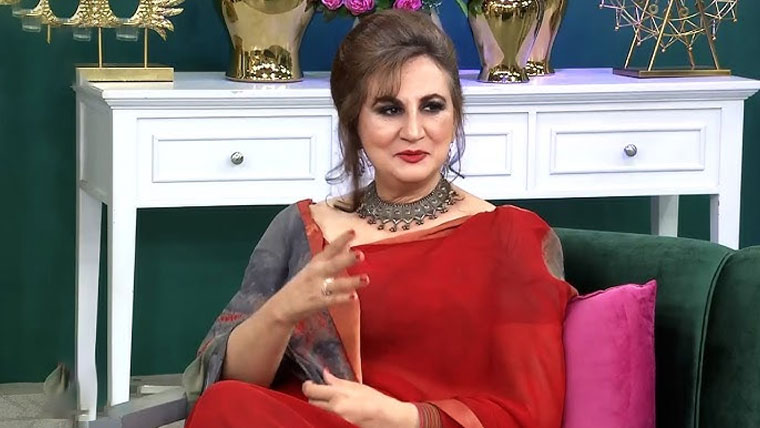
Lahore: (Tassawar News) The celebrated Pakistani veteran actress Sania Saeed, known for her consistent portrayal of complex and socially resonant characters, has contributed a powerful and thought-provoking analysis to the ongoing discussion regarding the perception and representation of women in South Asian societies. In a candid and highly illuminating podcast conversation, Saeed lamented the societal limitations placed upon women and strongly critiqued the Pakistani media’s failure to depict the multifaceted reality of female existence, particularly beyond the traditional markers of youth and marriage. Her insights challenge the foundational premises upon which female narratives are constructed in both the cultural sphere and mainstream entertainment.
The Societal Confinement of Womanhood
Saeed’s primary critique was directed at the deeply entrenched cultural tendency to narrow a woman’s worth exclusively to her reproductive capacity. She observed that this limited perception effectively dismisses a woman’s individuality, personal ambitions, and trajectory of personal growth outside of her familial role.
She articulated this societal confinement with striking clarity:
“In our culture, a woman is treated as if her only purpose is to give birth and raise children. Her life’s real journey begins after the age of 35 — but our television dramas rarely show stories of women beyond that age.”
This statement highlights a profound contradiction: while life experience, wisdom, and the true complexity of character often develop significantly after the prime child-bearing years, the cultural narrative deliberately ignores this substantial phase of a woman’s life. By equating maturity with a lack of narrative visibility, society effectively renders women over the age of 35 invisible or irrelevant in public storytelling, denying their experiences and evolution.
The Narrow Lens of Media Representation
The actress specifically addressed how the persistent influence of outdated gender norms is visibly reflected and perpetuated through Pakistani television content. She argued that female characters are almost universally framed through the narrow, superficial lens of youth, romance, and imminent marriage.
Saeed’s diagnosis of the media’s failure is sharp and unwavering: “Our dramas limit women to their youth and marriage. This reflects how society views them — as though they only exist to be young, beautiful, and married.”
She further expressed disappointment in the media’s tendency to withdraw attention and value from women who cross a certain age threshold. This phenomenon is not only reflected in narrative exclusion but also in casting decisions, a reality Saeed experienced firsthand: “A woman is only considered valuable when she is young. Even in my early career, I was cast as a mother long before I reached that stage in life.” This practical constraint demonstrates the powerful media mechanism that rushes women through their life stages on screen, minimizing the time dedicated to stories focused on their individual career, learning, or self-discovery outside of matrimonial pursuits. The industry’s focus thus remains firmly fixated on the initial stages of a woman’s life, failing to capture the rich, complex tapestry of her post-motherhood or professional life.
The Imperative of Economic and Emotional Independence
Beyond the critique of media portrayal, Sania Saeed passionately advocated for the practical means through which women can achieve genuine independence: economic empowerment. She emphasized that financial autonomy is the “foundation” upon which true self-determination is built.
Her counsel to women was direct and actionable: “Every woman should have a skill or talent that can become a source of income. Financial independence brings confidence, awareness, and decision-making power.”
Saeed linked financial capability directly to intellectual and personal development, noting the synergistic effect of participation in the world outside the domestic sphere. When women actively step outside their homes—be it for work, continuous learning, or self-expression—they gain essential exposure, experience, and strength. She summarized this process of experiential learning: “A woman who earns, learns. When she participates in life actively, she grows wiser and stronger.” This perspective positions economic engagement not merely as a survival mechanism but as a crucial engine for emotional maturity and self-actualization.
Conclusion: A Call for Realistic Narratives
Sania Saeed’s candid reflections underscore the profound disjunction between the complex reality of women’s lives in South Asia and their overwhelmingly simplistic portrayal in mainstream media. Her decades-long career, consistently marked by socially conscious and stereotype-challenging roles, lends considerable weight to her latest remarks, which powerfully highlight the need for a more realistic and mature representation of women over 35. By arguing that a woman’s most compelling narrative truly “begins after the age of 35,” she issues a direct challenge to creators and audiences alike to expand their gaze beyond youth and romance. Her appeal for economic and emotional independence resonates as a vital prerequisite for genuine societal progress. Ultimately, Saeed’s discourse serves as an uncompromising call for cultural introspection, demanding that the entertainment industry fulfil its moral and artistic responsibility to depict the full spectrum of female experience with dignity and complexity.