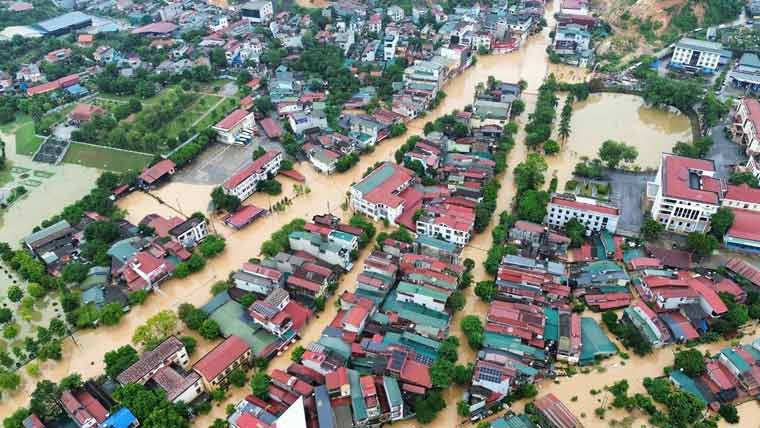
Hanoi: (Tassawar News) Vietnam is currently grappling with a humanitarian and infrastructural catastrophe following an episode of record-breaking rainfall that has unleashed widespread devastation across the central and northern regions of the country. Local media reports indicate the severity of the crisis, noting that an alarming figure of over 116,000 homes have been submerged, with three major urban and tourist cities now completely underwater. Authorities have officially described the current situation as the worst flooding disaster in decades, triggered by an unprecedented deluge that commenced last week, overwhelming local defenses and critical infrastructure.
Unprecedented Deluge and Widespread Destruction
The torrential downpour has surpassed all historical records for the affected regions, proving too powerful for existing drainage and containment systems. The immediate consequence has been the rapid transformation of streets into raging rivers, effectively cutting off ground access to numerous key population centres and administrative areas. This hydrological overload has created an extremely hazardous environment, leading to multiple tragic outcomes.
Local officials have confirmed that multiple fatalities have been reported across the affected provinces, while the number of individuals remaining missing following flash floods and large-scale landslides is reported to be in the dozens. The destructive power of the floods is evident in the damage witnessed: entire vehicles and residential houses have been buried under thick, heavy mudflows, and roaring floodwaters have violently swept through residential areas, compelling thousands of people to execute immediate, forced evacuations from their homes.
“The torrential downpour has overwhelmed drainage systems, turning streets into rivers and cutting off access to several key areas. Authorities have described the floods as the worst in decades, triggered by unprecedented rainfall that has battered the country’s central and northern regions.”
The crisis has been significantly exacerbated by rapidly rising river levels, which have led to extensive infrastructural collapse. Provinces across the central belt are reporting widespread failures, including the complete destruction of essential bridges, major roads, and critical power lines. The national electricity grid has suffered severe disruption, resulting in entire neighbourhoods being plunged into darkness. Furthermore, the breakdown of communication networks and ground transport links has compounded the crisis, severely complicating and delaying vital rescue and relief efforts.
Massive Economic and Agricultural Losses
The economic impact of this devastating event is projected to be immense, with early estimates suggesting billions of dong (equating to millions of USD) in overall agricultural and infrastructure losses. The agricultural sector, which forms the backbone of many local economies, has been hit particularly hard. The floods have destroyed more than 12,000 acres of crucial farmland, effectively wiping out staple rice and vegetable crops essential for local food security and supply chains. The total damage to infrastructure—roads, bridges, and power grids—will require a massive, sustained financial commitment for reconstruction.
“The floods have destroyed more than 12,000 acres of farmland, wiping out rice and vegetable crops crucial to local food supply chains. Early estimates suggest billions of dong (millions of USD) in agricultural and infrastructure losses, painting a grim picture for post-disaster recovery.”
Government and International Response
In response to the escalating crisis, the Vietnamese government has declared a state of emergency. The national response has been mobilized with urgency, involving the immediate deployment of the military and specialized emergency response teams to spearhead large-scale evacuations and coordinate complex relief operations. Boats and helicopters have been pressed into service to reach isolated, stranded families, while secure, temporary shelters have been rapidly established to accommodate the growing number of displaced residents.
Prime Minister Pham Minh Chinh has issued clear directives to all provincial authorities, emphasizing the absolute priority of saving lives and ensuring the swift restoration of essential services. The Prime Minister candidly warned that the full-scale recovery efforts will necessarily “take months,” a reflection of the profound scale of the disaster and the depth of the infrastructural damage sustained.
In parallel, the United Nations has stepped forward, offering explicit support for Vietnam’s humanitarian response. The UN Office for the Coordination of Humanitarian Affairs (OCHA) confirmed it is meticulously monitoring the situation and has pledged immediate logistical and financial assistance to aid both short-term relief and long-term reconstruction efforts. OCHA has further stated its readiness to quickly mobilize international aid should the domestic capacity be stretched beyond its limit.
Climate Change and Future Resilience
Environmental experts are increasingly vocal in their warnings, linking the current catastrophic event to the broader, intensifying phenomenon of climate change. They emphasize that climate change is demonstrably intensifying the frequency and severity of extreme weather events across the entire Southeast Asian region. Vietnam is identified as one of the countries most severely vulnerable to climate-related threats, including both rising sea levels and the increasingly erratic nature of monsoon rainfall.
Over the last decade, the nation has tragically experienced a growing frequency of catastrophic floods and typhoons. This pattern poses serious, systemic challenges to urban planning, water management, and national disaster resilience strategies.
As the threat level remains critically high, with floodwaters continuing to rise and the fear of further rainfall looming in the coming days, Vietnamese authorities are issuing strong and continuous public safety warnings. Citizens in low-lying areas are being urged to evacuate immediately and to avoid traveling through flooded zones at all costs. Rescue teams remain on the highest alert, prepared for further response operations in what has become a truly devastating period for the nation.
Conclusion
The record-breaking floods submerging Vietnam represent a national catastrophe, underscoring the severe and immediate threats posed by climate change-induced extreme weather. The widespread destruction of homes, the tragic loss of life, and the immense damage to vital infrastructure and agricultural land demand a comprehensive and sustained national and international response. While the government, supported by the United Nations, is actively prioritizing life-saving efforts, the long road to full recovery will require significant investment in both immediate relief and long-term resilience planning. This disaster serves as a stark global reminder of the urgency required in addressing climate vulnerability, making disaster preparedness and sustainable development an absolute imperative for Vietnam’s future stability.