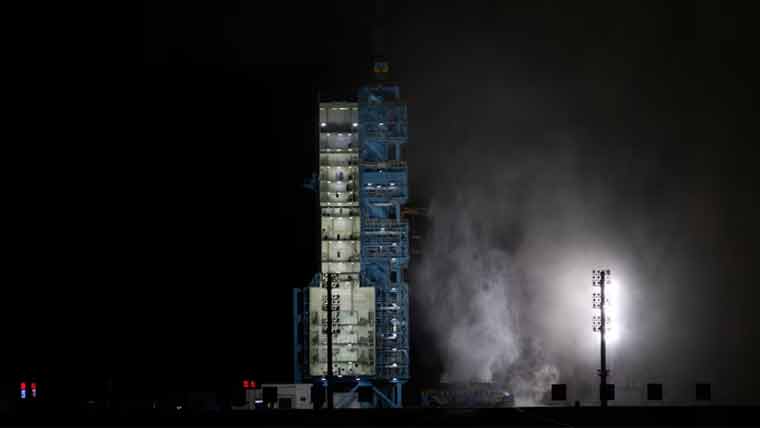
Beijing: (Web Desk) China’s ambitious space programme has registered yet another pivotal milestone with the successful launch of the Shenzhou-21 crewed mission. This latest flight, which ascended from the Jiuquan Satellite Launch Center in northwestern China, carries a crew of three taikonauts to the Tiangong Space Station for a planned six-month duration in orbit. The mission represents a critical step in the nation’s consistent commitment to long-term space exploration and applied scientific research, firmly cementing its status as a major global space power.
The Crew and Their Historic Role
The three-member crew of Shenzhou-21 is composed of Commander Zhang Lu, who is undertaking his second spaceflight, and two first-time taikonauts, Flight Engineer Wu Fei and Payload Specialist Zhang Hongzhang. The mission is particularly notable for the inclusion of Wu Fei, who, at 32 years old, has become China’s youngest-ever astronaut to travel into space. His participation symbolises the nation’s concerted effort to integrate and nurture its younger generation of space talent for future complex missions.
The crew’s composition reflects the specialized nature of China’s astronaut corps, featuring a pilot, a flight engineer, and a payload specialist. Together, they will execute the seventh crewed spaceflight to the permanently inhabited Tiangong Space Station, which became fully operational in 2022. The crew’s primary task is to conduct an in-orbit rotation with the incumbent Shenzhou-20 crew, who will return to Earth after a brief handover period.
Chinese officials described the launch as “another significant step toward the nation’s long-term ambitions in space exploration and research.” The successful lift-off and subsequent 3.5-hour rapid rendezvous and docking with the Tiangong core module—setting a new speed record—further underscore China’s rapid technological advancement in manned space operations.
An Ambitious Scientific and Biological Agenda
The six-month mission is slated to include a robust schedule of scientific and application projects, with 27 new experiments planned across a range of high-priority disciplines. These investigations are central to China’s goal of leveraging the Tiangong station as a premier platform for sustained scientific innovation.
A major highlight of the Shenzhou-21 mission is a pioneering experiment involving rodent mammals. Four mice were transported to the orbital laboratory, marking the first time China has conducted in-orbit biological research on small mammals. This crucial experiment is designed to study the effects of microgravity and confinement on the animals’ behavioural patterns and physiological processes.
“The findings will be critical to assessing the feasibility of long-term human survival and reproduction in space,” according to Chinese scientists, suggesting the research has profound implications for the nation’s deep-space and crewed lunar goals.
Beyond biological research, the taikonauts will conduct investigations in areas such as space life science, biotechnology, aerospace medicine, and microgravity fluid physics. Furthermore, their duties will involve performing Extravehicular Activities (EVAs) or spacewalks, managing cargo transfers, installing space debris protection devices on the exterior of the station, and engaging in educational outreach activities.
Long-Term Vision and Global Positioning
The routine but increasingly complex nature of the Shenzhou missions—now launched twice annually—highlights the reliability and maturity of China’s independent manned space programme. The successful launch of Shenzhou-21 reinforces the nation’s position as a dominant force in space exploration, pursuing bold long-term goals that include sending a crewed mission to the Moon by 2030 and eventually establishing a lunar base.
Moreover, the continued operation of the Tiangong Space Station provides China with an exclusive orbital laboratory following its exclusion from the International Space Station (ISS) in 2011 due to U.S. restrictions. This has driven China to expand its own international cooperation, evidenced by its agreement to train and fly the first foreign astronaut—reportedly from Pakistan—to the Tiangong station in the near future. This diplomatic effort solidifies China’s commitment to inclusive international collaboration in space, offering a distinct alternative to existing multilateral space arrangements.
conclusion
The Shenzhou-21 mission represents more than just a successful launch; it is a tangible manifestation of China’s rapidly accelerating technological capabilities and its firm dedication to becoming a leading power in space exploration. The crew’s six-month tenure will be instrumental in advancing national goals in space medicine, life sciences, and technology demonstration, all while consistently maintaining a permanent human presence in low Earth orbit. The successful orbital insertion and rapid docking are clear indicators of China’s sustained momentum towards achieving its overarching ‘space dream’ and its ambitious lunar aspirations.
This video shows the live launch footage of the mission [CASC Launches Shenzhou 21 Crew to the Tiangong Space Station].