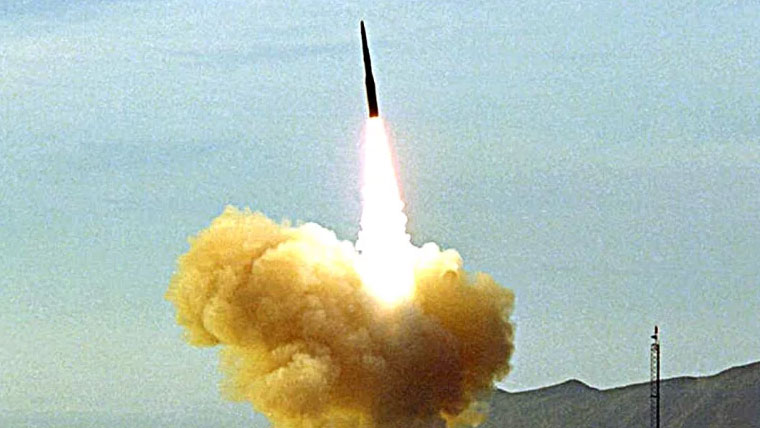
Washington (Web Desk): The global strategic landscape has been subject to renewed attention following the United States’ successful launch of an unarmed Intercontinental Ballistic Missile (ICBM), conducted under the direct authorization of President Donald Trump. This high-profile military exercise, which evaluated the accuracy and reliability of America’s long-range defence architecture, occurs amid increasingly fraught rhetoric concerning the resumption of nuclear weapons testing, signalling a potential escalation in the arms race between major world powers.
The Precision of American Deterrence
The missile, launched from the Vandenberg Space Force Base in California, traversed a trajectory of approximately 4,200 miles before successfully impacting its designated target area at the Ronald Reagan Ballistic Missile Defense Test Site located in the Marshall Islands. This demonstration of capability was classified as part of the GT-254 series of flight tests.
According to official statements released by the U.S. Air Force, the primary objective of this particular test was a rigorous evaluation of the long-term effectiveness and precision of the nation’s long-range defence systems. Crucially, the missile was unarmed and equipped instead with a specialized re-entry vehicle designed to meticulously collect extensive flight data. This data is essential for maintaining the operational readiness and technological edge of the U.S. nuclear deterrent forces.
The successful execution of the test affirms the United States’ commitment to ensuring the viability and reliability of its existing strategic arsenal. The performance metrics gathered from this type of test are vital for making necessary adjustments and upgrades to safeguard the integrity of the nation’s nuclear shield, thereby underpinning the principle of mutually assured destruction (MAD) that has characterized nuclear policy for decades.
The Nuclear Testing Debate: Breaking a Three-Decade Hiatus
The recent ICBM launch has gained particular prominence due to President Trump’s preceding announcement that the U.S. military intends to re-commence nuclear weapons testing. Such a move would mark a profound strategic shift, ending a moratorium that has been in place for over three decades, significantly since the end of the Cold War.
President Trump conveyed his rationale for this momentous policy change via a social media statement, asserting the essential nature of renewed testing to national security interests:
“To maintain America’s defense strength, it is essential to resume nuclear testing immediately.”
This declaration immediately drew intense global attention and concern, raising questions about the stability of the global non-proliferation framework. The potential end of the testing moratorium, which has been adhered to by major nuclear powers through tacit agreement or formal treaties, threatens to initiate a new and costly phase in the nuclear arms race, challenging decades of international effort aimed at limiting the spread and development of nuclear weapons.
The resumption of testing is viewed by critics as highly destabilizing, potentially undermining the Comprehensive Nuclear-Test-Ban Treaty (CTBT), which, while not ratified by the U.S., has largely been respected. Supporters, however, argue that modern testing is necessary to certify the safety and reliability of aging warhead stockpiles without reliance solely on complex computer modelling.
The Role of the Minuteman III in Strategic Deterrence
As reported by U.S. media, the missile utilized in the recent test, presumed to be a variant of the Minuteman III, remains a cornerstone of America’s strategic nuclear deterrence triad (comprising land-based ICBMs, submarine-launched ballistic missiles, and strategic bombers).
The doctrine surrounding the deployment and potential use of the Minuteman III is stringent and clearly defined:
According to U.S. media, the Minuteman III missile remains a key component of America’s nuclear deterrence system and would only be used in response to a nuclear attack on the United States.
This adherence to a “responsive-use-only” policy is designed to reassure global stakeholders that the U.S. arsenal serves a primarily defensive and deterrent purpose. The Minuteman III, housed in underground silos, offers the promptest response capability within the triad, providing the U.S. President with a crucial decision-making window in a crisis. The successful test confirms the continuing readiness of this vital component of the nation’s nuclear posture, reinforcing the credibility of the U.S. commitment to deterring aggression.
International Repercussions and the Russian Response
The announcement regarding the potential resumption of nuclear tests has been met with swift and firm condemnation from key global rivals. Notably, Russian President Vladimir Putin issued an explicit reciprocal warning, signaling a rapid tit-for-tat response should the U.S. proceed:
Meanwhile, Russian President Vladimir Putin warned that if the U.S. proceeds with nuclear tests, Russia will do the same.
This counter-threat highlights the perilous dynamic that could be unleashed by the U.S. action. The prospect of both nations resuming nuclear testing introduces a significant element of instability, potentially eroding the strategic arms control architecture built over half a century. Such a development would undoubtedly heighten global anxieties and dramatically increase defense spending across nuclear-capable states, drawing resources away from vital social and economic needs worldwide. The test and the subsequent international rhetoric are clear indicators of a deteriorating state of trust between Washington and Moscow, setting a concerning precedent for global security.
Conclusion: A Precursor to Strategic Instability
The successful test of the U.S. intercontinental ballistic missile, conducted concurrently with President Trump’s statements about resuming nuclear testing, represents a critical moment of heightened strategic tension on the global stage. While the ICBM launch itself was framed as a routine exercise aimed at ensuring the reliability of America’s long-range defence capabilities, it gains extraordinary significance when juxtaposed with the threat of breaking a three-decade nuclear test moratorium. The explicit and immediate reciprocal warning issued by Russian President Vladimir Putin underscores the inherent danger of this policy direction, suggesting that a unilateral decision by the U.S. could swiftly lead to a destabilizing, two-sided escalation in the nuclear arms race. The international community is thus confronted with the imperative of urging restraint to preserve the decades-long progress made in nuclear non-proliferation and global stability.
Would you be interested in learning about the history and technical specifications of the Minuteman III ICBM?