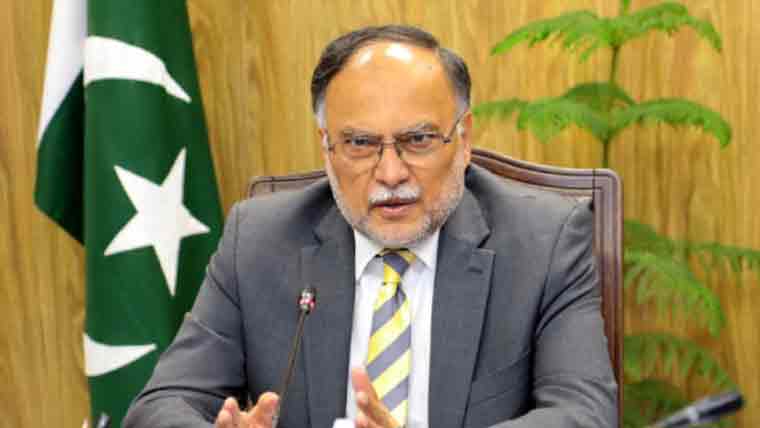
Islamabad: (Tassawar News) In a compelling address delivered at a recent public forum in Islamabad, Federal Minister for Planning and Development, Ahsan Iqbal, emphatically articulated the critical necessity of robust local government institutions for the enduring sustainability and comprehensive strengthening of Pakistan’s democratic framework. His remarks positioned empowered local bodies not merely as an administrative convenience, but as an indispensable component for the effective grassroots delivery of governance and services. The Minister’s statement underscores the current administration’s renewed focus on institutional reforms and participatory governance as central pillars for national development and democratic consolidation.
Crucial Role of Decentralization in Democratic Delivery
Minister Iqbal underscored a fundamental tenet of democratic theory: that true democratic systems cannot deliver effectively at the grassroots level without the empowerment of local councils. He stressed that decentralization of power and resources to representatives who possess a direct, intimate understanding of community needs is a prerequisite for achieving genuine progress and ensuring accountability in public service.
“Strong local government institutions are crucial for the sustainability and strengthening of democracy in Pakistan. Without empowering local bodies, democratic systems simply cannot deliver effectively at the grassroots level, leaving citizens disconnected from the very process meant to serve them.”
The Minister highlighted the direct correlation between local governance and tangible public welfare. He asserted that effective service delivery across vital sectors—including education, healthcare, sanitation, and infrastructure development—is only realistically achievable when empowered and financially autonomous local councils are functioning with optimal efficiency. This perspective shifts the focus from centralized planning to community-driven problem-solving.
“Local governments are the backbone of democracy. Effective service delivery in sectors like education, healthcare, sanitation, and infrastructure can only happen when empowered local councils are functioning efficiently, equipped with the necessary resources and decision-making authority.”
Critique of Previous Governance and Institutional Damage
In his address, Ahsan Iqbal launched a forceful critique of the preceding PTI government, accusing it of intentionally inflicting damage upon the country’s delicate institutional framework and actively undermining established democratic norms. His criticism centered on the alleged neglect of development and the promotion of political discord during the tenure of the previous administration.
According to Minister Iqbal, the PTI administration failed to initiate any significant development projects, choosing instead to focus on promoting a “politics of hatred and division” that polarized the national environment. More significantly for the topic of governance, he pointed to the widespread dissolution of local governments across the nation during that period. This action, he contended, severely weakened the foundational elements of democratic participation and community-based decision-making processes.
“The PTI government did not launch a single development project during its tenure but instead promoted a politics of hatred and division. Furthermore, the deliberate dissolution of local governments across the country critically weakened the very foundation of democratic participation.”
Ahsan Iqbal affirmed his own political party’s consistent and principled efforts to advocate for the restoration of these vital bodies. He noted that his party had “consistently raised its voice in courts and public forums” for the reinstatement of local bodies, recognizing them as an absolute, non-negotiable component of a truly functioning democracy.
Commitment to Institutional Restoration and Democratic Health
The Federal Minister provided a strong reaffirmation of the current government’s commitment to a concerted effort focused on rebuilding institutions, promoting accountability, and comprehensively restoring public confidence in the integrity and efficacy of democratic governance. He emphasized that the overarching goal of the administration is to ensure institutional continuity and to foster a culture of responsible political conduct and widespread civic participation, which he deems essential for Pakistan’s long-term democratic evolution.
“Our goal is to strengthen democratic institutions, not individuals. The true progress and sustainability of our democracy depends on institutional continuity, responsible political conduct, and the active inclusion of citizens at every level of governance.”
He argued that for democracy to be genuinely sustained, it must operate on principles of transparency, accountability, and the systematic inclusion of citizens at every tier of the governance structure. This focus on procedural health and citizen engagement is what he suggests will bridge the socio-economic gaps prevalent in the country.
Call for National Collaboration and Reform
Beyond the immediate administrative focus, Ahsan Iqbal issued an urgent call for national unity and collaboration across the entire political spectrum. He implored all political parties to elevate the national interest above partisan conflict, urging them to “move beyond confrontation” and redirect their energies toward nation-building. This process, he suggested, must be underpinned by a spirit of tolerance, collaborative effort, and reform-oriented politics.
Political analysts view Minister Iqbal’s comprehensive statement as a clear signal of the government’s serious and renewed focus on institutional reforms and the necessary adoption of participatory governance models. Such reforms are widely considered key prerequisites for effectively addressing complex public challenges, particularly in bridging the governance gaps between highly developed urban centres and underserved rural areas.
The event concluded with Minister Ahsan Iqbal reiterating his own ministry’s unwavering commitment to prioritizing national development projects specifically designed to narrow existing socio-economic disparities and, in parallel, to structurally strengthen Pakistan’s foundational democratic and administrative framework. His timely remarks contribute significantly to a national discourse currently grappling with the pressing needs for effective decentralization and comprehensive governance reforms, which are increasingly championed by civil society and political observers as the definitive path towards meaningful, sustained national progress.
Conclusion
Federal Minister Ahsan Iqbal’s vigorous emphasis on the absolute necessity of robust local government institutions provides a crucial perspective on the current political trajectory of Pakistan. By clearly linking the efficacy and sustainability of the nation’s democracy directly to the principle of decentralization, he frames local bodies as the indispensable engine for accountable service delivery and genuine grassroots participation. His critique of past actions that undermined these institutions is balanced by a strong, forward-looking commitment to institutional rebuilding, transparency, and collaborative, reform-oriented politics. The Minister’s address serves as a powerful reminder that the health of Pakistan’s democracy is not merely determined at the federal level, but is fundamentally rooted in the empowerment and operational efficiency of its local governance structures, thereby laying the groundwork for a more inclusive, stable, and prosperous future.