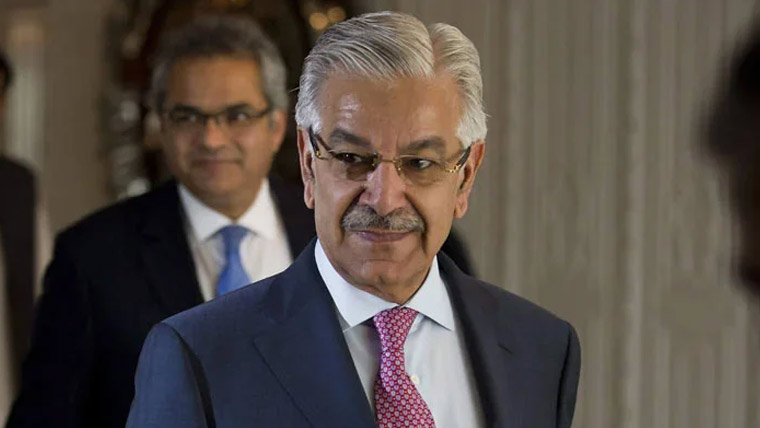
Islamabad: (Tassawar News) In a recent and unequivocal statement from Islamabad, Pakistan’s Defence Minister, Khawaja Muhammad Asif, delivered a forceful articulation of the nation’s security doctrine, signalling a pivotal shift towards a more assertive posture concerning cross-border incursions originating from Afghan territory. This declaration, relayed through various media outlets including Dunya News, transcends a mere diplomatic demarche, positioning itself instead as a strategic ultimatum designed to recalibrate bilateral relations amidst persistent terrorist threats. The Minister’s comments underscore a profound national resolve: the sustained and systematic exploitation of Afghan soil by proscribed militant entities is deemed an unacceptable existential threat, necessitating a decisive and unyielding response.
Mr. Asif’s remarks highlight a critical and burgeoning security predicament, notably the operational latitude enjoyed by hostile non-state actors within Afghanistan. He explicitly cautioned that the state of Pakistan would, in the absence of reciprocal action from the Kabul administration, feel compelled to utilize “decisive force where necessary.” This measured yet emphatic language serves to communicate a clear intent: military options remain actively on the table should diplomatic pressure prove insufficient to compel the dismantling of terrorist infrastructure. This warning is predicated on the verifiable establishment of what the Defence Minister terms “terrorist hubs” ensconced within the contiguous region of Afghanistan, demanding immediate and rigorous intervention by the ruling Taliban regime. The imperative conveyed is fundamentally one of sovereign duty and national defence.
“Pakistan will not tolerate cross-border infiltration from Afghan soil and reiterated that the country will not retreat from its position against terrorism.”
The core of Pakistan’s renewed insistence lies in the principle of sovereign territorial integrity and the cessation of sanctuary provision for groups deemed inimical to its national interests. The Defence Minister’s pronouncements, as reported by Dawn, directly implore the Kabul Taliban regime to cease the alleged provision of support, whether tacit or overt, to these militants. This demand is not merely rhetorical; it establishes a clear precondition for any future diplomatic engagement or improvement in the fractured bilateral relationship. Khawaja Asif emphatically stressed the impossibility of fostering robust regional cooperation in an environment where militant sanctuaries remain operational.
Furthermore, the discourse extended to the critical role of multilateral or bilateral mediation in resolving this escalating friction. The Minister stressed that any mediating party—whether a regional power or an international organisation—must “fully protect Pakistan’s interests.” This demand introduces a layer of complexity to future peace negotiations, mandating that the cessation of cross-border terrorism is not a collateral benefit but the central, non-negotiable objective of any mediated solution. Pakistan requires concrete, verifiable “assurances that Afghan territory will not be used to stage attacks” by designated groups, specifically naming the Tehrik-i-Taliban Pakistan (TTP) and the Baloch Liberation Army (BLA), underscoring the necessity of precluding their sustained operational presence within the region. This stipulation, as articulated via Reuters, signifies that Pakistan will no longer accept ambiguous commitments, demanding instead tangible mechanisms for compliance and accountability.
The Defence Minister also broadened his critique to encompass the domestic and regional political landscape, addressing internal and external pressures simultaneously. He launched a scathing condemnation of “some regional actors” whose actions are perceived as threatening Pakistan’s territorial sovereignty. This ambiguous reference implicitly points towards geo-political rivals accused of employing proxy elements to destabilise the country. In response, Khawaja Asif emphasized the state’s unwavering commitment to safeguard the national security calculus “by all lawful means.”
“Improvement in bilateral relations is impossible unless militant sanctuaries are dismantled. Pakistan requires assurances that Afghan territory will not be used to stage attacks, and that groups such as the proscribed TTP or BLA will not be allowed to operate in Pakistan.”
Addressing the political dimension within Pakistan, the Minister was overtly critical of those elements attempting to prioritize narrow, self-serving political ambitions over the paramount concern of national security. His condemnation of those who would operate under “Niazi law” serves as a direct, albeit veiled, political attack, reaffirming the current administration’s constitutional commitment to defending the homeland. This rhetoric seeks to foster internal cohesion and to delegitimise political dissent that, in the government’s estimation, threatens the collective interest. This political manoeuvre reinforces the gravity of the security challenges facing the nation, attempting to cast the government’s security stance as a matter of universal national concern rather than partisan politics.
The sustained propagation of violent extremism and the destabilising dynamic of cross-border militancy present an intractable challenge to South Asian regional security. Khawaja Asif’s strident warnings and preconditions for diplomatic normalisation constitute a critical inflection point in the precarious Pakistan-Afghanistan relationship. The emphasis on both kinetic capability and the demand for robust guarantees from the Kabul regime underscores Pakistan’s strategic pivot: a shift from patient diplomacy to an era of zero-tolerance and consequential action. The future trajectory of stability in the region is thus inextricably linked to the Afghan Taliban’s willingness and capacity to meet these rigorous security demands, thereby dismantling the operational infrastructure of transnational terror groups that perpetually jeopardise Pakistani sovereignty. The confluence of internal political solidarity and external security exigencies now defines the Islamabad government’s policy horizon.