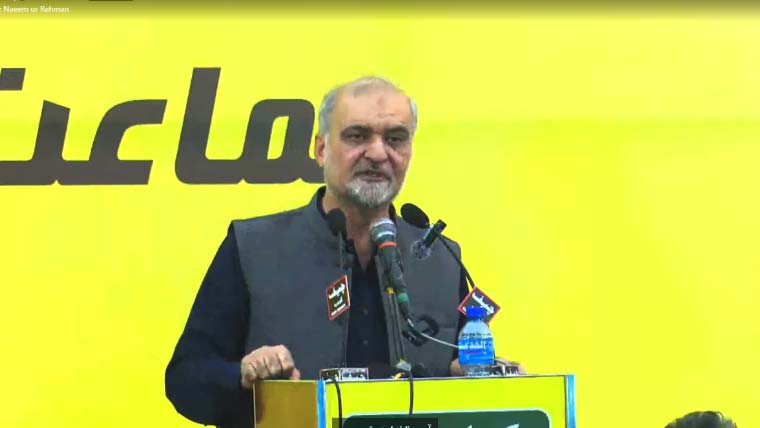
Gojra (Tassawar News): In a powerful demonstration of political dissent, Hafiz Naeem ur Rehman, the Chief of the Jamaat-e-Islami (JI), has launched a vehement critique against the current administration’s macroeconomic and agricultural policies, asserting that these fundamentally flawed decisions have engendered a profound crisis, culminating in serious national food security issues across the entire Pakistani domain.
Addressing an impassioned crowd at the “Kisan Road Caravan” congregation in the city of Gojra, Hafiz Naeem meticulously articulated the mounting exasperation within the agrarian community. His address served as a clarion call for immediate and structural reforms within the nation’s pivotal agricultural sector, which has historically been the bedrock of the national economy. The core of his demands centred on two concrete policy adjustments deemed essential for restoring equilibrium and ensuring equitable compensation for farmers. Specifically, he demanded an immediate halving of fertilizer prices and the establishment of the wheat support price at Rs. 4,500 per 40 kilograms. These proposed measures are positioned as non-negotiable prerequisites for alleviating the financial distress currently engulfing the farming community.
In a particularly searing indictment, the JI Chief highlighted the egregious disparity in commodity pricing: “The government is unconscionably exploiting farmers. It procured wheat at the meagre price of Rs. 1,900 and is now commercialising it for an inflated Rs. 3,800. This represents a profound economic injustice. Farmers must not be relegated to the status of bonded labour; they ought to be reinstated as the legitimate proprietors of their produce.”
Critique of Fiscal Priorities and Sectoral Misallocation
Hafiz Naeem further broadened the scope of his criticism to encompass the government’s overall fiscal architecture, particularly focusing on the misallocation of substantial financial resources. He explicitly condemned the provision of extensive subsidies to Independent Power Producers (IPPs), arguing that these policies have demonstrably exacerbated the cost-of-living crisis for the vast majority of ordinary citizens. This preferential financial treatment, he argued, constitutes a systematic undermining of public welfare.
He postulated an alternative and more equitable fiscal strategy, asserting that the capital currently being diverted to the IPPs could be repurposed and strategically reinvested into the underfunded education sector. Such a substantial reallocation, he contended, would not only revitalise this crucial sector but also substantially enhance its accessibility for students from disadvantaged backgrounds. The JI chief’s plea thus transmuted into a powerful exhortation for the administration to effect a fundamental change in investment priorities, advocating for a significant commitment to educational development and a material reduction in schooling costs for the working classes. This argument encapsulates a holistic critique, linking macro-level economic decisions directly to their social impact.
The Legitimacy Crisis and Agricultural Devastation
The political dimension of the criticism was equally pronounced. Hafiz Naeem did not merely question the government’s competence but its fundamental legitimacy, labelling the current administrators as “Form 47 products”—an evocative term used to imply widespread electoral manipulation and a deficit of democratic mandate.
He lamented the precipitous decline of the agricultural sector, which, since the nation’s inception, had consistently demonstrated its inherent resilience and strength. He accused the present government of having systematically and comprehensively “destroyed” this vital component of the national economy. According to his analysis, the catastrophic situation stems directly from the government’s failure to procure wheat from local farmers, juxtaposed against the unrelenting and steep escalation in the costs of essential inputs, namely fertilizers, diesel, and electricity. This policy failure, he maintained, has collectively plunged the agrarian community into a state of abject despair and financial ruin.
Elaborating on the gravity of the situation, the JI leader declared: “As a direct consequence of these anti-farmer policies, Pakistan is now confronted with profound food security challenges—a scenario that is unprecedented for several decades of our history.”
A Commitment to Rights and Future Mobilisation
Hafiz Naeem meticulously reaffirmed the Jamaat-e-Islami’s unwavering and unequivocal commitment to championing and safeguarding the rights of the agrarian community. He pledged that the party would maintain its role as a persistent and vocal advocate for farmers across all four provinces.
Furthermore, he underscored a forward-looking vision for national development, acknowledging the indispensable importance of women’s participation in the country’s progression. He proudly asserted that JI’s women’s division boasts a strength and structural coherence superior to that of any other mainstream political entity. This statement sought to position JI not only as a proponent of farmers’ rights but also as an inclusive force committed to broader social development.
The culmination of the address involved a strategic call to action. Hafiz Naeem issued an appeal to all Jamaat-e-Islami workers and dedicated supporters to converge at the historically significant Minar-e-Pakistan landmark on November 21st. He anticipated this gathering to be a truly monumental mobilisation, predicting that “a sea of people will rise to fundamentally free the nation from the grip of corrupt rulers.” He concluded with a solemn promise: the farmers’ movement will be sustained indefinitely across the nation until the administration capitulates and fully implements pro-farmer and pro-people policy reforms designed to guarantee affordable sustenance, equitable trade practices, and comprehensive social justice.
Conclusion
Hafiz Naeem ur Rehman’s address represents a multifaceted and scathing critique of the government’s operational efficacy and fiscal orientation. The core argument rests on the premise that short-sighted policy decisions, particularly within the agricultural domain, have systematically undermined the financial viability of farming, thus directly threatening Pakistan’s food sovereignty. By explicitly linking the subsidisation of IPPs to the neglect of the education sector and the plight of the common citizen, the JI Chief constructs a narrative of political and economic prioritisation failure. His strong demands for immediate policy amendments, coupled with the call for a massive public demonstration, signify an intent to escalate the political pressure, demanding not merely economic fixes but a fundamental reassessment of the current administration’s legitimacy and governance model. The movement’s continued momentum is thus predicated on the ability of the Jamaat-e-Islami to translate farmer frustration and public discontent into sustained, nationally cohesive political action.