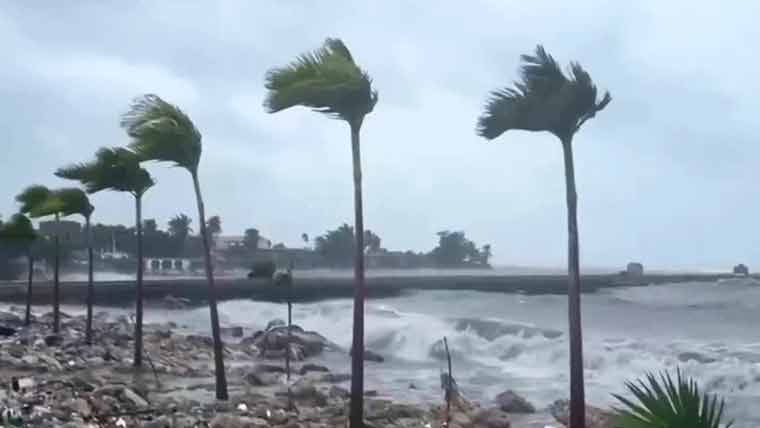
New York: (Tassawar News) The year’s most formidable tropical cyclone, Hurricane Melissa, has commenced its destructive trajectory across the Caribbean archipelago, already exacting a tragic toll and prompting widespread crisis measures. International news agencies confirm that the super-storm has been directly responsible for three fatalities in Haiti, where the immediate humanitarian situation has become acutely challenging.
The initial impact has been characterized by torrential and sustained rainfall, which has severely disrupted daily life across the southern regions of Haiti.3 The severity of the weather event necessitated the immediate evacuation of vulnerable populations, resulting in over 3,000 individuals seeking refuge in emergency shelters. The profound scale of the disruption extended beyond local infrastructure, leading to the cancellation of hundreds of flights across the region. Consequently, local governmental authorities have formally declared a state of emergency to facilitate rapid response and resource allocation. Meteorological data confirms the storm’s extreme intensity, with wind speeds recorded at a devastating 280 kilometers per hour, translating into widespread structural and environmental damage across affected zones.
Regional Threat and Precautionary Measures
The destructive potential of Hurricane Melissa has placed neighboring nations on high alert.4 Meteorologists have issued grave warnings indicating that the storm’s projected path poses an imminent threat to Jamaica.5 In response to this critical forecast, Jamaican officials have urgently exhorted residents, particularly those in low-lying or coastal areas, to relocate to safer, designated locations. The nation’s Prime Minister has publicly articulated profound concern over the potential for large-scale destruction that such an intense storm could inflict upon the island’s infrastructure and populace.6
“The sheer force and wind velocity associated with Hurricane Melissa classify it as an extremely dangerous phenomenon, compelling all at-risk nations to implement comprehensive disaster mitigation strategies,” noted a regional disaster management expert. “The immediate priority is the relocation of vulnerable communities and the deployment of resources to safeguard against catastrophic inundation and wind damage.”
Crisis Mobilization and Intensity Assessment
In a coordinated regional effort, emergency alerts have been disseminated throughout multiple Caribbean nations now lying within or near the storm’s path. Furthermore, rescue and disaster relief teams have been mobilized and placed on high operational alert as the hurricane continues its inexorable intensification.
Experts in atmospheric science have been unequivocal in their assessment, describing Hurricane Melissa as the “most dangerous tropical storm of the year.” This designation underscores the storm’s potential not only for immediate damage but also for long-term ecological and economic devastation across the fragile island states. The rapid mobilization of rescue assets reflects the urgent, high-stakes nature of the ongoing crisis and the potential for a severe humanitarian emergency.
Conclusion: The Urgent Need for Resilience and Aid
The catastrophic arrival of Hurricane Melissa underscores the vulnerability of Caribbean islands to extreme weather phenomena, immediately evidenced by the tragic loss of life and mass displacement in Haiti. With wind speeds reaching an alarming intensity and the storm’s trajectory posing an imminent threat to nations like Jamaica, the crisis necessitates a swift and comprehensive regional and international humanitarian response. The current focus must remain on disaster mitigation, ensuring the safety of populations under threat, and mobilizing resources for the inevitable, complex rehabilitation efforts that will follow the passage of this most destructive tropical storm of the year.