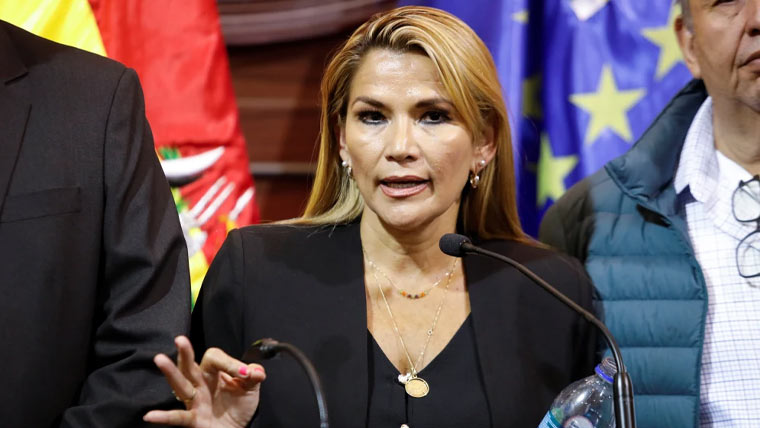
BUENOS AIRES (Web Desk): In a momentous and politically charged decision, the Supreme Court of Bolivia has annulled the 10-year prison sentence imposed on former interim President Jeanine Áñez, ordering her immediate release from detention after more than four years. The landmark ruling effectively overturns her 2022 conviction for allegedly orchestrating a “coup d’état” against former President Evo Morales, citing critical procedural and jurisdictional violations that rendered the entire trial invalid. This judicial reversal is widely seen as a significant inflection point in the Andean nation’s turbulent political and legal landscape.
Procedural Flaws and Jurisdictional Mandates
Justice Rómer Saucedo, who presided over the delivery of the decision, articulated the court’s basis for nullification, focusing squarely on the legal mechanisms employed during the initial trial. The core of the ruling rests on the finding that the case was heard in a regular criminal court, which the Supreme Court now deems inappropriate given Áñez’s status as a former lawmaker and president.
As Justice Saucedo clearly stated:
“Jeanine Áñez has been detained for more than four years. The trial contained procedural flaws. Therefore, her 10-year sentence is nullified, and her release is ordered.”
The court determined that the charges concerning alleged crimes committed by Áñez during the course of her official duties as a former senator and interim president should have been adjudicated by a special court designated specifically for such proceedings. This requirement ensures that legal processes concerning high-ranking officials adhere to strict constitutional and jurisdictional mandates. The failure to adhere to this specialized judicial route constituted a fundamental error that ultimately invalidated the conviction, suggesting a significant, possibly deliberate, lapse in due process during the initial proceedings. The verdict places a strong emphasis on the principle of due process and the correct application of legal jurisdiction, particularly in politically sensitive cases involving senior government figures.
Contextual Background: From Political Vacuum to Legal Scrutiny
The judicial saga of Jeanine Áñez is inextricably linked to the profound political upheaval that engulfed Bolivia in late 2019. Áñez, a conservative senator at the time, assumed the interim presidency following a wave of mass protests over disputed election results, which ultimately compelled Evo Morales, the nation’s first Indigenous president, to resign and flee the country.
Áñez consistently maintained that her assumption of power was a necessary constitutional act to prevent a chaotic power vacuum and facilitate a democratic transition. Conversely, Morales and his political apparatus, the Movement for Socialism (MAS), staunchly denounced the transition as a military-backed coup.
The 2019 transition period was marked by intense political violence. Áñez’s brief interim government was subjected to severe criticism for its robust response to pro-Morales demonstrations. Reports from various international bodies, including Amnesty International, highlighted the seriousness of the crackdown:
“Her interim government faced heavy criticism for the crackdown on pro-Morales protesters, which, according to Amnesty International, resulted in at least 35 deaths and over 800 injuries.”
This complex, violent history set the stage for the subsequent legal persecution. When the MAS party regained control in 2021, Áñez was arrested and subsequently charged with illegally assuming office. Her 2022 conviction was instantly condemned by human rights groups and international observers, who frequently characterized the judgment as politically motivated—a tool of retribution used by the ruling party against a former political adversary.
The Political Fallout and Áñez’s Personal Resolve
The arrest and sentencing of Áñez in 2022 served as a stark demonstration of Bolivia’s deep political polarization and the use of the judiciary as a battleground for political settling of scores. The Supreme Court’s current ruling, therefore, is not merely a technical legal correction; it is a powerful political declaration regarding the proper boundaries between executive power and judicial independence.
Although Áñez’s immediate public response was limited, a statement posted on social media shortly after her release encapsulated her perspective and defiant stance throughout her detention:
“I will never regret serving my country when it needed me most. I acted with a clear conscience and a strong heart, knowing that difficult decisions come with a price.”
This message reinforces her contention that her actions were guided by a sense of patriotic duty rather than criminal intent, underscoring the political nature of the original charges. The acquittal clears her immediate legal jeopardy, though the broader political implications regarding accountability for the 2019 violence remain a sensitive and unresolved issue.
Emerging Political Landscape and Judicial Independence
This judicial development occurs in the immediate aftermath of a significant political shift in Bolivia, where the centrist Christian Democrat Rodrigo Paz recently secured the presidency. Paz’s victory marks the conclusion of nearly two decades of socialist dominance under Evo Morales and the MAS party, signalling a potential rebalancing of power within the Andean nation.
Political analysts suggest that the annulment of Áñez’s sentence may herald the initial phase of a move towards greater judicial independence in Bolivia. The decision by the Supreme Court to prioritize adherence to complex jurisdictional rules over the political expediency of upholding a high-profile conviction suggests a willingness to resist executive pressure and assert the judiciary’s role as a guarantor of constitutional process.
The future impact of this ruling on Bolivia’s political dynamics will be closely monitored. It could potentially strengthen the opposition and foster a more open and less punitive political environment, moving away from the pattern of “lawfare” that has characterized recent administrations. The challenge for the new government will be to capitalize on this apparent judicial impartiality to foster genuine national reconciliation and strengthen democratic institutions.
Conclusion: A Precedent for Due Process
The Bolivian Supreme Court’s decision to nullify the conviction and order the release of former interim President Jeanine Áñez represents a pivotal assertion of judicial authority and the supremacy of due process. The ruling, which hinged upon fundamental procedural and jurisdictional errors in the original trial, effectively underscores the necessity for the judiciary to operate independently of political influence and adhere strictly to constitutional law, particularly in cases involving high-level government officials.
While the annulment corrects a perceived political injustice and offers a measure of vindication for Áñez, the broader context of the 2019 political crisis and the associated violence demands ongoing scrutiny. The ruling offers the new political administration an opportunity to champion institutional reform and move towards a more balanced political landscape. Ultimately, the enduring legacy of this judicial reversal will be determined by its capacity to establish a lasting precedent for impartiality and respect for constitutional jurisdiction within Bolivia’s judicial system.
Would you like to explore the international reaction to this ruling or the specific jurisdictional requirements for prosecuting former heads of state in Bolivia?