Tokyo: (Tassawar News) During his official diplomatic visit to Tokyo, U.S. President Donald Trump once again brought the complex geopolitical dynamics of the India-Pakistan conflict into the international spotlight, marking the second public mention of the issue.1 His statements provided a retrospective account of his administration’s alleged intervention during a period of acute regional tension.
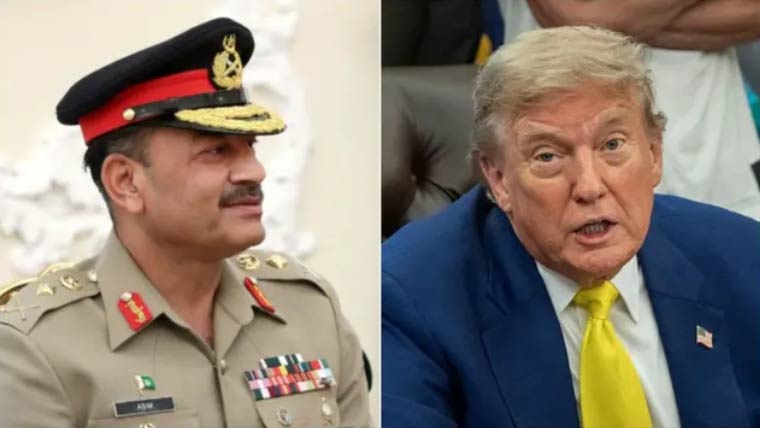
Speaking at a press briefing, President Trump referenced a recent instance where he claimed the nuclear-armed South Asian rivals were on the “brink of a serious conflict.” He provided a specific, though unsubstantiated, detail regarding the escalation, asserting that seven newly acquired Indian aircraft were destroyed during this critical phase.2 The President recounted his personal involvement, noting that he directly contacted Indian Prime Minister Narendra Modi, the Pakistani Prime Minister, and a figure he identified as a Field Marshal, urging all parties to exercise restraint and avoid further escalation.3
Nuclear Deterrence and Economic Leverage
President Trump detailed the dual nature of his warning, employing both the gravity of nuclear conflict and the leverage of economic partnership. His core message emphasized the catastrophic ramifications of military engagement between the two states:
“I conveyed to them the undeniable truth that if two nuclear-armed nations proceed to war, the subsequent suffering would be universal,” affirmed President Trump. “To reinforce the imperative of peace, I explicitly warned both sides that a decision to pursue war would inevitably result in the suspension of trade relations with the U.S., thereby utilizing economic policy as a powerful tool of deterrence.”
The President characterized the resolution of the crisis as a “remarkable outcome,” claiming the issue was successfully defused within a 24-hour timeframe. He further asserted a broader record of diplomatic success, claiming responsibility for preventing “eight wars within eight months,” including his claimed mediation of a ceasefire between two unnamed nations in Malaysia.4
Strengthening U.S.-Japan Defence and Economic Ties
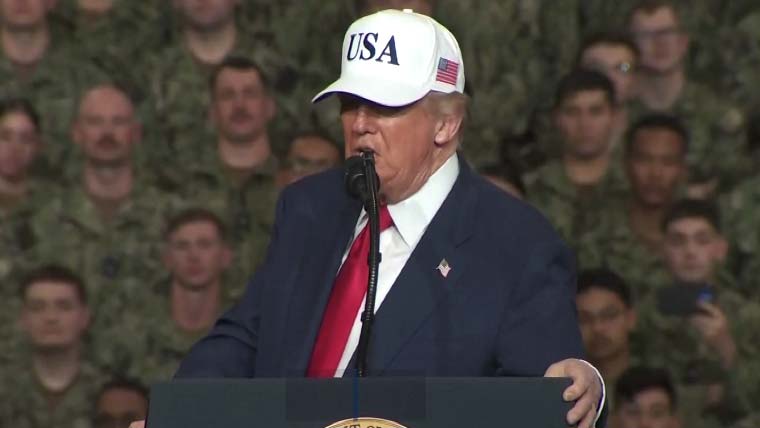
Beyond his comments on South Asia, the Tokyo visit served to reinforce the vital U.S.-Japan strategic alliance. During his stay, President Trump visited a U.S. military base where he formally approved the first shipment of U.S. missiles designated for Japan’s advanced F-35 fighter jets.5 Addressing American troops, he emphasized the enduring strategic significance of U.S.-Japan relations for regional peace and security. He concluded this engagement by reiterating his administration’s domestic policy, declaring, “Under our administration, America is becoming great once again.”
The diplomatic substance of the visit was further cemented when President Trump and the Japanese Prime Minister executed a formal agreement designed to secure the supply of rare and critical minerals.6 This pact highlights a coordinated strategy to safeguard supply chains for essential industrial and technological components.7 Significantly, Japan’s first female Prime Minister publicly lauded President Trump’s concerted efforts toward peace and diplomacy, providing a high-profile endorsement of his international engagement strategy.
Conclusion: A Multifaceted Diplomatic Agenda
President Trump’s visit to Japan showcased a multifaceted diplomatic agenda, simultaneously focusing on both crisis retrospective and strategic alliance fortification. His highly personalized account of intervening in the India-Pakistan conflict, leveraging the threat of nuclear war and the power of trade suspension, underscores a transactional approach to international relations. Furthermore, the agreements reached in Tokyo—particularly the approval of missile shipments and the pact on critical minerals—demonstrate a concrete commitment to enhancing the U.S.-Japan security and economic partnership, which remains crucial for maintaining stability across the Asia-Pacific region.