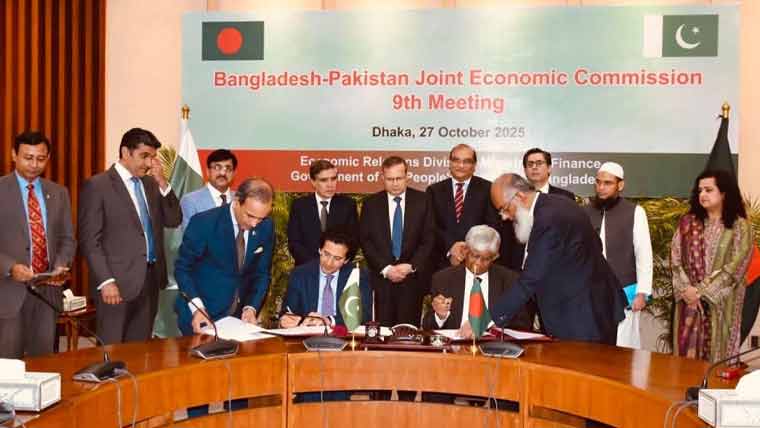
Islamabad (Tassawar News) The recent convocation of the 9th Session of the Pakistan-Bangladesh Joint Economic Commission (JEC) in Dhaka constitutes a momentous stride in the bilateral relationship, marking the first such high-level meeting in two decades. This significant diplomatic event, co-chaired by Pakistan’s Federal Minister for Petroleum, Ali Pervez Malik, and Bangladesh’s Finance Adviser, Dr. Salehuddin Ahmed, heralds a renewed phase of economic collaboration and strategic engagement between the two South Asian nations, placing a firm emphasis on regional connectivity and shared prosperity.
Strategic Connectivity and Trade Augmentation
A primary outcome of the productive discussions was Pakistan’s proactive extension of an overture granting Bangladesh access to the strategic capacities of the Karachi Port Trust (KPT). This initiative is designed to be a catalyst for bolstering regional trade connectivity, allowing Dhaka to substantively expand its commercial outreach. By leveraging Pakistan’s strategically positioned seaports, Bangladesh can secure more efficient and geographically advantageous trading routes with pivotal regional economies, notably including China and the Central Asian states. This offer is a clear manifestation of Pakistan’s commitment to facilitating broad-based regional economic integration.
The joint communiqué emanating from the session explicitly detailed the mutual intent to invigorate economic, trade, and developmental ties. Furthermore, both delegations underscored the imperative of augmenting synergistic initiatives between their respective national shipping corporations.
“Pakistan’s proposal to allow Bangladesh to utilize the Karachi Port Trust (KPT) would enable Dhaka to expand its trade outreach with China, Central Asian states, and other regional economies through Pakistan’s strategic seaports.”
Enhancing cooperation in maritime linkages and logistics efficiency is deemed critical to streamlining the supply chain and reducing the transactional friction inherent in international commerce. This collaborative focus on logistical infrastructure is essential for establishing resilient and sustainable trade mechanisms that can support higher volumes of bilateral and multilateral exchange.
Prioritizing Air Connectivity and People-to-People Exchange
Beyond maritime logistics, the JEC made tangible progress in addressing the perennial issue of insufficient air travel infrastructure. A definitive agreement was reached to accelerate efforts aimed at the prompt establishment of direct flight operations between Pakistan and Bangladesh. The participants recognized that superior air connectivity is not merely a convenience but a critical enabling function in fostering multifaceted relationships. Direct flights are poised to play a pivotal role in stimulating trade growth, significantly boosting tourism, and facilitating greater people-to-people exchanges, thereby strengthening the cultural and social bonds that underpin political relations.
Federal Minister Ali Pervez Malik expressed profound gratitude for the hospitality extended by the Bangladeshi side, simultaneously reaffirming that the bedrock of relations between the two sovereign nations rests upon the principles of mutual respect, friendship, and shared aspirations for regional development and harmony. This sentiment of goodwill provided the necessary diplomatic context for the substantive discussions on economic cooperation.
Standardisation, Quality Assurance, and the Knowledge Corridor
A particularly noteworthy achievement of the 9th JEC was the formal signing of a Memorandum of Understanding (MoU) between the Pakistan Halal Authority and the Bangladesh Standards and Testing Institute. This specialised agreement is strategically designed to foster advanced collaboration in critical areas such as Halal certification, rigorous product quality assurance, and comprehensive standardisation protocols. By aligning these regulatory processes, the MoU is expected to significantly facilitate trade in Halal goods, opening up more fluid commercial pathways across regional and possibly broader international markets.
Further demonstrating a forward-looking vision, the discussions centered on the conceptualisation and eventual development of a Pakistan-Bangladesh Knowledge Corridor. This ambitious proposal is intended to transcend mere commercial cooperation by promoting intensive academic collaboration, fostering research exchange initiatives, and enhancing skill development programmes. The focus on knowledge creation and diffusion is a testament to the belief that human capital development is essential for sustained economic growth in both nations.
Commitment to Educational and Technical Capacity Building
The proposed Knowledge Corridor framework immediately yielded concrete offers of support from the Pakistani side. In a gesture underscoring Pakistan’s commitment to educational and cultural cooperation, an offer of 500 fully funded scholarships was made available for eligible Bangladeshi students. These scholarships are intended to facilitate access to higher education within Pakistan’s reputable university system. This initiative represents a substantial investment in the future intellectual capacity of Bangladesh.
Furthermore, under the aegis of the well-established Pakistan Technical Assistance Program (PTAP), Islamabad formally announced a significant fivefold increment in the provision of technical training slots, raising the total from 5 to 25. This expansion is specifically designed to offer enhanced professional and technical capacity-building opportunities for Bangladeshi professionals across various crucial sectors, ensuring that the necessary skilled manpower is available to support the economic transition and modernisation efforts in Bangladesh.
Diversification Across Key Economic Sectors
The comprehensive nature of the JEC discussions is reflected in the broad spectrum of sectors earmarked for intensified bilateral cooperation. The two countries reached a consensus to deepen collaboration across vital economic areas, including but not limited to trade and investment, industry, energy security, climate change mitigation, and the pivotal field of information technology.
The joint communiqué also meticulously outlined opportunities for synergistic development in sectors such as agriculture, transport infrastructure, education, banking and financial services, public health, tourism, information and broadcasting, and the textile industry. A strong emphasis was also placed on developing cooperation in specialized areas like medical and religious tourism, recognizing the strong cultural and social potential inherent in facilitating such cross-border movements. This comprehensive agreement signals a desire to create a robust and highly diversified economic relationship, reducing reliance on any single sector and making the partnership more resilient to economic volatility.
Conclusion: A Milestone for Future Development
The formal signing of the agreed minutes of the 9th Joint Economic Commission meeting by the delegation heads marks a definitive diplomatic milestone. Officials from both nations have unanimously lauded the outcome, characterizing it as a successful conclusion that strategically lays the groundwork for broader regional integration and sustained, mutually beneficial development. The salutary resuscitation of the JEC after a twenty-year dormancy unequivocally heralds a demonstrable political will from both Pakistan and Bangladesh to prioritize a forward-looking relationship. By resolving to focus decisively on trade, connectivity, and collective regional prosperity, the two nations have successfully ushered in an era of renewed collaboration, which is expected to yield substantial economic dividends and contribute significantly to stability and growth across the South Asian landscape.