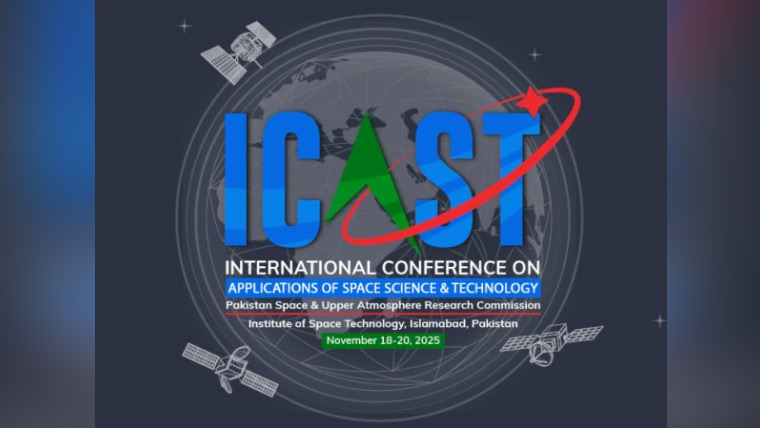
Islamabad: (Tassawar News) Pakistan is poised to take centre stage in the international scientific community by hosting a prestigious global space conference, The International Conference on Applications of Space Science and Technology (ICAST–2025). This high-profile event is scheduled to attract representatives from a remarkable 25 countries, with the expectation that several pivotal agreements will be formally signed, marking a significant step forward for Pakistan’s involvement in the international space sector.
Organisational Framework and Schedule
The monumental ICAST–2025 conference is a collaborative endeavour, being jointly organised by the Pakistan Space and Upper Atmosphere Research Commission (SPARCO) and the esteemed Institute of Space Technology (IST). This partnership between the nation’s premier space agency and a leading academic institution underscores the commitment to both the practical application and educational advancement of space science within Pakistan.
The three-day summit is slated to commence on November 18 and will run through to November 20, providing a concentrated platform for international dialogue, knowledge exchange, and strategic planning. The venue, Islamabad, the nation’s capital, is set to become a temporary hub for global space experts, policymakers, and academics.
“The decision to jointly host ICAST–2025 reflects a concerted national effort to bridge the gap between indigenous research and global best practices in space technology. The involvement of both SPARCO and IST ensures that the conference will cover the full spectrum from theoretical physics to actionable applications.”
International Participation and Core Objectives
The significance of ICAST 2025 is underscored by the confirmation of attendance from representatives of major international organisations. The conference will feature delegates from influential global bodies such as the Institute of Electrical and Electronics Engineers (IEEE), the Islamic World Educational, Scientific and Cultural Organization (ICESCO), the Asia-Pacific Space Cooperation Organization (APSCO), the Space Network (SNET), and the National Committee for Global Space Applications (NCGSA). This level of participation from key international players highlights the conference’s stature as a crucial forum for multilateral cooperation in space science and technology.
According to a SPARCO spokesperson, the overarching main theme of the conference is strategically focused on the “Role of Space Science and Technology in Sustainable Development.” This theme is highly pertinent in the current global climate, where technological advancements are increasingly viewed through the lens of their capacity to address urgent planetary challenges.
In alignment with this central theme, the conference agenda is meticulously structured to include dedicated special sessions focusing on critical global issues, specifically:
- Climate Change: Discussing the utilisation of satellite data for monitoring environmental shifts, predicting extreme weather events, and supporting mitigation strategies.
- Food Security: Exploring the application of remote sensing and geospatial data for optimising agricultural practices, monitoring crop health, and managing water resources.
- Disaster Management: Focusing on the use of Earth Observation (EO) satellites for rapid response, damage assessment, and early warning systems related to natural calamities.
- Sustainable Infrastructure: Examining how space technology can aid in the planning, construction, and monitoring of resilient and environmentally sound urban and rural infrastructure projects.
“The direct focus on sustainable development demonstrates a mature approach by the organisers, recognising that space technology is not merely an avenue for exploration, but a powerful, essential tool for ensuring planetary resilience and improving the quality of human life across the globe.”
Program Structure and Key Sessions
The exhaustive three-day program has been designed to offer a comprehensive and multifaceted exploration of contemporary space science and technology. The schedule is packed with various types of sessions to cater to different segments of the scientific and technical community:
- Plenary Sessions (5): These high-level sessions will feature keynote addresses from distinguished international leaders and experts, setting the intellectual tone and direction of the conference.
- Technical Sessions (23): These sessions will be dedicated to the presentation of peer-reviewed scientific papers, showcasing cutting-edge research, novel methodologies, and technical breakthroughs in specific domains of space science and its applications.
- Masterclasses (12): Providing intensive, focused instruction from senior practitioners, these classes are designed to enhance the practical skills and specialized knowledge of participants in various space-related fields.
A Unique Interdisciplinary Focus: Moon Sighting
In a unique and culturally relevant addition to the program, ICAST 2025 will feature a dedicated special session on the scientific, religious, and technical aspects of moon sighting. This specific session reflects Pakistan’s position as a nation where the lunar calendar holds immense religious and cultural importance.
This interdisciplinary discussion is expected to facilitate a dialogue between astronomers, religious scholars, and technologists, examining how modern astronomical data and technological tools can be effectively utilised to enhance the accuracy and consensus regarding the sighting of the new moon.
“The inclusion of the moon sighting session is a thoughtful acknowledgment of local cultural context, bridging the traditional practice with contemporary scientific rigour. It highlights the potential for technology to serve not just global objectives but also to address important national and religious requirements.”
Conclusion
ICAST 2025 represents a landmark event for Pakistan, firmly establishing the nation as a proactive contributor and host within the global space community. By bringing together experts from 25 nations and major international organisations, the conference provides an unparalleled opportunity for Pakistan to forge critical agreements, secure collaborative partnerships, and showcase its growing technological capabilities. With a central theme anchored in sustainable development and an ambitious program covering everything from climate change to space-based infrastructure and a unique focus on socio-religious applications like moon sighting, the summit promises to be a profoundly impactful and strategically significant event that will define the trajectory of Pakistan’s space program for the coming years. The expected signing of numerous important agreements underscores the tangible, outcome-oriented goals of the Islamabad summit, positioning it as a key moment in international cooperation for global betterment through space technology.