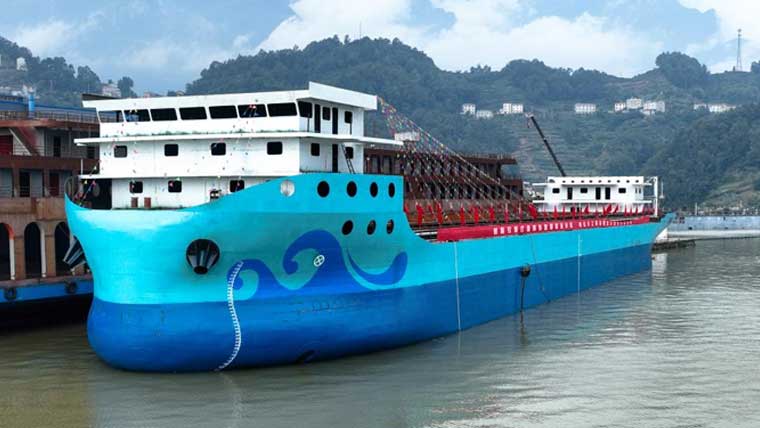
Beijing (Web Desk): In a profound demonstration of its commitment to sustainable infrastructure and maritime decarbonisation, China has officially launched the world’s largest electric cargo ship. Named Gezhouba, this massive vessel is powered entirely by a state-of-the-art lithium battery system, marking a definitive shift away from traditional, pollution-heavy marine fuels. This engineering feat signifies a momentous development towards realising eco-friendly transport logistics, particularly within China’s vital inland waterways.
Engineering and Operational Specifications
The Gezhouba is not only a symbol of environmental commitment but also a significant technological achievement in shipbuilding scale. The vessel is designed for heavy-duty bulk cargo transport and boasts impressive specifications:
- Length: The ship measures an imposing 130 meters from bow to stern.
- Cargo Capacity: It can transport an immense load of up to 13,000 tonnes of cargo.
- Power System: The vessel operates on a collective of 12 lithium battery power units, which together deliver a colossal energy capacity of 24,000 kWh of electricity.
Crucially, the operational design addresses the traditional drawbacks of battery-powered transport, notably charging time and range limitations. Engineers have incorporated a system that allows for the rapid replacement of the battery packs, drastically reducing downtime and maintaining operational fluidity. Furthermore, the ship boasts a highly functional maximum range of 500 kilometres on a single charge, making it perfectly suited for frequent trips along established inland shipping corridors, such as the Yangtze River.
According to the engineers behind the project, the vessel is not only designed for clean operation but also for efficiency: “The ship’s battery packs can be quickly replaced, and it boasts a maximum range of 500 kilometers,” highlighting the focus on practical, real-world application in commercial logistics.
Integration of Smart and Green Technologies
The vessel’s innovation extends beyond its propulsion system into the realm of smart shipping. The Gezhouba is equipped with an advanced smart control system that significantly enhances navigational precision and operational safety. This integrated system supports two critical futuristic functions:
- Remote Navigation: Allowing for long-distance, guided control from a centralised command centre.
- Automatic Berthing: Enabling the vessel to dock itself with minimal or no human intervention, improving efficiency and safety at port.
Yin Shunping, an academician from the Chinese Academy of Engineering, emphasised that this project is not merely an isolated case of shipbuilding innovation, but a comprehensive validation of integrated technologies for the future of maritime transport.
Yin Shunping stated that the project represents “not just innovation in shipbuilding, but also a major technological breakthrough, successfully integrating large-scale batteries and DC power systems.” He added that the team effectively showcased real-world applications of “remote piloting, multi-network integration, and ship-to-shore communication technologies.”
This successful integration of high-capacity energy storage, direct current (DC) power management, and advanced digital controls firmly establishes a technical blueprint for the next generation of large, electrified vessels.
Significant Environmental Impact
The primary driver and most compelling feature of the Gezhouba project is its profound environmental benefit. By eliminating the consumption of fossil fuels, the vessel delivers substantial, measurable reductions in pollutants and greenhouse gases. The vessel’s planned operation is expected to have a tangible impact on air quality and climate goals, particularly along the busy river routes it will service.
According to data reported by Chinese media outlets:
- Fuel Savings: The vessel is anticipated to help save approximately 617 tonnes of traditional fuel annually.
- Carbon Reduction: This transition to electric power is projected to reduce carbon dioxide emissions by around 2,000 tonnes per year.
These figures underscore the massive potential for electrification to decarbonise the maritime sector, which historically has been heavily reliant on heavy fuel oils and is a significant contributor to global greenhouse gas emissions. The Gezhouba is positioned as a practical, commercially viable example of how a major economy is implementing its national strategy to achieve cleaner, more sustainable energy consumption across its critical transport infrastructure.
conclusion
The launch of the Gezhouba electric cargo ship is a landmark achievement, heralding a new era for sustainable global shipping. By combining unprecedented battery capacity (24,000 kWh) with intelligent autonomous features and rapid battery-swap technology, China has not only created the world’s largest electric bulk carrier but also a viable template for the future of green maritime logistics. The confirmed environmental savings of over 617 tonnes of fuel and 2,000 tonnes of CO2 emissions annually solidify the vessel’s role as a leading global example in the necessary transition toward zero-emission transport solutions.
This video provides visual context on the launch of the vessel [China launches world’s largest all-electric river cargo ship].