Islamabad (Tassawar News) The political landscape of Azad Jammu and Kashmir (AJK) is currently gripped by a palpable sense of anticipation, following concerted and intensified efforts by the Pakistan Peoples Party (PPP) leadership to orchestrate a change in government. Reports circulating in Islamabad on October 30, 2025, suggest that a motion of no-confidence against the sitting administration is imminent, potentially being tabled in the AJK Legislative Assembly within a mere twenty-four hours. This development underscores a significant inflection point in regional politics, reflecting a determined bid by the PPP to assume the reins of power.
High-Level Consultations and Legal Scrutiny
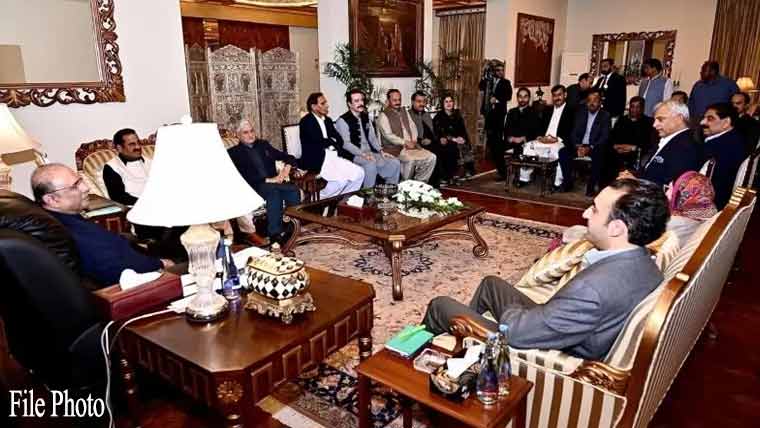
The gravity of the political undertaking was immediately evident in the high-level consultative meetings convened by the party. A pivotal session was held at the Aiwan-e-Sadr (Presidency), underscoring the institutional weight attached to these deliberations. The meeting was chaired by the PPP’s co-chairman, Asif Ali Zardari, a political veteran whose presence signalled the central executive’s direct involvement in the regional affairs of AJK. Key figures, including Bilawal Bhutto Zardari and Faryal Talpur, alongside the central and regional leadership and members of the PPP’s AJK Parliamentary Party, were integral participants in the discourse.
A substantial component of the meeting involved a meticulous examination of the legal and procedural ramifications associated with the no-confidence motion. The expertise of senior legal counsel, Farooq H. Naek, was leveraged to brief the attendees on the constitutional and parliamentary complexities inherent in the process of replacing an elected government. This preparatory step highlights the PPP’s commitment to navigating the transition strictly within the confines of established democratic and legal norms, thereby preempting potential challenges to the legitimacy of the subsequent government formation. The reliance on expert legal advice is a calculated move designed to ensure the entire process is legally robust and procedurally impeccable.
“The rigorous consultation on the legal and procedural intricacies of the no-confidence motion, guided by senior constitutional experts, demonstrates the PPP’s strategic intent to effect a constitutional transition of power, aiming for a seamless and challenge-free assumption of governmental authority in Azad Kashmir.”
Deliberation Over the AJK Prime Ministerial Nominee
Despite the apparent consensus on pursuing the no-confidence motion, the selection of the successor to the office of the Prime Minister of Azad Kashmir remains an open and highly contested matter. Insiders revealed that no final decision on the candidate had been reached, with the PPP leadership engaged in extensive internal assessment of multiple potential nominees. This cautious approach is driven by the dual objectives of securing political stability in a notoriously fractious political environment and achieving party consensus among the various factions within the AJK Assembly. The choice of the next Prime Minister is critical, as the individual must possess the political acumen to manage a potentially delicate coalition and unify the diverse regional and political interests.
Later in the day, Bilawal Bhutto Zardari took the lead in chairing a dedicated meeting focused exclusively on reviewing the potential nominees for the coveted executive position. The names currently under active consideration include prominent political figures such as Latif Akbar, Faisal Mumtaz Rathore, Chaudhry Yasin, and Sardar Yaqoob Khan. Each candidate brings a distinct political profile and regional influence to the table, making the final decision a complex balancing act. The party anticipates making an official announcement shortly, contingent upon the successful culmination of these intricate internal consultations, thereby setting the stage for the formal challenge to the current establishment.
Strategic Alliances and Institutional Continuity
In a move widely regarded as highly strategic, the PPP has successfully negotiated an understanding with the incumbent President of Azad Kashmir, Barrister Sultan Mahmood Chaudhry. This agreement represents a crucial element in the PPP’s broader strategy to ensure institutional continuity and stability. Party sources have confirmed the leadership’s decision not to seek the removal of President Sultan Mahmood, thereby guaranteeing his continuation in office under the new governmental framework. This arrangement is particularly insightful, as it signals a desire to avoid protracted institutional friction and maintain an important symbolic and constitutional check on the executive, irrespective of the political turnover.
Furthermore, a significant political realignment has transpired with the formal announcement of the Barrister Group’s merger with the Pakistan Peoples Party. This amalgamation marks an important shift in the political landscape of the region, bolstering the PPP’s legislative strength in the AJK Assembly. The integration of this group is expected to significantly ease the transition of power and provide a more comfortable parliamentary majority, which is vital for effective governance and legislative stability in the aftermath of a no-confidence vote. The successful absorption of the Barrister Group highlights the PPP’s skill in forming strategic alliances and consolidating its parliamentary base.
“The decision to retain Barrister Sultan Mahmood Chaudhry as the AJK President, juxtaposed with the formal merger of the Barrister Group into the PPP, showcases a pragmatic and calculated political strategy aimed at ensuring institutional equilibrium while simultaneously consolidating a dominant legislative majority.”
Conclusion: A Crucial Juncture for AJK Governance
Political observers concur that the forthcoming days are crucial for AJK’s political scenario. The Pakistan Peoples Party is demonstrably determined to form a new coalition government, meticulously balancing the imperative of political dominance with the necessity of maintaining institutional balance. The success of this political undertaking will ultimately hinge on the party’s ability to manage internal unity among its various competing interests, and its effectiveness in solidifying external alliances. Analysts universally agree that the capacity of the PPP to navigate these internal and external political currents will be the decisive factor in shaping the future trajectory of governance in Azad Kashmir. A failure to secure internal cohesion or a misstep in alliance management could potentially lead to prolonged political instability, an outcome the region can ill afford. The smooth execution of this planned transition, therefore, is paramount for the democratic health and administrative efficacy of Azad Jammu and Kashmir. The political machinations of the coming hours will undoubtedly determine the region’s governmental fate, setting a precedent for future coalition politics.