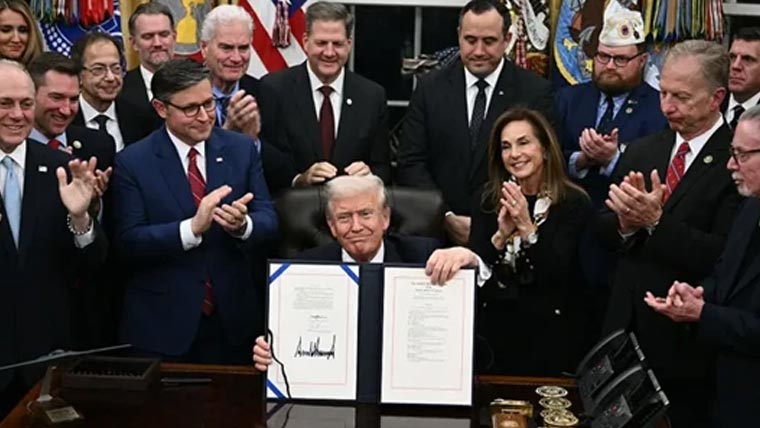
(Web Desk) The prolonged political impasse in the United States, culminating in the longest government shutdown in the nation’s history, officially drew to a close with the signing of a pivotal funding bill by President Donald Trump. This legislative action, which had secured earlier approval from both chambers of Congress, immediately initiated the process of restoring operational capacity across numerous federal departments that had been severely disrupted for an unprecedented period of 43 days. The conclusion of the shutdown brought palpable relief to hundreds of thousands of federal employees and millions of Americans who rely on essential government services.
Legislative Passage and Bipartisan Effort
The resolution was solidified in the U.S. House of Representatives, where the funding legislation passed with a vote of 222 in favour and 209 against. Notably, the successful passage was facilitated by a degree of bipartisan cooperation, with six Democratic members aligning with the Republican majority to support the bill. This convergence of votes signalled a critical, albeit temporary, collective prioritisation of restoring government functionality and mitigating the escalating financial hardship faced by federal workers. The readiness of legislators from across the political aisle to endorse the measure underscored the mounting pressure to address the human cost of the fiscal deadlock.
Prior to affixing his signature to the funding bill, President Trump expressed a distinct sense of optimism regarding the prevailing national conditions. He framed the resolution as a positive development, asserting that the country was maintaining a robust performance across a diverse range of economic sectors. His remarks were delivered amidst an atmosphere of anticipation, as government employees awaited definitive clarity concerning the schedule for receiving their pending salaries and the formal resumption of their regular work schedules.
The Profound Impact of a 43-Day Stoppage
The 43-day duration of the government shutdown exacted a significant toll on federal operations and the personal lives of public servants. A vast number of government employees were compelled to perform their duties without compensation, while thousands of others were placed on involuntary, unpaid leave, referred to as furlough. Reports emerged detailing widespread difficulties among federal workers in managing essential household expenses, leading to acute financial strain and uncertainty. Concurrently, numerous essential government services experienced significant deceleration or were temporarily suspended entirely.
One of the most critically affected areas was the aviation sector. Staffing shortfalls directly impacted vital services, particularly air-traffic control operations and airport security screening, raising concerns about potential safety implications and contributing to operational inefficiencies and delays across the national air travel system. The strain on these essential public safety functions underscored the far-reaching and potentially hazardous consequences of prolonged government closures.
“The shutdown, which lasted 43 days, significantly impacted federal operations. Thousands of government employees were forced to work without pay, while others were placed on unpaid leave. Many reported difficulties managing household expenses, and several essential government services slowed down or were temporarily halted.”
Restored Funding and Employee Relief
The newly enacted spending bill delivers a critical, albeit temporary, solution by ensuring funding for the affected federal agencies through January 30. This short-term appropriation grants the government a necessary period of financial stability, allowing core financial activities to recommence and alleviating the intense pressure that had built up on public service departments. Critically, the measure facilitates the immediate restart of numerous vital programs, including food assistance services that provide crucial support to low-income families throughout the country, thereby mitigating a growing humanitarian concern.
A fundamental provision of the bill centres on the mandated payment of pending salaries to the federal workforce who had endured weeks without their rightful income. Employees across critical sectors—including homeland security, agriculture, transportation, and public safety—are now slated for reimbursement for the hours they worked, and, in some cases, for the time they were furloughed. With the necessary funding officially restored, payroll processing is expected to swiftly return to its standard operational cycle.
The restoration of funding was particularly welcomed by aviation authorities, as it guarantees the full reinstatement of the air-traffic control system. This measure is projected to immediately enhance airport operations, reduce the persistent delays that had mounted during the shutdown, and reinforce the safety protocols that had been operating under duress.
The Unfinished Business of Fiscal Negotiation
While the temporary funding has successfully allowed for the reopening of federal services and alleviated immediate distress, policy analysts are unanimous in their assessment that a lasting, long-term agreement on federal budgeting remains an unresolved challenge requiring sustained, genuine bipartisan commitment. The shutdown served as a potent illustration of the profound, cascading consequences of sustained funding delays, particularly for those in essential government roles whose duties are fundamental to national security and public welfare.
Many experts continue to emphasize the urgent need for developing sustainable solutions within the political negotiation framework to prevent future disruptions of such magnitude. The instability caused by the shutdown highlights the fundamental fragility inherent in relying on stop-gap funding measures to sustain the apparatus of government.
“The shutdown revealed the far-reaching consequences of funding delays, particularly for workers in essential government roles. Many experts emphasize the need for sustainable solutions to prevent future disruptions of such magnitude.”
Conclusion: Stability Restored, Deeper Debates Continue
The termination of the longest government shutdown in U.S. history provides immediate, tangible relief to millions of Americans who rely directly on federal programs, simultaneously marking a crucial return to operational stability within the government. However, the significance of this reopening is tempered by the recognition that it is merely the first step toward resolving deeper, entrenched budgetary and fiscal debates.
Discussions surrounding broader fiscal agreements, border security, and the political negotiation processes that led to the crisis are expected to continue with intensity. While the operational machinery of government is once again fully functioning, the challenge remains for policymakers to translate this temporary reprieve into a durable, cooperative framework that ensures the continuous funding and stability necessary for effective national governance. The incident underscores the critical necessity for political stakeholders to find common ground on budgetary matters to safeguard both the efficiency of public services and the financial well-being of the federal workforce.