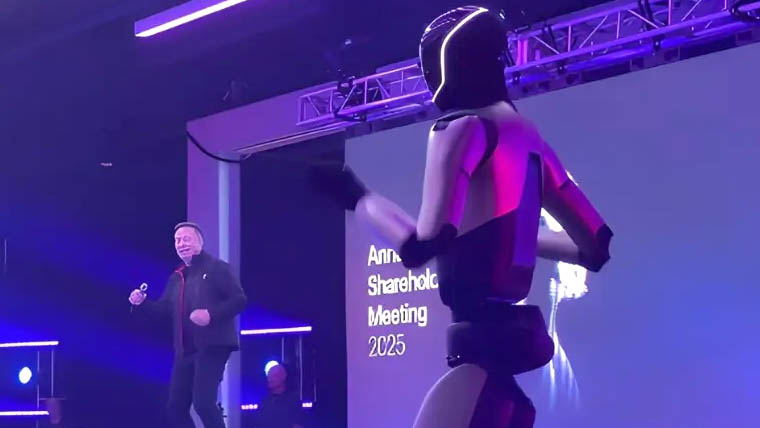
The technological landscape is undergoing a rapid metamorphosis, and Tesla, under the guidance of its CEO, Elon Musk, once again stands at the epicenter of innovation. The recent unveiling of the Tesla Optimus robot in a short but utterly captivating video has not only astonished the global audience but has also provided a tangible glimpse into the future of advanced robotics. The footage, showcasing the humanoid robot executing a synchronized dance routine with remarkable fluidity under the glow of neon lights, transcended mere entertainment. Its graceful movements, deliberate arm waves, and rhythmic steps collectively presented a performance that was simultaneously artistic, highly technical, and profoundly futuristic. Beyond the aesthetic spectacle, this demonstration unequivocally highlighted a critical transition: the domain of robotics is moving decisively from the pages of science fiction into the practical realities of everyday life.
Design Excellence: The Engineering Behind Optimus
The design and engineering of the Tesla Optimus are testaments to cutting-edge integration of vehicle technology and AI adapted for bipedal motion. According to detailed specifications provided by Tesla, Optimus is meticulously crafted as a humanoid robot engineered to function with the cognitive and physical capabilities analogous to those of a human being.
Physically, the robot stands at an approximate height of 1.73 meters and possesses a relatively light operational weight of 57 kilograms. This combination of dimensions is achieved through the use of lightweight yet highly durable materials, ensuring both structural integrity and efficient energy consumption. Crucially, the propulsion system for Optimus is derived from the same high-performance components that power Tesla’s world-renowned electric vehicles (EVs). Specifically, it is powered by the high-capacity batteries and sophisticated actuators found in Tesla’s automotive line, guaranteeing extended operational life and highly efficient, nuanced movement.
However, the genuine architectural breakthrough resides in its artificial intelligence (AI) framework. Optimus operates utilizing a specialized, customized version of Tesla’s sophisticated Full Self-Driving (FSD) computer. This powerful processing core has been ingeniously adapted to manage the unique demands of a bipedal (two-legged) system. This adaptation is what endows the robot with the fundamental abilities essential for navigating the complex human world: independent walking, proactive obstacle avoidance, and comprehensive object recognition in dynamic and unstructured environments.
“The use of the adapted FSD computer for a bipedal system is the cornerstone of Optimus’s intelligence, allowing it to interpret the world and move autonomously,” states a robotics engineer affiliated with the project.
This technological convergence represents a significant leap, applying lessons learned from autonomous vehicle navigation directly to the challenges of human-scale mobility and interaction.
Achieving Human-Like Awareness and Dynamic Stability
To interact seamlessly with its surroundings, Optimus is equipped with a sophisticated array of advanced cameras and sensors strategically embedded throughout its frame. These sensory components function collectively to provide real-time environmental awareness, which is essential for enabling the robot to perform complex, nuanced tasks. This sensory input is critical for facilitating natural, human-like interaction with both inanimate objects and, eventually, with human beings.
The achievement embodied by the robot’s smooth dance routine is not merely in its programmed movements, but in its underlying dynamic stability. Experts from leading professional organizations, such as the Institute of Electrical and Electronics Engineers (IEEE), have rapidly acknowledged Tesla’s creation as a monumental milestone in this area. Dynamic stability refers to the complex capability of a machine not only to maintain balance while standing still but, more critically, to think, process information, and execute physical actions while maintaining continuous equilibrium. This ability to integrate cognitive function with balance control is the critical step toward developing truly capable and intelligent robots that can navigate and operate effectively within spaces fundamentally designed for human occupation.
A report from the IEEE suggested that Tesla’s breakthrough marks: “A critical step toward creating robots that can move intelligently in human spaces, transitioning from pre-programmed movement to genuine dynamic thinking.”
This level of performance suggests that the challenges of locomotion and manipulation, long considered the primary roadblocks in practical humanoid robotics, are systematically being overcome.
Ambitious Applications: From Industrial Floors to Domestic Spheres
Tesla’s vision for the Optimus robot is clear and ambitious: it is positioned not as a direct replacement for human labour but as a highly sophisticated collaborative assistant. In the immediate context of industrial and manufacturing environments, Optimus is expected to undertake numerous repetitive or hazardous tasks. The initial industrial applications are projected to include:
- Performing assembly line operations with high precision and consistency.
- Handling toxic or heavy materials, thereby removing human workers from dangerous environments.
- Moving packages and managing logistics within expansive warehouse settings.
However, the long-term ambitions articulated by Tesla extend far beyond the confines of factories and industrial complexes. The company has explicitly suggested that subsequent, more refined versions of the Optimus robot could fundamentally redefine domestic chores and personal assistance. These future iterations are envisioned taking on household responsibilities, such as:
- Washing dishes and cleaning kitchen spaces.
- Folding laundry and managing household textile organization.
- Assisting with a broad array of general household tasks, potentially evolving into a helpful and indispensable companion in the fabric of everyday life.
This expansive outlook illustrates Tesla’s belief that Optimus will become a generalized utility machine, adaptable to virtually any environment where repetitive or complex physical tasks are required.
Public Response: A Mix of Awe, Humour, and Legitimate Concern
The immediate aftermath of the Optimus video release on November 7, 2025, saw an enormous volume of public reaction across all social media platforms. The reactions were characterized by a fascinating and often contradictory blend of emotions. While a significant portion of viewers expressed admiration for the technological progress and engineering prowess displayed, others responded with humour, light-heartedly joking about robots replacing professional performers or, facetiously, even political figures.
However, beneath the initial awe and amusement, the public discourse quickly pivoted to more genuine and profound questions regarding the societal implications of this technology. The most pressing query consistently raised was the potential for an impending era where advanced robots could displace large segments of the human workforce.
“The fascination with Optimus is undeniable, yet the underlying anxiety about job displacement reflects a deep societal concern regarding the speed of AI integration,” a social media analyst noted.
This complex blend of excitement and anxiety perfectly encapsulates society’s evolving and often conflicted relationship with Artificial Intelligence and advanced robotics. People remain fundamentally fascinated by the technological potential yet are simultaneously cautious and acutely aware that the once distinct boundary separating human capability and machine intelligence is rapidly becoming blurred.
Conclusion: A Symbol of Humanity’s Next Technological Step
Ultimately, the Tesla Optimus is more than merely an exceptionally advanced piece of mechanical engineering; it is a profound symbol of humanity’s next major technological step. It represents the seamless and powerful merging of advanced automation, sophisticated artificial intelligence, and the intimate sphere of daily life. Should Tesla maintain its current and aggressive pace of development, humanoid robots like Optimus are poised to become a routine fixture in our homes, offices, and factories within the foreseeable future.
Optimus’s significance lies not just in its precise mechanics or advanced programming, but in its capacity to spark the human imagination. It effectively illustrates a compelling future scenario where machines are no longer relegated to the status of simple, single-function tools but are elevated to the role of genuine partners in progress. This vision foresees a world where technology actively moves, thinks, and evolves alongside us, potentially ushering in a revolutionary phase of human-machine collaboration that will fundamentally shape the socioeconomic and industrial paradigms of the 21st century.
Would you like me to elaborate on the technical specifications of the FSD computer as adapted for the Optimus robot?