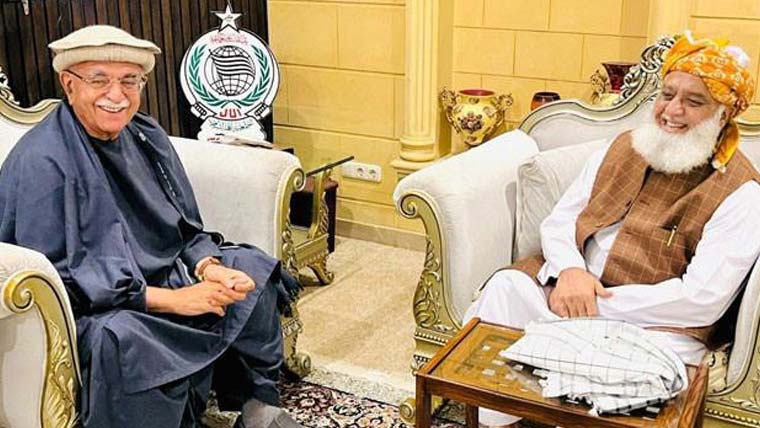
Islamabad: (Tassawar News) The political atmosphere in Islamabad is currently defined by a discernible tension, stemming from the ruling coalition’s intent to table the 27th Constitutional Amendment. In response to this legislative initiative, a high-level strategic summit of opposition leadership convened at the residence of Maulana Fazlur Rehman. The delegation, spearheaded by the veteran politician Mahmoud Khan Achakzai, included prominent figures such as Asad Qaiser and Senator Allama Raja Nasir Abbas, signifying a robust effort to coalesce the diverse elements of the opposition into a unified, formidable bloc. This meeting transcended a mere exchange of political pleasantries; it represented a critical juncture aimed at formulating a comprehensive and cohesive strategy to address the sweeping constitutional revisions proposed by the government.
The core objective of the deliberations was unequivocally the draft of the 27th Constitutional Amendment, the provisions of which have rapidly become the paramount subject of intense debate across the parliamentary and intellectual spheres. The opposition leaders engaged in a thoroughgoing assessment of the amendment’s potential systemic repercussions, focusing acutely on key areas such as the preservation of provincial autonomy, the equitable distribution of national resources, and the fundamental governance structure of the federation. It was unanimously recognised that the maintenance of a singular, harmonious position within the opposition ranks is axiomatic, serving as the essential bulwark for mounting effective parliamentary resistance should the need arise for constitutional challenge.
The Erosion of Federalism: Unpacking the 27th Amendment
A comprehensive understanding of the opposition’s concerns necessitates an examination of the precise articles targeted for amendment. Political analyses, corroborated by insider sources, indicate that the 27th Amendment seeks to fundamentally restructure three key domains: judicial authority, fiscal federalism, and the distribution of legislative powers.
Firstly, the proposed changes are widely seen as potentially diluting the hard-won decentralisation achieved through the landmark 18th Constitutional Amendment. Specifically, proposals to remove the constitutional guarantee protecting the provinces’ share in the National Finance Commission (NFC) Award—a provision secured under Article 160 (3A)—are viewed as being fundamentally antithetical to the principles of participatory federalism. The opposition contends that enabling the federal government to retrospectively claw back resources would severely impair the fiscal self-sufficiency of provincial administrations, potentially stifling regional development and exacerbating inter-provincial grievances.
Secondly, the amendment purportedly includes provisions to reclaim legislative control over subjects previously devolved to the provinces, such as education and population welfare. This move is fiercely resisted by parties championing provincial rights, who argue that decision-making authority in these social sectors must remain localised to ensure policies are appropriately tailored to diverse regional and cultural requirements.
Thirdly, and perhaps most controversially, are the rumoured amendments pertaining to the judicial framework and the command of the armed forces. Proposals to establish a new Constitutional Court and potentially modify Article 243, which pertains to the control and command of the armed forces, have generated intense scrutiny from legal experts and opposition figures alike.
“The proposed dismantling of the financial safeguards under Article 160, coupled with the attempted re-centralisation of the educational mandate, represents a profound challenge to the constitutional order. We cannot, in good conscience, permit the roll-back of the 18th Amendment’s legacy, which was secured through decades of democratic struggle and consensus.”
The Convergence of Opposition Forces
The political gravity imparted by this strategic meeting in Islamabad cannot be overstated. The attendance of key participants highlights the serious intent to cohere a unified stance against what is perceived as a significant overreach by the federal administration. Beyond the senior figures such as Senator Allama Raja Nasir Abbas and former Federal Minister Asad Mahmood, the presence of JUI-F spokesperson Aslam Ghauri confirms that the consultation process is deeply cross-factional.
This series of ongoing consultations, confirmed by reliable political sources, is explicitly geared toward ensuring that the opposition’s collective voice resonates clearly and forcefully in the forthcoming sessions of the National Assembly. Discussing not only the constitutional reforms but also the broader political environment and current parliamentary developments, the leaders underscored the imperative of opposition parties in maintaining the vital democratic balance within the system.
The role of Maulana Fazlur Rehman is particularly pivotal. As a seasoned and central figure in Pakistan’s complex opposition politics, his capacity to mediate between disparate political entities and forge a national consensus is considered indispensable. Analysts suggest that the convergence of Achakzai’s delegation with Rehman is a calculated and strategic manoeuvre designed to harmonise the messaging and meticulously coordinate the parliamentary tactics required to effectively counter the government’s move. This strategic alignment is essential, given the government’s declared numerical advantage in the National Assembly, although the critical nature of a two-thirds majority means that even a unified opposition carries significant leverage.
“The current political exigency demands a united front that transcends individual party manifestos. This constitutional proposal threatens the very foundation of provincial autonomy, necessitating a collaborative and principled resistance. We are engaged in a dialogue to ensure our parliamentary actions are robust, coordinated, and reflective of a true national opposition consensus.”
Political observers view this intensive engagement as a decisive development, particularly at a time when multiple opposition parties are actively seeking a unified position on such crucial constitutional matters. It underscores the political maxim that effective governance requires not just a working majority, but also a legitimate, institutionalised opposition capable of checking legislative overreach and safeguarding fundamental constitutional principles. The collective effort towards achieving a national consensus on the 27th Amendment, and other pending legislative matters, is now clearly underway, necessitating further intensive consultations both within the capital and among the provincial legislatures to fully gauge the mood of the federating units.
Conclusion
In summation, the high-stakes meeting of opposition leaders led by Mahmoud Khan Achakzai and Maulana Fazlur Rehman represents a crucial step in formalising the parliamentary response to the proposed 27th Constitutional Amendment. The core of their opposition stems from the belief that the amendment, through its planned revisions to fiscal distribution and devolution of powers, poses an existential threat to the autonomy achieved by the provinces under the 18th Amendment. By solidifying their unified front, the opposition aims to exert maximum pressure on the government to either withdraw or substantially revise the draft bill, thereby protecting the delicate balance of power inherent in Pakistan’s federal structure. The outcome of these negotiations will undeniably shape the future course of the current political dispensation and redefine the contours of civil-military-judicial relations in the country.